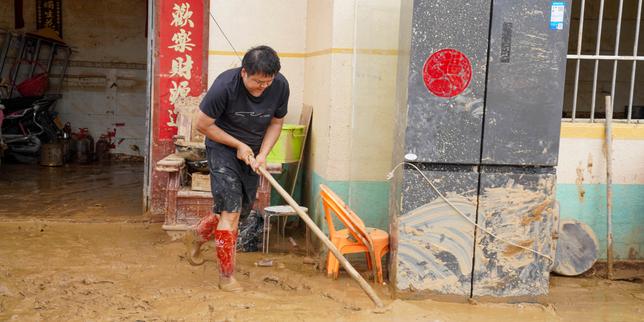
You can't engineer your way out of a changing climate with mid-century infrastructure. Southern China is learning this hard truth right now. A devastating combination of record-breaking tropical rainfall and sudden dam failures has left at least 39 people dead and nine missing in the Guangxi region.
It's not just a story about heavy rain. It's a wake-up call about the structural integrity of small-scale reservoirs when hit by unprecedented weather anomalies. As the region begins digging out from under feet of mud, an even bigger threat is churning out at sea. Typhoon Bavi is tracking directly toward the eastern coast, threatening to overwhelm an already saturated landscape.
The situation on the ground reveals that the traditional methods of predicting and managing seasonal floods don't work anymore.
The Liulan Dam Disaster
Most of the casualties didn't come from rising riverbanks. They came from structural failure. When Tropical Storm Maysak dumped over 90 centimeters of rain in the hardest-hit pockets of Guangxi, small reservoirs reached their absolute breaking points.
Near the town of Liulan, under the jurisdiction of Nanning city, the walls of a major local reservoir collapsed. The sudden breach unleashed a wall of mud and water that swept through downstream villages with virtually no warning. That single structural failure accounts for 26 of the confirmed deaths.
Local residents stated that they received zero emergency alerts. Many didn't even realize they were in danger until the torrent hit their doors. "Never before had it been this serious," noted a resident named Mr. Huang.
Worse yet, Liulan wasn't an isolated incident. Just a few miles away near Gantang, another smaller dam also gave way under the hydraulic pressure.
When you look at the numbers, it becomes clear how overwhelmed the region actually was.
- Over 90 centimeters of cumulative rain fell in extreme zones.
- 130,000 residents required emergency evacuation across the province.
- More than 8,000 rescue workers and 5,700 boats had to be deployed just to navigate the flooded streets.
More Than Mud and Water
The impact of these failures ripples through local economies in bizarre and dangerous ways. In Hengzhou, the floodwaters smashed through the perimeter walls of a major commercial snake breeding farm. Nearly 900 reptiles escaped directly into the standing floodwaters. Emergency crews are currently combing through submerged neighborhoods with antivenom kits, warning residents to stay out of the water entirely.
Further northeast in Guigang, military rescue teams had to use a fleet of boats to extract over 10,000 students and teachers trapped inside a cluster of school buildings that had essentially become an island. Nearby, a local zoo reported more than 100 animals missing, including zebras and porcupines swept away by the current.
This isn't standard seasonal flooding. It's structural cascading failure.
Typhoon Bavi Is the Next Major Threat
While Guangxi tries to restore power to roughly 60,000 blacked-out homes, the eastern coast of China is preparing for a second punch. Typhoon Bavi is currently tracking northwest through the Pacific.
Packing sustained winds of 184 kilometers per hour, the storm is projected to skirt northern Taiwan before making landfall late Saturday near Fujian or Zhejiang province. Meteorologists point out a troubling detail: ocean surface temperatures in the western Pacific are currently running 2 to 3 degrees Celsius above historical averages. This extreme ocean heat acts like rocket fuel for incoming typhoons, preventing them from weakening as they approach land.
With the ground already saturated by previous storms, Bavi has the potential to trigger massive landslides and further urban flash flooding in China's major economic hubs.
The Problem With Minor Reservoirs
If you want to understand why this keeps happening, look at how China built its water management network. The country relies on tens of thousands of small, aging earth-rock dams built decades ago. These smaller reservoirs are often managed by local townships rather than federal engineers. They lack the sophisticated early-warning sensors and reinforced spillways found on massive projects like the Three Gorges Dam.
When a storm drops an entire year's worth of rain in a few days, these smaller earthen barriers liquefy and fail.
If you live or operate a business in eastern coastal provinces like Fujian or Zhejiang, you need to look past the official weather advisories.
- Map your local drainage. Don't assume a nearby small reservoir or canal will hold just because it did during past storms.
- Secure backup power and fresh water immediately. Structural failures wipe out local grids and contaminate municipal water systems for weeks.
- Move inland before the heavy winds start. As Guangxi proved, waiting for an official evacuation order can leave you trapped by a sudden surge of water.