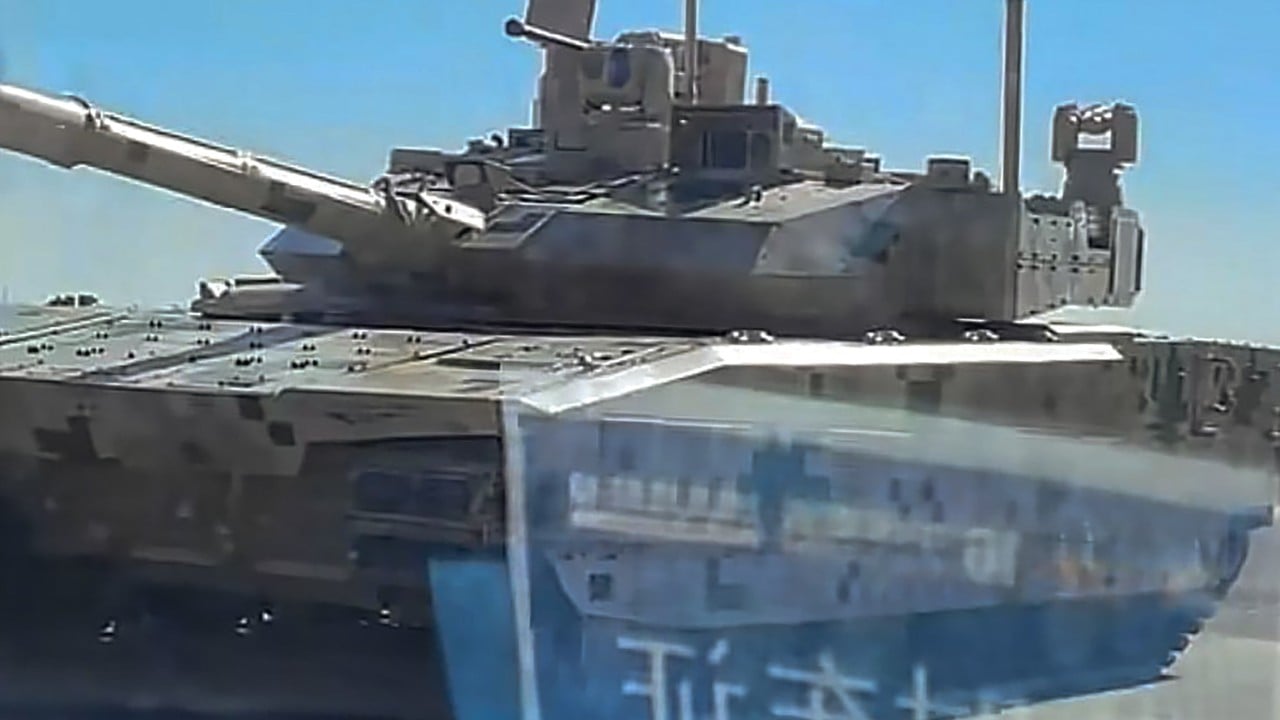
Defense blogs love a shiny brochure. Every time the Zhuhai Airshow rolls around, the defense media ecosystem falls over itself to parrot press releases from Norinco, treating incremental bolt-on upgrades like a fundamental shift in armored warfare. The latest breathless headline? That China’s upgraded VT-4B main battle tank has absorbed "fourth-generation" technology from the PLA's domestic Type 100 program, instantly turning a budget export platform into a peer-competitor to Western heavy metal.
Stop buying the marketing deck.
If you look past the glossy paint and the buzzwords, the VT-4B isn't a generational leap. It is a heavy, fuel-guzzling compromise wearing a high-tech Halloween mask. By grafting sensors, active protection launchers, and networked battle management screens onto a 1990s-era chassis lineage, Norinco isn't handing developing nations a silver bullet. They are selling a maintenance nightmare disguised as an apex predator.
The Myth of Trickle-Down Fourth-Gen Armor
The core argument pushed by defense cheerleaders is simple. China develops an advanced domestic tank—often labeled the Type 100 or next-generation armored vehicle in intelligence circles—and then filters that architecture down to the export-only VT-4B. On paper, the spec sheet looks intimidating. You get a 125mm smoothbore gun, an autoloader, GL-6 active protection systems (APS), remote weapon stations, and panoramic sights with automated target tracking.
Here is the problem with that narrative. You cannot turn a third-generation hull into a fourth-generation tank simply by bolting sensors to the turret roof.
True fourth-generation armored design—the kind currently driving the American M1E3 Abrams overhaul, the European MGCS program, and China's own internal next-gen prototypes—is built from the keel up around crew survivability, reduced acoustic and thermal signatures, hybrid-electric propulsion, and unmanned or heavily isolated turrets.
The VT-4 series traces its DNA directly back to the Type 90-II and the MBT-2000 (Al-Khalid), platforms designed decades ago when the primary threat was a frontal slugfest with T-72s, not top-attack loitering munitions and thermal-imaging drone swarms. Adding a modern fire-control computer and a couple of hard-kill radar panels to an older hull architecture doesn't erase its foundational flaws. It just makes the target more expensive when it burns.
The Carousel of Death Remains Intact
Let’s talk about the elephant inside the hull. Like almost every Sino-Soviet tank design, the VT-4B relies on a carousel-style autoloader sitting directly beneath the turret basket.
Proponents argue this keeps the tank light—around 52 tons compared to the 65-plus tons of an M1A2 SEPv3 or Leopard 2A7—and allows for a three-man crew. That weight advantage looks great when crossing shaky bridges in Southeast Asia or Africa. It looks terrible the millisecond a tandem-charge warhead penetrates the side hull.
In Western designs like the Abrams, propellant charges are stored in isolated bustle compartments with blowout panels. When hit, the blast vents upward, and the crew walks away. In the VT-4B, your three-man crew is sitting directly on top of high-explosive propellant charges. Upgrading the optics or slapping extra explosive reactive armor (ERA) blocks onto the glacis plate does nothing to fix this internal geometry. When the armor is defeated, the catastrophic turret-popping cook-off remains an inherent feature of the blueprint.
Why Active Protection Systems Are Not Magic Shields
The loudest talking point surrounding the VT-4B upgrade is its integration of hard-kill Active Protection Systems, specifically systems derived from the GL-5 and GL-6 architectures. The lazy consensus assumes that once you mount four millimeter-wave radars and a few interceptor launchers on a turret, anti-tank guided missiles (ATGMs) and FPV drones become obsolete.
I have watched procurement officers from mid-tier militaries blow tens of millions of dollars chasing this exact illusion, only to realize during live-fire trials that physics doesn't care about brochure specs.
Active protection systems introduce brutal operational trade-offs that rarely make it into airshow press kits:
- The Infantry Massacre Problem: Hard-kill APS works by firing explosive fragmentation charges outward to detonate incoming projectiles meters away from the hull. Tanks do not operate in empty deserts; they operate surrounded by friendly dismounted infantry. Turn on a hard-kill APS in an urban environment, and your own tank will shred the squad tasked with protecting its flanks. Turn it off to protect your troops, and your expensive fourth-gen upgrade becomes a blind 52-ton coffin.
- Saturation and Top-Attack Blind Spots: Most export-grade APS setups are optimized for flat-trajectory threats—RPGs and traditional ATGMs flying parallel to the ground. Modern battlefields are dominated by steep-angle top-attack munitions and cheap, agile FPV drones diving vertically at 70-degree angles. Radar coverage cones struggle at extreme elevations, and interceptor launchers rarely carry enough reloads to survive a coordinated swarm of five $500 drones.
- Electronic Warfare Beacons: To intercept a missile, your tank's millimeter-wave radars must actively emit energy. On a modern electromagnetic battlefield, lighting up an active radar on a main battle tank is the equivalent of firing a flare gun in a dark room. Enemy electronic support measures (ESM) will triangulate your armored platoon long before your gunners ever spot a target through their shiny new thermal sights.
The Logistics Trap Nobody Talks About At Zhuhai
When a country like Thailand, Nigeria, or Pakistan buys a tank, they aren't just buying steel. They are marrying a supply chain for thirty years.
Historically, the entire value proposition of Chinese export armor was brutal simplicity. You bought a cheap tank that ran on forgiving diesel engines, required minimal depot-level maintenance, and could be repaired by a mechanic with a wrench and a hammer. The VT-4B breaks that contract.
By cramming complex electro-optical suites, digital data links, auxiliary power units (APUs), and radar-guided interceptors onto the chassis, Norinco has pushed the VT-4B into a maintenance tier that most of its target customers cannot sustain.
Consider what happens six months after delivery in a humid, dusty operational environment:
- Sensor Degradation: Delicate panoramic sights and millimeter-wave radar arrays require specialized calibration rigs and climate-controlled depot facilities. One bad monsoon season or a few months of fine desert dust without rigorous seal maintenance turns a fourth-generation targeting system into dead weight.
- Power Generation Bottlenecks: Every new screen, cooling unit, radar panel, and electronic countermeasure drains massive electrical load. Even with upgraded engines in the 1,200 to 1,500 horsepower range, running modern digital architectures while idling in an ambush position forces reliance on auxiliary power units. When the APU fails—and in export fleets, they always fail first—the crew has to run the main turbine or diesel engine just to keep the sensors awake, roasting their thermal signature and burning through fuel reserves.
- Black-Box Vendor Lock-In: A mechanic in Abuja or Bangkok cannot fabricate a replacement circuit board for a proprietary Chinese fire-control computer. Every damaged sensor module has to be shipped back to a specialized Norinco facility. In peacetime, that means half your fleet sits in a motor pool waiting on customs clearance. In wartime, it means your armored battalion cannibalizes half its own tanks just to keep the other half running.
Are You Buying A Tank Or A Target?
Defense analysts love to ask, "How does the VT-4B stack up against the T-90MS or the K2 Black Panther?"
That is the wrong question entirely. Comparing tank-on-tank spec sheets in 2026 is like comparing cavalry saber lengths in 1916. Tank-on-tank engagements account for a microscopic fraction of armored losses in modern high-intensity warfare. The real killers are persistent ISR drones, artillery scatterable mines, loitering munitions, and long-range fiber-optic guided missiles.
If you are a defense ministry with a $300 million procurement budget, buying fifty VT-4Bs loaded with pseudo-fourth-gen gizmos is strategic malpractice. You are concentrating your entire budget into fifty massive, high-signature targets that still lack the roof armor, electronic warfare autonomy, and logistical resilience to survive a modern kill web.
What Smart Buyers Actually Do Instead
If you want to understand how serious militaries are adapting—and why the VT-4B represents a dead end—look at the shift toward distributed lethality and modular survivability.
Instead of dumping cash into a heavy, bespoke export tank with baked-in proprietary electronics, forward-thinking commanders are splitting their budgets:
- Prioritize Passive Signature Management Over Active Gizmos: Multispectral camouflage nets, thermal-dampening exhaust shrouds, and low-observable hull coatings cost a fraction of a hard-kill APS and never run out of ammo. If a drone operator cannot distinguish your tank from a patch of scrub brush on an infrared feed, you win the engagement before a shot is fired.
- Decouple the Sensor from the Shooter: Why put a $2 million panoramic sight on top of a tank that gets shot at, when you can keep the tank hull-down behind a ridge and feed targeting data to it from a $3,000 tethered drone hovering 100 meters overhead? The VT-4B still treats the tank as the primary reconnaissance platform. That doctrine is obsolete.
- Invest in Organic Counter-UAS Vehicles, Not Tank-Mounted Band-Aids: Bolt-on anti-drone cages and turret-mounted jammers are stopgaps. Real armored survivability requires dedicated short-range air defense (SHORAD) vehicles equipped with directed energy, programmable airburst cannons, and wide-spectrum electronic warfare suites traveling alongside the armor—not crammed onto the turret roof of the tank itself.
The Uncomfortable Truth About The VT-4B
Let’s be fair to Norinco's engineers. Within the constraints of a export-regulated budget platform, the VT-4B is an impressive piece of systems integration. Its 125mm gun firing modern tungsten APFSDS rounds will punch straight through older T-72s, M60s, and second-tier armored vehicles. Its mobility is respectable, and for a nation fighting low-intensity border skirmishes against insurgents lacking modern ISR networks, the VT-4B will dominate the battlefield.
Norinco knows exactly who their buyer is. They aren't trying to beat the Pentagon or out-engineer Rheinmetall. They are building an affordable status symbol for developing nations that want the prestige of a modern armored brigade without paying $15 million per hull for a Leopard 2A8.
There is nothing wrong with buying a budget workhorse. The disaster happens when buyers believe the airshow hype and deploy a dressed-up third-generation hull as if it were an invulnerable fourth-generation apex predator.
Bolting a smartphone to a typewriter doesn't make it a supercomputer. It just gives you a typewriter with a cracked screen the first time you drop it.