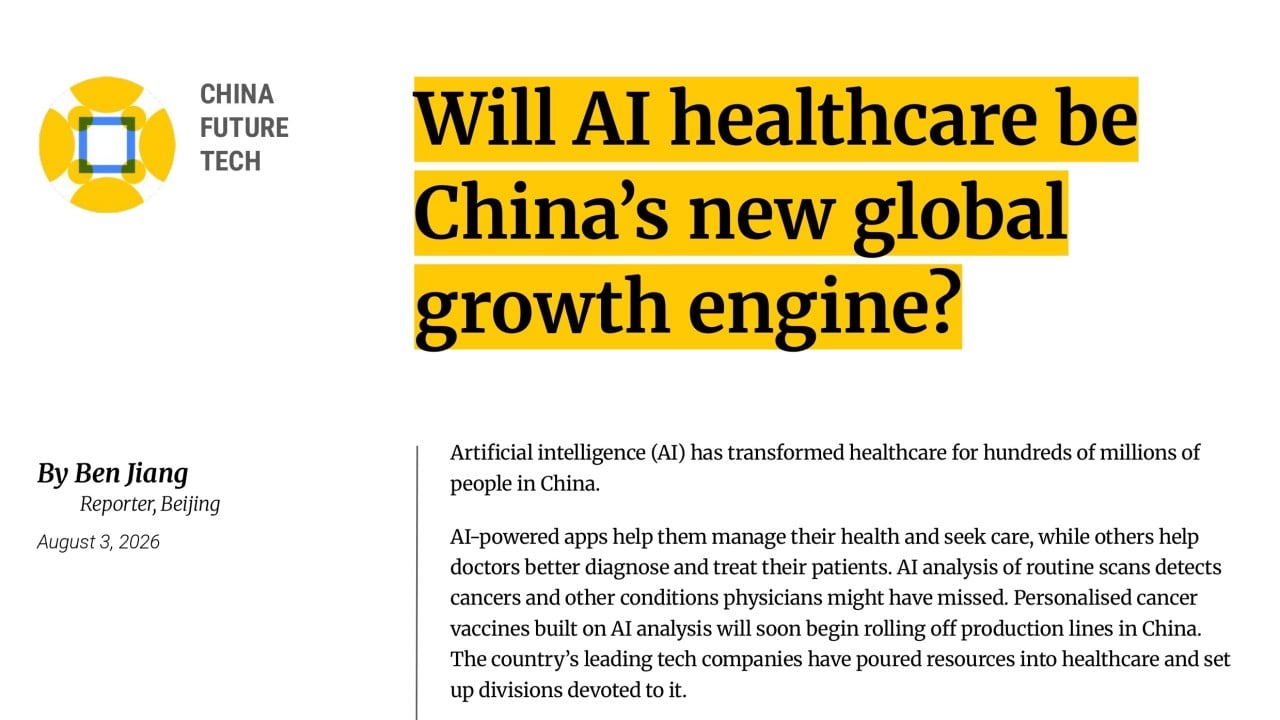
The conversation around digital medicine usually orbits Silicon Valley startups burning cash on administrative chatbots. Meanwhile, a quieter shift is happening across Asia. China’s domestic push into algorithmic diagnostics and automated hospital systems isn't just about fixing local doctor shortages. It's turning into a massive export engine. If you think this is just local hype, look at the numbers. MarketsandMarkets data shows China's health AI sector scaling from roughly $1.6 billion to over $9 billion by 2030, compounding at more than 40% annually.
That kind of hyper-growth changes things. When domestic adoption hits a critical mass of millions of users—like Ant Group's A-Fu app handling massive volumes of routine health inquiries and clinical support in remote areas—software stops being an experiment. It becomes industrial infrastructure.
The Domestic Testing Ground Nobody Talks About
Western companies often struggle to scale healthcare software because patient data sits in fragmented silos across thousands of independent hospital networks and insurance providers. China bypassed this bottleneck through sheer state-backed centralization and standardized electronic health records.
When authorities back in late 2025 and early 2026 pushed for algorithmic integration across thousands of hospitals and township clinics, they weren't buying novelty tools. They needed hard execution. The goal is shrinking primary care misdiagnosis rates from historical highs down to baseline targets, while pushing diagnostic imaging accuracy past 95%.
When you test diagnostic tools on hundreds of millions of patients across three-tiered hospital networks, your machine learning models get battle-tested in ways a Western pilot project involving three university hospitals simply cannot replicate. Companies like Tencent with their Miying imaging platform have processed millions of scans, building a moat of localized clinical data that competitors can't easily buy.
Exporting Infrastructure Instead of Just Apps
Selling software to foreign hospitals is notoriously difficult. Regulatory hurdles block entry, and local doctors hate foreign workflows. So how does China plan to turn this domestic engine into a global titan?
The strategy relies on hardware-software integration. Chinese tech firms aren't just shipping raw code. They package clinical AI algorithms directly inside medical imaging hardware, diagnostic workstations, and portable screening vans shipped straight to emerging markets across Southeast Asia, Latin America, and parts of the Middle East.
If a rural clinic in Indonesia buys an affordable ultrasound machine or X-ray unit pre-loaded with automated lesion detection software, they get immediate clinical capability without needing a specialist on-site. This bundle-selling approach bypasses the traditional software adoption friction. It treats AI as a native feature of medical hardware.
The Regulatory Hurdles and Quality Realities
Let's be completely honest about the roadblocks. Global expansion isn't a straight line. Regulatory bodies like the US FDA and the European Medicines Agency maintain strict validation standards for black-box diagnostic algorithms. Convincing Western regulators to accept clinical datasets generated entirely within Chinese hospital networks remains a massive hurdle. Data privacy laws, such as China's Personal Information Protection Law alongside foreign cross-border data transfer restrictions, create friction for cloud-based health models.
Furthermore, software built to solve clinician shortages in densely populated Chinese provinces faces localization issues abroad. Disease prevalences differ, patient demographics shift, and local medical liability laws change entirely. An algorithm optimized to spot specific regional pathologies might stumble when deployed in a European clinic with a completely different patient profile.
To win globally, companies have to spin up localized clinical trials and secure separate regulatory approvals jurisdiction by jurisdiction. Some firms are already doing this by partnering with research hubs in neutral markets, proving their models work outside domestic borders.
What This Means for Global Health Markets
Ignore the geopolitical noise for a second and look at the economic reality. Healthcare systems everywhere are collapsing under the weight of aging populations and ballooning administrative costs. Western hospitals are desperate for tools that actually lower costs instead of adding more software bloat.
If low-cost, high-efficiency clinical AI systems successfully clear regulatory hurdles in developing nations first, they will build a massive revenue base. That capital funds the next generation of drug discovery and autonomous surgical planning tools.
Stop viewing Chinese health tech through a lens of imitation. The scale of their current deployment means they're solving real-world implementation problems that Western systems are still writing whitepapers about. Watch how these integrated hardware-software bundles penetrate emerging markets over the next twenty-four months. That expansion will determine whether algorithmic medicine finds a true global standard.

