Twenty percent of the world’s oil supply moves through a strip of water so narrow that, from the deck of a supertanker, you can almost see the ghosts of empires lining the shore. The Strait of Hormuz is not just a geographic coordinate. It is a jugular vein. If it gets squeezed, the global economy does not just slow down; it gasps for air.
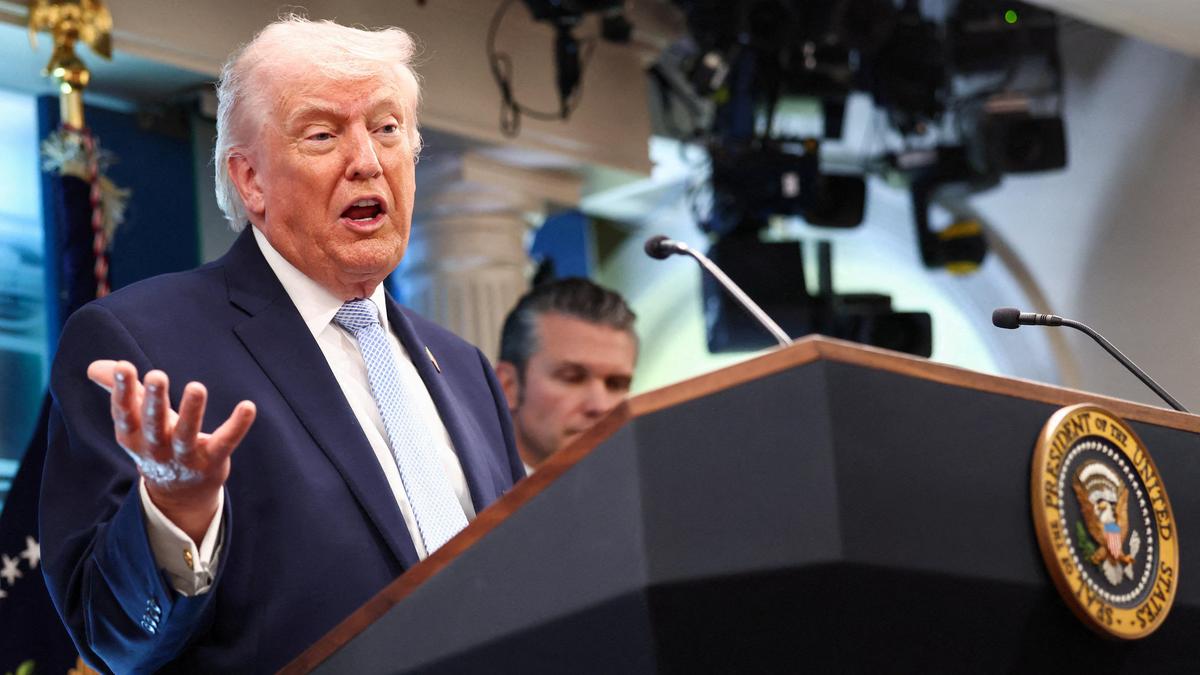
When Donald Trump speaks about "traffic buildup" in the Hormuz Strait, the words sound mundane. They sound like a morning commute on a rainy Tuesday in New Jersey. But in the context of international energy security, "traffic" is a polite euphemism for a potential catastrophe. We are talking about the collision of geopolitical ego, ancient rivalries, and the raw, unyielding physics of logistics.
Consider a ship captain named Elias. He is hypothetical, but his reality is shared by thousands of sailors currently navigating the Gulf. Elias stands on the bridge of a vessel carrying two million barrels of crude oil. Beneath his feet is a cargo worth roughly $150 million. To his port side lies Iran; to his starboard, Oman. The navigable channel is only two miles wide in each direction.
Elias isn't thinking about grand strategy. He is thinking about the radar. He is watching for "traffic"—not just other tankers, but the fast-attack craft of the Iranian Revolutionary Guard that often buzz around like hornets. He knows that if one mine is detected, or if one tanker is seized, the insurance premiums for his ship will skyrocket before he even reaches the next port. If the Strait closes, Elias is stuck in a dead-end pond with nowhere to go.
The Physicality of Power
The United States has long acted as the self-appointed traffic cop of this corridor. This role is not born of altruism. It is born of necessity. The global market is a delicate ecosystem where a disruption in the Middle East ripples out to a gas station in Ohio within forty-eight hours.
The "buildup" Trump referenced isn't just about ships waiting in line. It’s about the friction of tension. When the U.S. Navy increases its presence, or when the administration promises to "help" with the flow of goods, it is an exercise in signaling. It tells the markets that the police are on the beat. It tells the speculators to calm down.
But there is a deep irony in this. The U.S. is now a net exporter of energy, yet it remains tethered to the stability of a waterway on the other side of the planet. Why? Because oil is a fungible global commodity. Even if not a single drop of Persian Gulf oil reached American shores, a spike in global prices would still hit every American wallet. We are bound by the math of the barrel.
The Shadow of the 1980s
To understand the current anxiety, we have to look back at the "Tanker War" during the Iran-Iraq conflict. It was a period of sustained, brutal maritime chaos. Commercial vessels were struck by missiles. Sea mines drifted like hidden predators. The world watched as the primary artery of its energy supply was sliced open.
During that era, the U.S. began "reflagging" Kuwaiti tankers, effectively saying: If you hit this ship, you are hitting the United States. It was a high-stakes gamble that turned merchant sailors into front-line soldiers. The current talk of "helping with buildup" is a modern echo of that commitment. It is an acknowledgment that the freedom of navigation is the bedrock of the modern world. Without it, the "seamless" flow of commerce—a term often used by economists who have never seen a storm at sea—evaporates.
The reality on the water is far from seamless. It is loud. It is metallic. It smells of salt and diesel.
The Cost of a Clogged Vein
What happens if the help doesn't come? What if the "traffic" becomes a permanent blockade?
The immediate result is a logistical nightmare. Crude oil doesn't just sit in ships; it exists in a constant state of motion. Refineries are tuned to receive specific grades of oil at specific times. If the flow stops, the refineries have to dial back. If they dial back, the supply of gasoline, jet fuel, and plastics begins to dry up.
But the secondary effect is psychological. Markets run on confidence. The moment the Strait of Hormuz is perceived as "closed," the price of oil doesn't just go up—it teleports. We are talking about a world where $150 or $200 per barrel becomes a terrifying reality.
Think about the ripples. The cost of shipping a container from Shanghai to Los Angeles rises because the bunker fuel is more expensive. The cost of a head of lettuce in London rises because the truck that delivered it paid more at the pump. The cost of a plane ticket to see a dying relative becomes unaffordable. This is the human element behind the dry headlines of maritime "traffic."
The Invisible Guard
There is a certain vulnerability in admitting that our entire way of life depends on a few miles of water controlled by a hostile power. It’s uncomfortable. We prefer to think of our economy as a digital, ethereal thing—bits and bytes moving through the cloud. But the cloud runs on electricity, and electricity often runs on gas, and gas is moved by ships.
The U.S. promise to intervene is a heavy lift. It requires carrier strike groups, minesweepers, and a constant, grueling rotation of personnel. It is a massive expenditure of blood and treasure to keep the "traffic" moving.
Iran knows this. They use the Strait as a lever. They don't have to close it to win; they just have to threaten to close it. Every time a drone is launched or a verbal threat is issued, the "buildup" of anxiety does the work for them. They are playing a game of chicken with the global economy, and the U.S. is the only driver willing to stay on the road.
The Weight of the Promise
When an American president says the U.S. will "help," he is signing a blank check. He is telling the world that the American taxpayer will underwrite the safety of global trade. It is a massive, invisible subsidy that most people never think about until they see the price of a gallon of gas jump twenty cents overnight.
But can we actually "fix" traffic in a place like Hormuz?
Military force can clear a path, but it cannot create peace. You can escort a tanker, but you cannot stop the underlying rot of a regional cold war. The help being offered is a bandage on a wound that has been weeping for forty years. It is a necessary bandage, but a bandage nonetheless.
The sailors like Elias don't care about the politics. They care about the horizon. They look for the silhouette of a grey hull—a U.S. destroyer—and they feel a momentary sense of relief. That ship represents the only thing standing between them and a total breakdown of the order they rely on.
We live in a world where the most sophisticated technologies are still beholden to the ancient rules of the sea. We have built a civilization of glass and light, but it rests on a foundation of heavy tankers moving through a dangerous corridor. The "traffic" Trump speaks of is the friction of our existence. It is the sound of a world trying to keep moving while the gears are being jammed.
The sun sets over the Gulf, turning the water into a sheet of hammered gold. Somewhere out there, a captain is checking his radar. He sees the "traffic." He sees the narrowness of the path. He waits for the help he was promised, knowing that if it doesn't come, the lights on the shore might go out for everyone.