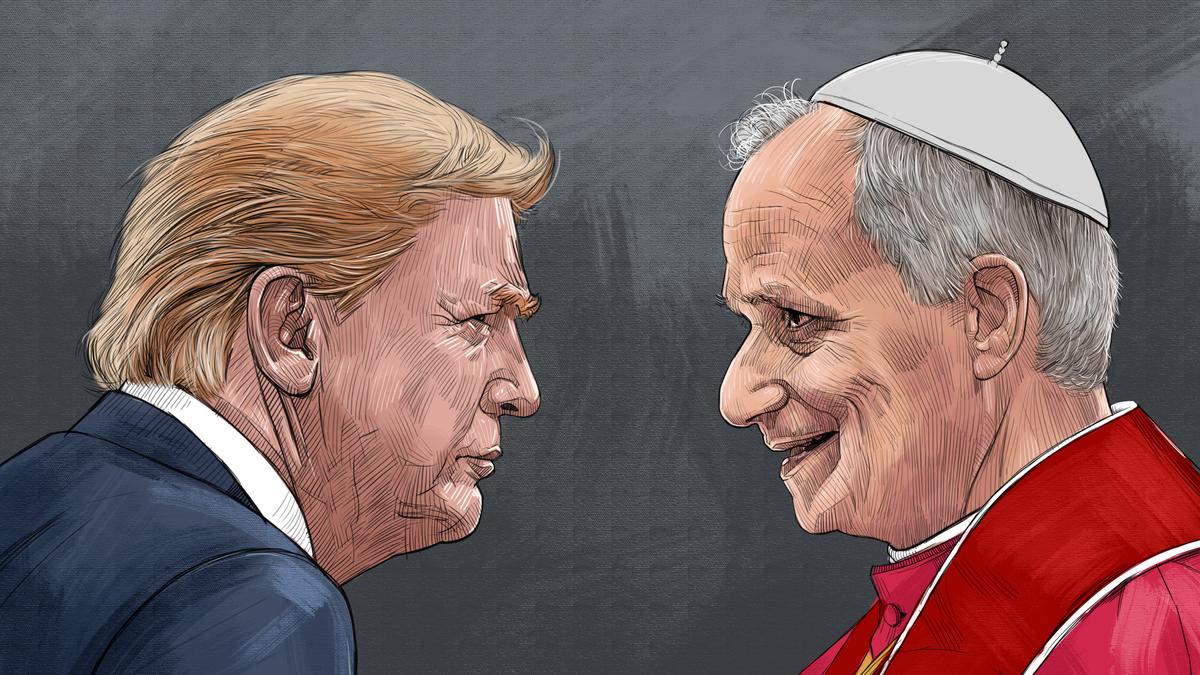
The collision was inevitable, but the speed of the impact has caught even the most cynical observers off guard. On one side sits the 47th President of the United States, Donald Trump, wielding the raw, transactional power of a second-term administration emboldened by a massive electoral mandate. On the other stands Pope Leo XIV, the first American pontiff in history, who has traded the diplomatic niceties of his predecessors for a sharp-tongued defense of global humanitarian norms. This is not merely a spat between a politician and a priest; it is a fundamental struggle over who defines the moral soul of the West in 2026.
At the center of the current firestorm is Operation Epic Fury, the joint U.S.-Israeli military campaign in Iran. While Washington frames the conflict as a necessary surgical strike against nuclear proliferation, Leo XIV has denounced it as a "delusion of omnipotence." The rift deepened when the President suggested on social media that "an entire civilization will die tonight," a statement the Pope labeled "truly unacceptable." The tension has now devolved into a digital-age religious war, with the White House casting the Vatican as a "radical left" political actor and the Pope positioning the Church as the final check on unchecked nationalism.
The Theological Offensive
Historically, the Vatican operates on "civilizational time," moving with a glacial caution that spans centuries. Leo XIV has shattered that precedent. Since his election in May 2025, he has leveraged his American identity not to bridge gaps with his homeland, but to dismantle the religious justifications often used by the American right. When administration allies invoked scripture to bless the Iranian intervention, the Pope issued a blunt corrective: God does not listen to the prayers of those who wage war.
This is a direct hit to the administration's base. For decades, the Republican party has relied on a coalition that includes a significant, culturally conservative Catholic vote. By framing the President’s policies on immigration and war as fundamentally "anti-life," Leo XIV is attempting to reclaim the moral high ground from partisan influencers. He isn't just disagreeing on policy; he is challenging the administration’s right to claim the Christian mantle.
Power as a Weapon vs. Power as a Stewardship
The friction arises from two irreconcilable definitions of authority. For the Trump administration, power is a tool for coercion and intervention. It is measured in stock market indices, military hardware, and the ability to dictate terms to allies and enemies alike. This "America First" 2.0 strategy views international norms and religious interference as obstacles to be cleared.
In contrast, the Vatican under Leo XIV views power as institutional memory and moral orientation. The Pope argues that true leadership does not seek to dominate, but to preserve the conditions for human dignity. This manifests in his vocal opposition to Operation Metro Surge, the administration's aggressive domestic deportation initiative. Leo has characterized the treatment of migrants as "extremely disrespectful," aligning himself with a globalist perspective that views national borders as secondary to human rights.
The Digital Disinformation Battlefield
Technology has weaponized this disagreement in ways never seen during the papacies of John Paul II or Francis. The administration has utilized sophisticated digital messaging to recast the Pope as a "liberal politician" who is "weak on crime." This is a deliberate strategy to delegitimize the Pope’s spiritual authority by dragging it into the mud of partisan bickering.
The low point of this exchange occurred when an AI-generated image appeared on the President’s social media feed, depicting himself in a Christ-like pose—a move that was later deleted but served its purpose in signaling to the base where their true loyalty should lie. By collapsing the distinction between the sacred and the political, the administration is attempting to neutralize the Vatican's influence among American voters.
The Fracture of the American Pew
This conflict is tearing through American parishes. Current polling indicates a sharp divide:
- Net Favorability: Leo XIV maintains a +34 net favorability rating among Americans, significantly higher than the President’s -12.
- The Catholic Split: While nearly half of Catholic voters supported the President in 2024, that support is eroding, currently sitting at roughly 48%.
- The Conflict of Loyalty: Laypeople are increasingly forced to choose between their political identity and their religious leadership, a choice many find exhausting.
The President’s claim that the Pope supports a nuclear-armed Iran—a claim rated "Pants on Fire" by fact-checkers—highlights the desperation of the narrative battle. The Vatican has been a signatory to the Treaty on the Prohibition of Nuclear Weapons since 2017, yet in the "post-truth" environment of 2026, the facts of the matter are often secondary to the volume of the accusation.
A Diplomacy of Force
The fallout has moved beyond rhetoric into the realm of hard diplomacy. The "Greenland crisis" and the suspension of various foreign aid programs have signaled a U.S. retreat from the very international order the Church helped build after World War II. Vatican officials have privately expressed fears that the administration views the Holy See as just another hostile NGO rather than a sovereign entity.
Reports of a "hostile meeting" with a Vatican ambassador in January 2026 suggest that the traditional backchannels of diplomacy are frozen. For the first time in modern history, there is a genuine possibility that a sitting Pope may decline to visit the United States for the duration of a presidency. The "Avignon" label—a reference to the 14th-century period when the papacy was forced out of Rome—has even been whispered in the halls of the Curia, signaling a sense of existential threat.
The standoff between the two Americans—one in the Oval Office and one in the Apostolic Palace—is a preview of a world where moral authority and state power no longer speak the same language. The President is betting that nationalism and economic results will outweigh the Pope’s "soft power." The Pope is betting that the Gospel remains more durable than any election cycle. Neither side appears ready to blink, and the space for "dialogue" that Leo XIV so often calls for is rapidly vanishing under the weight of the next news cycle.