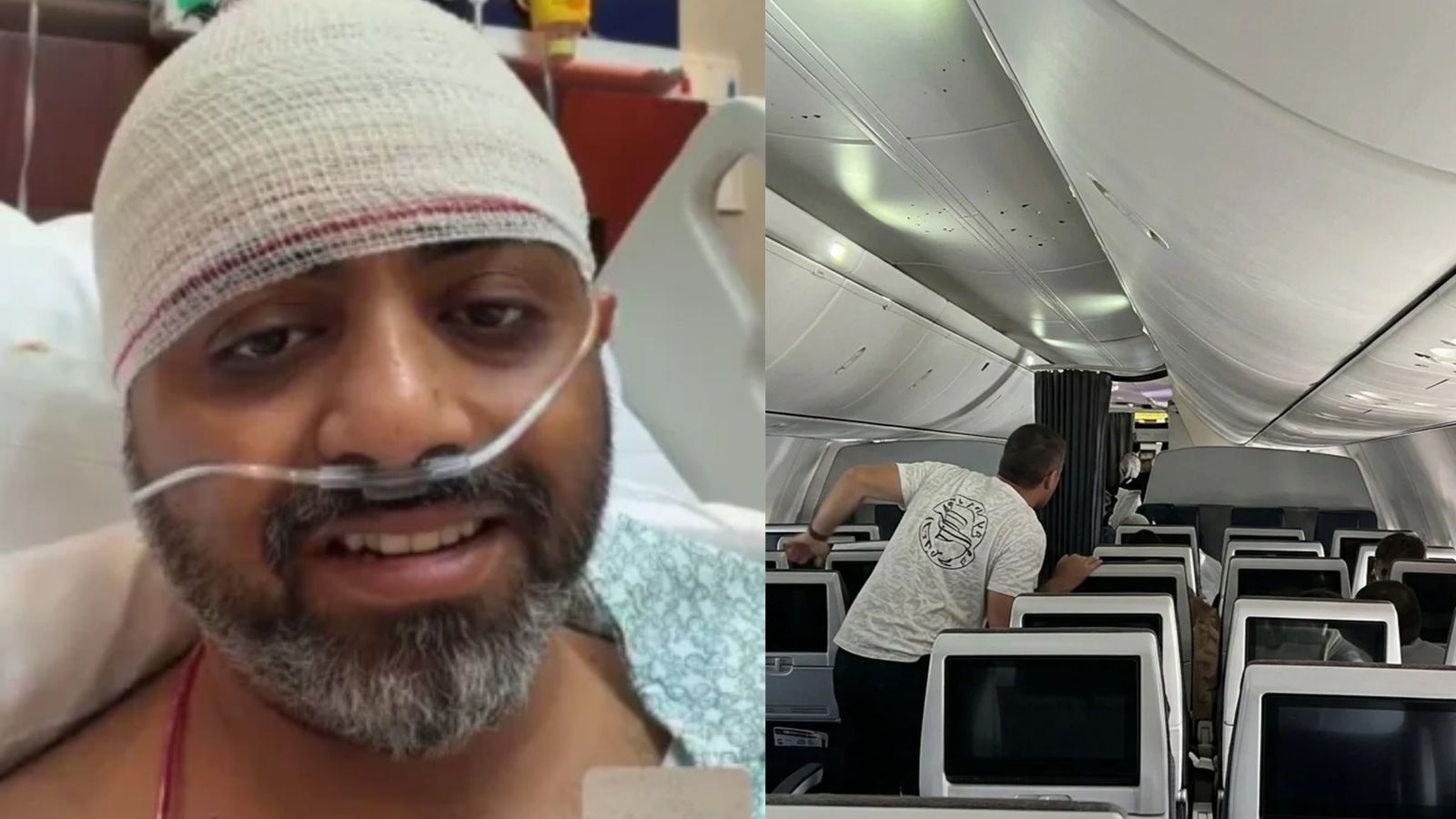
Commercial aviation security for decades treated the locked cockpit door as the definitive barrier against violent takeover. The September 30, 2026 incident aboard Flydubai flight FZ1073—where Captain Smit Machchhar was assaulted inside the flight deck by his co-pilot, Hamam al-Hammami, as the Boeing 737 plunged more than 17,000 feet from roughly 34,000 feet toward Tel Aviv before stabilizing and diverting to Tabuk, Saudi Arabia—exposes a structural inversion of that assumption. When threat actors operate on the inside of the flight deck rather than trying to breach it from the cabin, physical fortification designed to keep intruders out can delay intervention from outside crew members and passengers.
Standard human-interest coverage focuses on survival determination, high-level diplomatic calls, and dramatic recollections of blows struck while checking fuel and landing timings. Treating the event purely as an individual feat of willpower obscures the operational mechanics that enabled the attack, the physical and procedural bottlenecks that complicated recovery, and the systemic trade-offs governing modern flight deck access. This analysis deconstructs the incident through four operational lenses: the Anatomy of an Inside-the-Perimeter Breach, the Flight Deck Access and Contention Bottleneck, the Aerodynamic and Physiological Cost Function of Sudden Loss of Control, and the Screening and Governance Limits of Cross-Border Airline Operations.
The Anatomy of an Inside-the-Perimeter Breach
Post-9/11 aviation hardening optimized for external perimeter defense. Reinforced doors, keypad access protocols, and strict sterile-cockpit rules were engineered on the premise that both authorized occupants inside the flight deck share baseline operational intent and situational awareness. That model breaks down when one of the two primary flight crew members initiates a physical assault.
In flight FZ1073, the attack unfolded during routine cruise operations roughly two hours into the flight, with 174 passengers—including 27 children—aboard. Machchhar was seated looking forward and reviewing landing timings and fuel figures while al-Hammami stood behind him and prayed—an action Machchhar initially treated as routine before being struck from behind. From a systems perspective, three mechanics made this initial phase particularly hazardous:
- Asymmetric positional advantage. Standing behind a seated, task-focused pilot removes visual line-of-sight and grants immediate leverage against the head and upper body before defensive posture can be established.
- Simultaneous threat and control disruption. A physical assault inside a two-pilot cockpit does not merely injure an occupant; it competes directly with flight-path management, altitude monitoring, and emergency communication at high cruise altitude.
- Cognitive load and physiological shock. Blunt trauma, bleeding, vision loss, and consciousness disruption degrade decision speed and motor coordination precisely when rapid threat assessment and aircraft stabilization are required.
What remains a known fact from public accounts is that Machchhar unbuckled his seatbelts, attempted to block blows, reached toward the door mechanism to summon help, and suffered severe injuries and loss of consciousness. What remains an educated hypothesis pending formal aviation and security investigation findings is the exact sequence of flight control inputs versus manual intervention that produced the 17,000-foot descent and subsequent recovery.
The Flight Deck Access and Contention Bottleneck
A fortified flight deck door solves one problem while introducing a two-sided access paradox. When an attacker inside the cockpit blocks entry or refuses to grant access, cabin crew outside face procedural and physical friction trying to re-enter.
Accounts from Machchhar and passenger recollections highlight how access contention operated during the crisis. Flight attendants attempted to use door-entry procedures from outside while al-Hammami prevented access from inside. Furthermore, when the door was eventually opened and passengers or crew reached the threshold, physical obstruction and struggle near the doorway complicated immediate entry to the flight controls.
Why Door Protocols Create Friction Under Duress
Standard access-control logic relies on deliberate verification delays so a crew member inside can evaluate who is requesting entry. In a normal security scenario—such as a cabin crew member bringing refreshments or checking on an incapacitated pilot—that delay is a feature that prevents forced entry. Under an active cockpit assault, however, every second spent negotiating door logic or clearing physical obstructions compounds altitude loss and crew incapacitation.
The second limitation lies in role ambiguity outside the cockpit. During an unannounced emergency involving rapid pitch changes and cabin alarm cues, flight attendants and available passengers—including onboard relief pilots or medically trained travelers—must rapidly coordinate without a standardized, pre-rehearsed breach sequence for an incapacitated or hostile flight deck occupant. Accounts of the incident note both relief pilots reaching the cockpit to help stabilize the aircraft and passengers—including a dentist who assisted with Machchhar's injuries—playing roles in the recovery and stabilization phase.
Aerodynamic and Physiological Cost Function of Sudden Loss of Control
Aircraft do not forgive delayed recovery at high altitude. A descent of more than 17,000 feet from roughly 34,000 feet compresses operational timelines and imposes severe physical and psychological demands on everyone aboard.
The cost function of an uncommanded or poorly controlled high-altitude descent can be broken down into four interacting variables:
- Altitude and vertical speed budget. At ~34,000 feet, an aircraft has substantial potential energy and altitude margin, but steep or rapid vertical descent consumes that margin quickly and increases airspeed and G-load risks if not arrested cleanly.
- Cabin environment and physiological strain. Rapid altitude shifts, turbulence, and sudden pitch changes heighten disorientation, injury risk for unrestrained occupants, and acute stress responses.
- Crew workload concentration. Stabilizing an upset aircraft, diagnosing system or control anomalies, communicating distress, and selecting a suitable diversion airfield—in this case Prince Sultan bin Abdulaziz Airport in Tabuk—demand undivided attention from pilots capable of flying the jet.
- Post-event trauma and recovery lag. Survival does not end at touchdown. Machchhar noted that he only felt out of danger upon landing, and reported experiencing flashes of the initial blow and palpitations in the days afterward while receiving care in Saudi Arabia and the United Arab Emirates.
In aviation human factors, startle and surprise degrade structured instrument scan unless mitigated by high-hour procedural conditioning. Machchhar's background—having flown Boeing aircraft for roughly 17 years, served as a senior commander and line training captain earlier in his career at SpiceJet, joined Flydubai in 2022, and logged over 9,750 Boeing 737 hours by September 2026—represents a known fact regarding his operational experience. Whether that specific training background directly determined the exact recovery trajectory remains a hypothesis to be evaluated alongside the actions of the relief pilots and crew rather than assumed as a sole causal factor.
Screening and Governance Limits of Cross-Border Airline Operations
Whenever a licensed or vetted crew member is implicated in an attack, scrutiny immediately shifts to background checks, continuous monitoring, and cross-border regulatory coordination. Public reporting following the FZ1073 incident highlighted questions around how the co-pilot passed airline background checks, whether the United Arab Emirates would tighten screening rules for foreign pilots, what role Indian investigators would play given Machchhar's nationality and prior career, and how intelligence or law enforcement agencies across jurisdictions share vetting data.
Four Structural Constraints in Crew Vetting
- Point-in-time vetting versus continuous behavioral drift. Traditional background checks verify criminal records, employment history, and credentials at hiring or periodic renewal intervals. They are far weaker at detecting gradual ideological radicalization, personal crisis, or covert operational planning occurring between formal checks.
- Credential verification gaps. Public reporting noted that al-Hammami had completed a three-year distance-learning aviation management degree at Buckinghamshire New University in 2023 without undertaking pilot training there. Academic or management credentials are distinct from flight proficiency and security clearance, underscoring why multi-layered verification across flight schools, licensing authorities, and security databases is essential.
- Jurisdictional fragmentation. International carriers operate across overlapping legal, diplomatic, and investigative regimes. When a flight departs one hub, crosses regional airspace, diverts to a third country, and involves crews and passengers of multiple nationalities—drawing high-level diplomatic engagement from the UAE, India, and Israel—coordinating evidentiary access and regulatory reform takes time.
- Privacy and civil liberties boundaries. Aggressive continuous surveillance of pilots risks alienating crew members, discouraging open mental health or peer reporting, and creating false positives without guaranteeing early detection of a disciplined insider.
There is no silver bullet in insider-threat prevention. Even rigorous psychological evaluations and background screening cannot eliminate low-probability, high-severity insider anomalies with mathematical certainty, which means operational resilience and rapid recovery must carry equal weight alongside pre-flight prevention.
Strategic Action for Airlines and Aviation Regulators
Airlines and aviation regulators should treat flight FZ1073 as a mandate to pair insider-threat resilience with rapid cockpit recovery protocols, rather than relying solely on static pre-employment vetting or one-way door barriers.
Specifically, carriers and regulators should execute three concrete measures:
- Mandate standardized "incapacitation and hostile-cockpit" entry drills for cabin crew and relief pilots. Train crews on timed access escalation, physical door-clearance coordination, and immediate transfer of flight-path control so exterior intervention does not stall at the threshold during an active assault.
- Upgrade cockpit anomaly detection and dual-crew situational awareness. Pair cockpit door status alerts with automated flight-envelope and vertical-speed deviation prompts that immediately alert dispatch and cabin leadership when uncommanded pitch or altitude excursions occur.
- Establish cross-border continuous vetting triggers tied to behavioral and travel anomalies. Build formal data-sharing channels between hiring carriers, civil aviation authorities, and security agencies so warning signs emerging after initial onboarding trigger timely security reviews without relying solely on periodic calendar renewals.