Two hundred meters below the churning grey surface of the North Atlantic, there is no sunlight. There is only the hum of machinery and the crushing weight of the ocean. In this ink-black void, a game of high-stakes hide-and-seek is being played with terrifying precision. It is a world where sound is the only currency, and silence is the only shield.
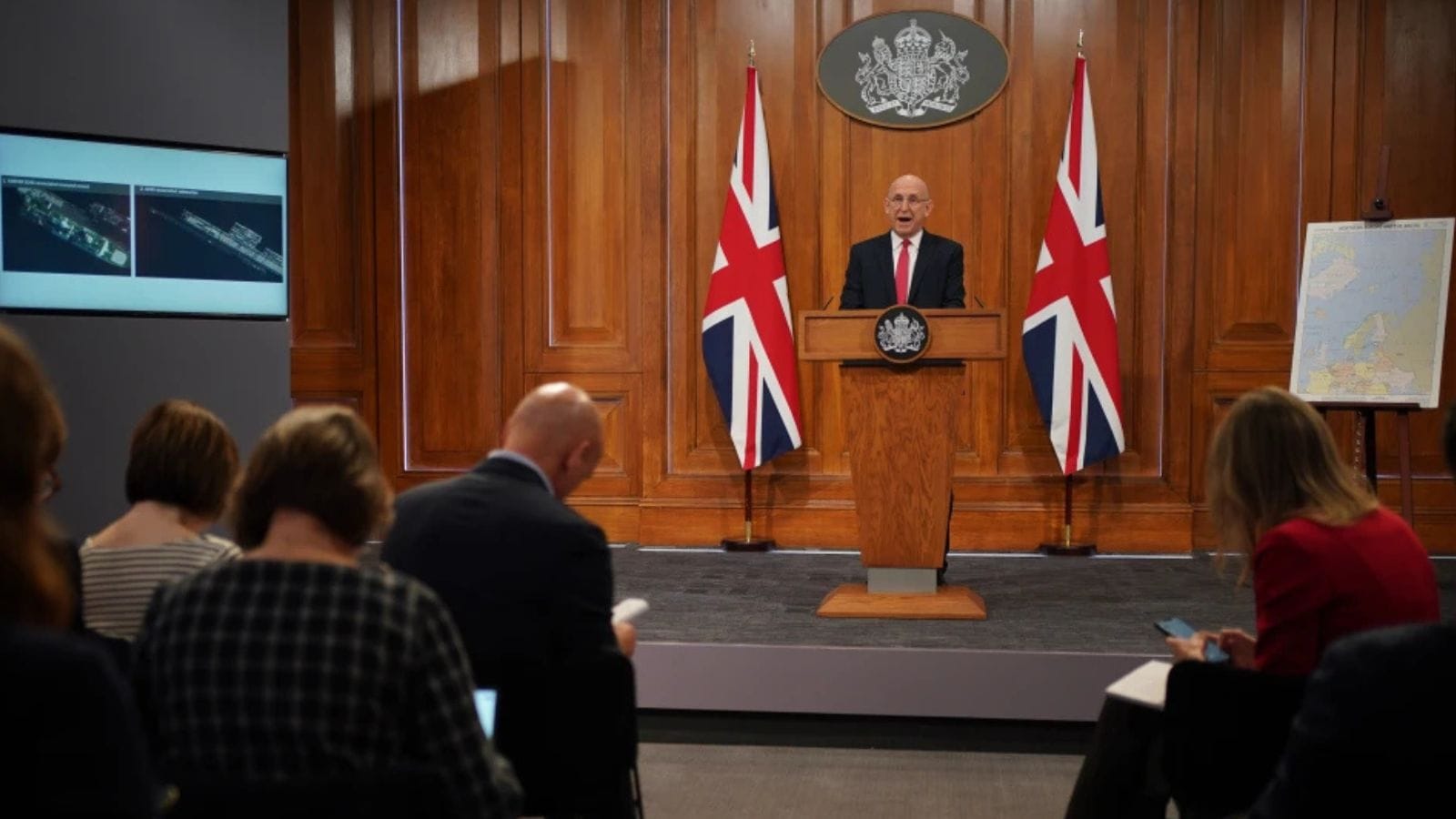
Recently, the surface world caught a glimpse of this hidden struggle. The United Kingdom and Norway launched a coordinated military operation to track and deter Russian submarines moving through the "GIUK Gap"—the strategic naval chokepoint between Greenland, Iceland, and the United Kingdom. On paper, it was a routine display of NATO interoperability. In reality, it was a desperate race to maintain the integrity of the invisible threads that hold the modern world together.
The Sound of a Shadow
To understand why a few steel tubes moving through deep water matters to someone living in a London flat or an Oslo suburb, you have to look at the seabed.
The ocean floor is crisscrossed with thousands of miles of fiber-optic cables. These are the nervous system of the 21st century. They carry 97% of all international data. Your bank transfers, your private messages, the very infrastructure of the global economy—it all sits in the mud at the bottom of the Atlantic.
Now, imagine a Russian Severodvinsk-class submarine hovering near those cables.
These vessels aren't just designed for nuclear deterrence. They are equipped for "underwater work." This is the euphemism military analysts use for the ability to tap, cut, or interfere with these vital links. If those cables go dark, the world doesn't just lose Netflix. It loses its pulse. The financial markets would freeze. Emergency communications would vanish. The chaos would be instant, and it would be total.
This is the "invisible stake" that forced the Royal Navy and the Norwegian Armed Forces to scramble their most sophisticated assets. They weren't just looking for ships. They were defending the very concept of a connected world.
The Human at the Sonar Screen
Let’s look at a hypothetical sailor—we’ll call him Thomas—stationed aboard a British Type 23 frigate, HMS Northumberland.
Thomas doesn't see the Russian submarine through a window. He hears it. Or rather, he tries to. Modern Russian submarines are coated in "anechoic tiles"—rubberized scales designed to absorb sonar waves and dampen the sound of the engines. In the sonar room, Thomas wears high-fidelity headphones, his eyes fixed on a waterfall display of shifting frequencies.
The stress is visceral.
He is listening for a "signature"—the specific acoustic fingerprint of a Russian reactor pump or a propeller blade. It is a grueling, mind-numbing task that requires the patience of a saint and the ears of a concert pianist. If Thomas misses a faint rhythmic clicking buried under the roar of the Atlantic waves, a wolf enters the fold undetected.
The cooperation between the UK and Norway is designed to give Thomas more "eyes" and "ears." While Thomas listens from his frigate, a Norwegian P-8A Poseidon maritime patrol aircraft circles overhead. The Poseidon drops "sonobuoys"—disposable acoustic sensors that dangle into the depths, transmitting data back to the plane.
This is the synergy that the press releases talk about, but for Thomas, it’s a lifeline. It’s the difference between searching for a needle in a dark haystack and having a friend hold a flashlight.
The Chessboard of the Deep
Why now? Why this sudden surge in activity?
The geopolitical temperature has reached a boiling point. Since the escalation of the conflict in Ukraine, the North Atlantic has become a secondary front in a much broader shadow war. Russia knows it cannot win a conventional surface battle against the combined power of NATO. But in the deep water, the playing field is more level.
The Russian navy has been revitalizing its Northern Fleet with a focus on stealth. They are testing the boundaries of what the West can detect. By surging submarines into the Atlantic, they are sending a message: We can touch you where you feel safest.
The joint operation by the UK and Norway was the counter-message.
By deploying the Royal Navy’s "Submarine Hunter" frigates alongside Norwegian intelligence assets, NATO demonstrated that the GIUK Gap remains a locked gate. It wasn’t just about showing off hardware; it was a psychological maneuver. It was a way of telling the Kremlin that their "ghosts" are being followed.
The Fragility of the Deep
There is a profound vulnerability in this arrangement that many people struggle to grasp. We often think of national security in terms of borders and walls—things we can see and touch. But the North Atlantic is a wilderness. It is vast, unforgiving, and largely unmonitored.
The technology required to track a modern submarine is staggering. A Type 23 frigate uses a "towed array" sonar—a cable several kilometers long, bristling with sensors, dragged behind the ship to get away from its own engine noise. This cable is a marvel of engineering, but it is also fragile. A sharp turn or a mechanical failure can render the ship "blind."
When Norway and the UK operate together, they provide redundancy. If one ship loses its trail, the other picks it up. If the weather grounds the Norwegian planes, the British ships hold the line. It is a partnership born of geography and necessity. Both nations share a coastline that looks out onto the same dark water. Both nations understand that if the Atlantic is lost, their sovereignty is a polite fiction.
The Weight of the Silence
What happens when the operation ends? The ships return to port. The crews go home to their families. The headlines fade.
But the submarines don’t go away.
They remain out there, drifting in the currents, waiting. The game never truly ends; it only pauses. This is the reality of modern deterrence. It is a constant, exhausting effort to maintain a status quo that most people don’t even know exists.
We live our lives in the sunshine, scrolling through our phones and conducting our business, blissfully unaware of the hunters and the hunted circling each other in the dark. We trust that the cables stay intact. We trust that the silence remains unbroken.
But that trust is bought and paid for by people like Thomas, sitting in a darkened room, listening to the heartbeat of the ocean and praying that he never hears the sound of a shadow moving toward the wires.
The North Atlantic is not just a body of water. It is a bridge. And right now, the UK and Norway are the sentries standing on that bridge, peering into the fog, making sure the world we know doesn't vanish into the deep.
The water remains cold. The silence remains heavy. And somewhere, deep below, the chase continues.


