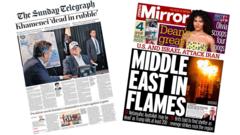
The headlines screaming about rubble in Tehran or a Middle East engulfed in a permanent firestorm are missing the structural reality of the current crisis. While tabloid editors focus on the cinematic imagery of destruction, the actual story is the terminal failure of a forty-year military doctrine. Iran’s "Strategic Depth"—the idea that it could fight its wars in Lebanon, Yemen, and Iraq to keep its own borders pristine—has evaporated.
For decades, the Islamic Republic operated under the assumption that its regional proxies acted as a forward-deployed insurance policy. If you touched the center, the periphery would ignite. However, the recent series of high-level intelligence breaches and precision strikes has revealed a different truth. The insurance policy has defaulted. Tehran is no longer managing a network of influence; it is presiding over a crumbling architecture of failed deterrence.
The Intelligence Hemorrhage
The most jarring aspect of the current escalation is not the raw firepower, but the absolute transparency of the Iranian security apparatus. It is impossible to maintain a regional shadow war when your internal communications are effectively public record for your adversaries. We are seeing a level of penetration that suggests the traditional methods of human and signals intelligence have been superseded by something more foundational.
When a leadership target is neutralized in a supposedly "secure" hardened facility, it isn't just a failure of the bodyguards. It is a failure of the entire technological and social ecosystem surrounding that leader. The modern battlefield doesn't care about concrete thickness. It cares about the digital trail. Every smartphone, every encrypted radio that isn’t actually encrypted, and every disgruntled middle-manager in a state bureaucracy is a vector for a kinetic strike.
The Iranian leadership now faces a "paranoia tax." Every hour spent purging the ranks or second-guessing the loyalty of their inner circle is an hour not spent on strategic planning. This internal friction slows down decision-making to a crawl, while their opponents are operating at the speed of real-time data feeds.
The Myth of the Unstoppable Proxy
We have been told for years that groups like Hezbollah or the various militias in Iraq were independent, self-sustaining entities that could bring the global economy to a halt. That narrative is dying. These groups are proving to be heavily dependent on a centralized command-and-control structure that is currently being dismantled piece by piece.
Without the steady flow of specialized hardware and, more importantly, the technical advisors from the IRGC, these proxies revert to being localized insurgencies rather than regional power brokers. They can still cause pain, certainly. They can still fire rockets. But the ability to coordinate a multi-front "Ring of Fire" requires a level of synchronization that is currently being jammed by superior electronic warfare and proactive interdiction.
Consider the logistics. A missile is a paperweight without a guidance kit. A drone is a hobbyist toy without a secure uplink. By targeting the nodes that connect Tehran to its outposts, the opposition has effectively turned a regional threat back into a series of isolated, manageable problems.
The Economic Dead End
War is expensive. Maintaining a regional empire while your domestic economy is suffocating under sanctions and systemic corruption is an impossible math problem. The Iranian rial’s steady march toward worthlessness isn't just a statistic; it’s a strategic constraint.
When a government chooses to fund a militia in Damascus over a water project in Sistan and Baluchestan, it creates a domestic vulnerability that no amount of revolutionary rhetoric can mask. The "Middle East in flames" narrative often ignores the fact that the fuel for these flames is being diverted from a population that is increasingly unwilling to freeze in the dark for the sake of a pan-Islamic dream.
The leadership is trapped. To pull back from the proxies is to admit the failure of the 1979 mission. To double down is to risk a domestic implosion that would make the 2022 protests look like a rehearsal.
The Technological Displacement of Conventional Deterrence
The old rules of Middle Eastern conflict relied on a balance of terror involving standing armies and the threat of mass mobilization. That era is over. We have entered the age of asymmetric technological dominance.
In this new reality, $100 million worth of conventional air defense can be bypassed by a $500 drone or, more likely, by a cyber-attack that tells the radar there is nothing to see. The IRGC has invested heavily in ballistic missiles, but these are "loud" weapons. They are visible from space the moment the silos open. They are the blunt instruments of a previous century.
The current conflict is being won in the "gray zone"—the space between peace and total war where data is the primary ammunition. If your opponent knows where you are, what you’re saying, and who you’re meeting with before you even arrive, you have already lost. The physical "rubble" is just the final, formal acknowledgement of a defeat that happened in the digital sphere days or weeks prior.
The Failure of the Russian Alignment
Tehran’s pivot toward Moscow was supposed to provide a high-tech shield against Western-aligned pressure. Instead, it has revealed the limitations of Russian military technology. The S-300 and S-400 systems, long touted as the ultimate deterrent against aerial incursions, have shown significant gaps when faced with modern stealth and integrated electronic warfare suites.
Furthermore, Russia is currently too preoccupied with its own attrition in Ukraine to act as a meaningful security guarantor for Iran. The "Eurasian Alliance" is, for now, a partnership of convenience between two states that are both struggling to adapt to a world where their primary exports—oil and old-school intimidation—are losing their leverage.
The Strategic Miscalculation of Escalation
There is a common belief that "flames" in the Middle East benefit the radical elements in Tehran because it forces the world to the negotiating table. This is a dated assumption. The world is no longer as dependent on the Strait of Hormuz as it once was.
Alternative energy routes, increased production in the Americas, and a general global hardening against energy blackmail have reduced the "oil weapon" to a shadow of its former self. If Iran closes the Strait, it hurts its own primary customer, China, more than it hurts the West. This creates a strategic checkmate. You cannot burn the house down if you are the one locked in the basement.
The Role of Regional Realignment
While the headlines focus on the kinetic war, the diplomatic map is being redrawn. The Abraham Accords were not just a series of photo ops; they represented a fundamental shift in how regional powers view their security. There is a growing bloc that views technological integration and economic stability as more valuable than the perpetual grievance of the "Resistance Axis."
This bloc isn't just watching the conflict; they are providing the intelligence and the logistical support that makes the dismantling of the proxy wall possible. They are betting on a post-IRGC Middle East, and they are putting their resources behind that bet.
The Hard Reality of the Rubble
When we talk about "Khamenei dead in the rubble," we shouldn't take it literally—though in this climate, anything is possible. We should take it metaphorically. The idea of the Supreme Leader as an untouchable, divinely guided strategist is what is currently lying in the debris.
The image of invincibility is a dictator’s most important asset. Once that image is shattered by the reality of precise, clinical strikes that the state is powerless to stop, the social contract of the autocracy begins to dissolve. The security forces start looking for an exit. The bureaucrats start leaking documents to buy future immunity.
The crisis isn't just about missiles and borders. It’s about the total collapse of a governance model that traded the prosperity of its people for a regional influence that turned out to be a house of cards.
The next phase of this conflict won't be a grand peace treaty or a final, cinematic battle. It will be the slow, grinding realization within Iran that the cost of their "Strategic Depth" has become the destruction of their strategic future. Every proxy that falls and every "secure" bunker that is breached reinforces the same lesson: you cannot fight a twenty-first-century war with a twentieth-century mindset and a seventeenth-century ideology.
The fire isn't just across the Middle East. It is under the foundations of the regime itself. Stop looking for the end of the world in the headlines and start looking for the end of a failed empire in the data logs and the empty coffers. The transition is already happening. It isn't a "game-changer," it's a foreclosure.
Prepare for a region where the old giants are no longer standing, and the new power is defined not by how much you can burn, but by how much you can see.

