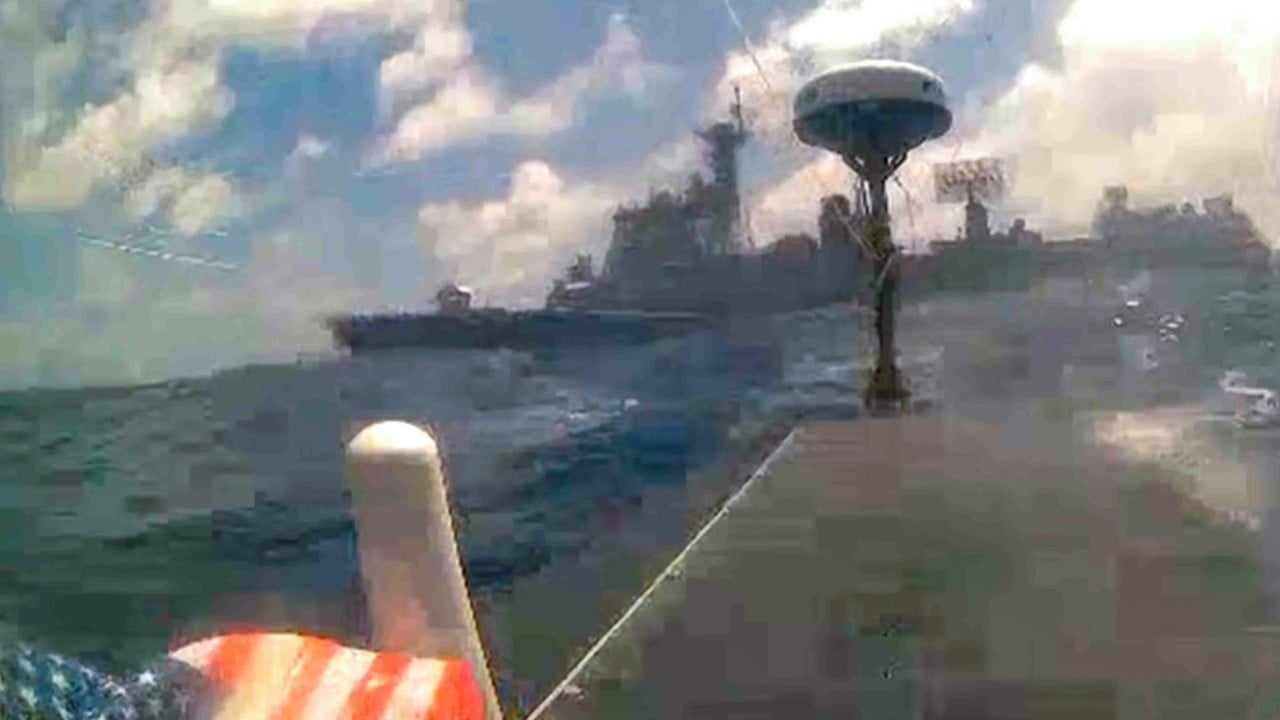
Every defense pundit in Washington and Taipei is currently high on the same bad trip. They look at a $50,000 fiberglass commercial boat strapped with off-the-shelf GPS guidance, slap the label "sea drone" on it, and convince themselves that a swarm of modified jet skis is going to turn the Taiwan Strait into a maritime graveyard for the People's Liberation Army Navy.
It is a comforting fantasy. It allows budget-constrained defense ministries to pretend that asymmetric warfare is a magic wand. I have watched defense contractors blow millions of venture capital dollars trying to scale hobbyist hardware into military solutions, and I am here to tell you that the lazy consensus surrounding commercial uncrewed surface vessels is entirely detached from the physical reality of modern naval combat.
Stop treating hobbyist toys like capital warships. The strategic reality of the South China Sea and the Taiwan Strait requires a brutal dose of engineering truth.
The Commodity Trap of Off-The-Shelf Hardware
The core misconception is that commercial availability equals combat scalability. The argument goes like this: because you can buy commercial marine electronics, carbon-fiber hulls, and consumer-grade mesh radios off Alibaba or through Western marine suppliers, you can mass-produce thousands of lethal surface interceptors overnight.
This logic ignores the fundamental physics of the maritime domain. Commercial hulls are built for recreational lakes, calm coastal waters, or predictable commercial shipping lanes. They are laminated with resins that degrade under UV stress within months, powered by outboards that shake themselves to pieces in a sea state four, and controlled by frequencies that military electronic warfare units can jam with a pocket transceiver.
I have spent time inside procurement rooms where engineers tried to retrofit commercial hulls with encrypted military datalinks and explosive payloads. By the time you reinforce the transom, add marinized shock-mounting for guidance computers, install military-grade inertial navigation systems to compensate for GPS denial, and wrap the hull in radar-absorbent material, your $50,000 budget toy costs $800,000. And it is still structurally fragile compared to a purpose-built military hull.
The PLA does not need to sink every drone you throw at them. They just need to wait for the fuel lines to crack from wave slap or the consumer-grade alternator to fail fifty miles offshore. Commercial sea drones operating in open water have an attrition rate dictated by saltwater corrosion and wave fatigue long before they ever enter an enemy radar horizon.
The Bandwidth Bottleneck Nobody Wants to Talk About
Let us address the communications fantasy. In a controlled test environment, a pilot sitting in a container twenty miles away can guide a commercial hull smoothly using high-definition video feeds. It looks cinematic. It looks like the future.
Now try that inside the electromagnetic soup of the Taiwan Strait.
The PLA possesses some of the most sophisticated electronic attack capabilities on earth. Their signal intelligence platforms do not just jam frequencies; they map networks, inject malware, spoof GPS coordinates, and saturate the radio spectrum with noise so dense that standard commercial data links choke instantly.
When you lose line-of-sight control or your satellite connection goes dark, what does your commercial sea drone do? A military-spec autonomous system has robust pre-programmed contingency behaviors, hardened inertial backups, and strict rules of engagement coded into silicon hardened against radiation and EMP. A commercial drone running on an open-source flight controller either loops in circles waiting for a heartbeat signal or drifts helplessly into commercial shipping lanes, becoming a hazard to civilian freighters rather than a threat to an amphibious landing fleet.
Bandwidth is finite. When you deploy a swarm of fifty commercial craft, you run straight into the spectrum management wall. Unless your guidance architecture relies on resilient, peer-to-peer optical or acoustic comms—technology that is wildly expensive and far from "off-the-shelf"—your swarm turns into a disorganized cluster of expensive debris the moment the shooting starts.
The Scale Fallacy in the Littoral Theater
Defense analysts love to compare maritime drones to aerial drones in Ukraine. This is a category error of the highest order.
The Black Sea is geographically constrained, relatively shallow in contested zones, and dominated by a Russian naval adversary whose surface fleet has suffered from institutional inertia and poor damage control. Ukraine used uncrewed surface vessels effectively against stationary targets like docked warships in Sevastopol because the targets could not dodge and the approaches were shielded by geography.
The Taiwan Strait is a different beast entirely. It is a hundred miles of open, hyper-turbulent water swept by monsoons, strong currents, and heavy commercial maritime traffic. At any given hour, thousands of container ships, fishing vessels, and bulk carriers transit these waters.
Imagine a swarm of low-profile commercial sea drones trying to pick out a Type 055 destroyer from a dense soup of commercial shipping using computer vision algorithms trained on pristine imagery. The false positive rate alone would paralyze the system. If your autonomous interceptor mistakes a container ship for a landing platform dock because the lighting shifted, you have just committed an international incident or wasted your payload on a box of consumer electronics heading for Rotterdam.
Furthermore, the PLA Navy does not operate in isolation. A modern Chinese amphibious assault group is an integrated bubble of air defense, rotary-wing anti-submarine warfare, close-in weapon systems, and rapid-fire naval guns designed to shred incoming surface threats at range. A fragile, unarmored commercial hull carrying a few hundred pounds of explosives is a slow-moving target for a 30mm remote weapon station or a helicopter-borne door gunner using thermal optics.
The Wrong Question About Asymmetry
The entire debate is trapped in a flawed framing: How do we build cheap things to stop expensive things?
That is a politician's question, not a strategist's question. Asymmetric warfare does not mean buying cheap garbage and hoping quantity has a quality all its own. True asymmetry requires exploiting structural vulnerabilities in the enemy's system while minimizing your own single points of failure.
If Taiwan or its allies want to deny the strait to an invading fleet using uncrewed systems, they need to abandon the obsession with cheap surface hulls entirely. Surface vessels are visible, fragile, and vulnerable to every sensor band known to modern science.
The real maritime disruption lies underneath the water and deep in the logistics web, not skimming across the whitecaps where every Chinese destroyer radar can paint them. Modular, pressure-hull-certified underwater vehicles that operate beneath the wave action—where sea state is irrelevant and visual identification is impossible—change the math. But those systems are expensive, require industrial-base manufacturing depth, and cannot be crowdsourced from a startup garage in Austin.
We are romanticizing the scrappy underdog narrative because it avoids the hard, unsexy work of building heavy industrial defense capacity.
What Actually Works
If you are serious about maritime deterrence in the Western Pacific, strip away the commercial tech hype and look at the engineering fundamentals that actually survive contact with the PLA:
- Prioritize Sub-Surface Infrastructure: Surface drones are billboards for radar and visual sensors. Invest in seabed sensing networks and long-endurance underwater gliders that can linger quietly for months without emitting a signature.
- Hardened Resiliency Over Cost Savings: If a drone costs $50,000 but fails 90 percent of the time in a high-jamming environment, its effective cost per successful mission is infinite. Buy fewer units that can survive an electromagnetic pulse and operate through total GPS denial.
- Decentralized Execution with Zero Dependence on Constant Links: True autonomy means the platform makes terminal engagement decisions locally based on multi-spectral sensor fusion, not because a human operator clicked a mouse five miles away through a congested commercial radio link.
The ocean does not care about your venture capital pitch deck. Saltwater ruins shortcuts, electronic jamming exposes weak architectures, and a 12,000-ton destroyer laughs at a fiberglass hull stuffed with hobby parts. Stop buying the marketing hype of the commercial drone revolution.
Build for the physics of the fight, or stop pretending you are ready for it.
(Note: Data points referenced derive from known naval architecture parameters, littoral operating environments in the East and South China Seas, and published electronic warfare assessments by defense analysts specializing in Indo-Pacific theater dynamics.)

