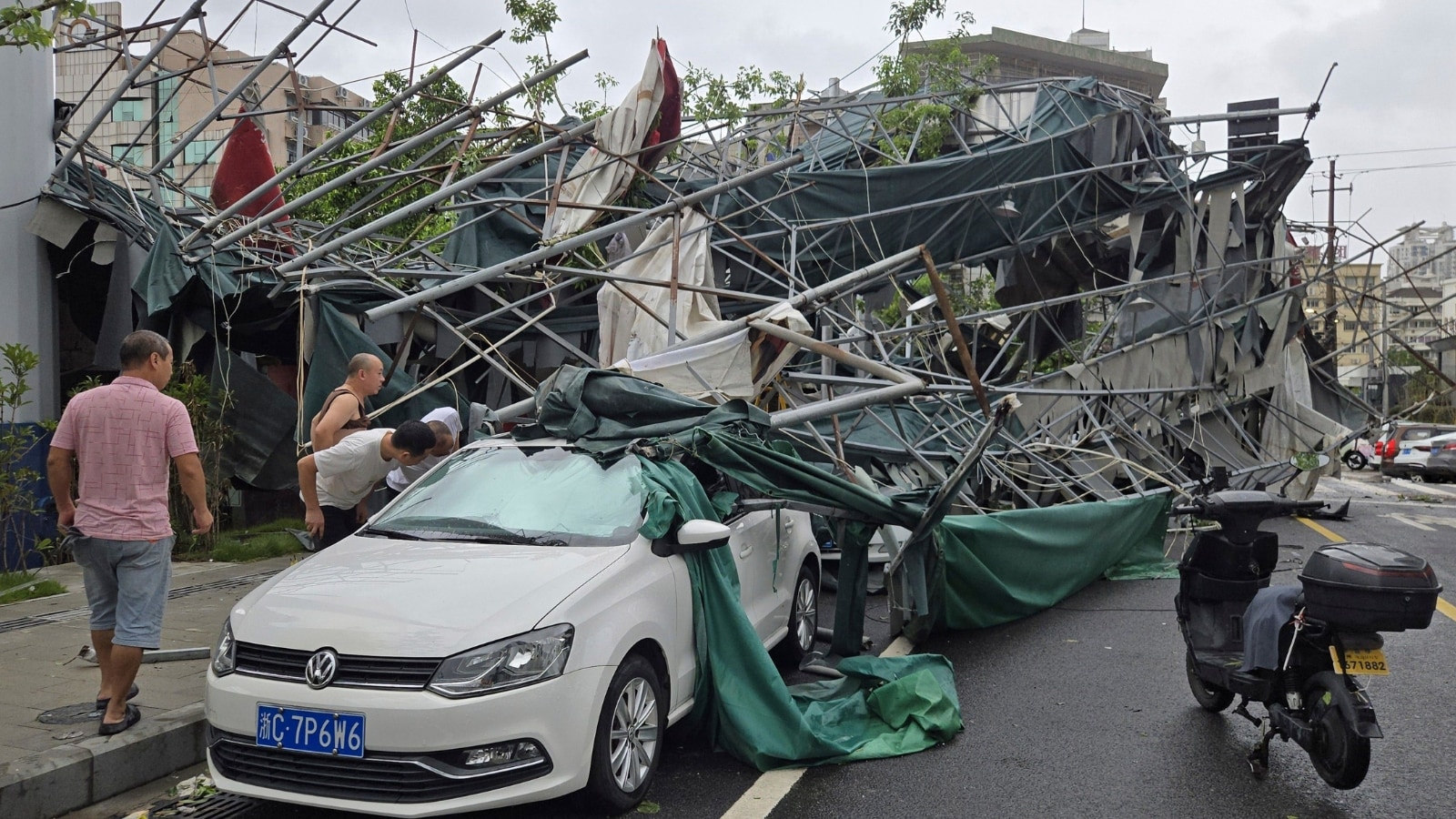
The rain over Shanghai did not fall. It struck.
There is a distinct sound when millions of tons of Pacific moisture collide with twenty-four million lives compressed into vertical glass. It is a dull, concussive roar, like gravel pouring endlessly down a corrugated iron chute. By mid-morning, the Bund had vanished. The Huangpu River rose up, greasy and swollen, spilling over granite promenades where tourists usually feed breadcrumbs to the wind.
Below the surface of the headlines, behind the cold meteorological designations, a single atmospheric engine was rewriting human plans. Tropical Storm Dolphin had arrived.
Consider a man named Chen. (Note: Chen is a composite persona drawn from hundreds of stranded passengers at Pudong International Airport during the storm.) Chen sits on a blue plastic linkage chair that smells faintly of floor disinfectant and old anxiety. His sneakers are soaked through, a dark, heavy gray. In his lap sits a dead smartphone, its battery choked out after six hours of refreshing a flight status app that only ever flashed a single, cruel word: Canceled.
He was supposed to be in Tokyo by midnight for a merger negotiation that had taken fourteen months to secure. Now, he is one of nine hundred small universes paused mid-flight across the sprawling tarmac of eastern China.
Nine hundred flights. That number is too large to feel. It is a statistic that glides off the human brain like grease on a hot skillet. But shrink that number down. Nine hundred metal tubes, each packed with weddings, funerals, job interviews, missed birthdays, and desperate medical emergencies, frozen in place.
The air traffic control towers at Pudong and Hongqiao went quiet, save for the rhythmic chatter of vectoring ground crews securing loose cargo against wind gusts topping fifty knots. Outside the terminal windows, massive Boeing and Airbus bodies sat squat and heavy, their wings flexing under the downward pressure of sheets of water so dense it turned the daylight the color of a wet slate shingle.
Floods do not respect concrete. That is the first lesson of a city built on a delta. Shanghai is a marvel of human stubbornness, a swamp wrestled into a glittering forest of skyscrapers by sheer engineering will. Yet, when Dolphin pushed storm surges up the estuary, the subterranean arteries of the metropolis blinked.
Subway stations turned into white-water flumes. Commuters who had stepped out of air-conditioned train cars twenty minutes earlier found themselves chest-deep in churning brown water, clutching briefcases like life rafts. Water is patient. It fills every parking garage, every basement archive, every neglected drainage grate, until the ground floor of human commerce simply ceases to exist.
Meteorologists called Dolphin a tropical storm, a classification that sounds manageable, almost polite. It lacks the apocalyptic gravity of a category-five hurricane. But terminology is a poor shield against geography. When a slow-moving system drops six inches of rain on a city whose water table is already level with the street, the category ceases to matter. The physics of saturation take over.
Back in the terminal, the human cost was measured in small, quiet indignities.
An elderly woman traveling alone to visit her grandchildren clutched a boarding pass that was rapidly dissolving into gray pulp in her sweaty palm. She didn't speak English, and the departure boards had long since stopped cycling through destinations, settling instead into a static, uniform sea of red cancellations. A young gate agent, barely twenty-four, with dark circles bruised beneath his eyes, knelt beside her. He didn't offer corporate boilerplate. He simply handed her a paper cup of lukewarm water and pointed toward a charging station that still had a pulse.
That is what weather reports miss. They tell you the wind speed in meters per second. They tell you the barometric pressure dropping in the eye of the vortex. They do not tell you about the smell of wet wool and stale coffee that hangs over a terminal housing ten thousand stranded souls. They do not record the collective, low-frequency hum of frustration that vibrates through a building when human momentum hits an absolute wall.
By afternoon, the storm's outer bands began to drag their heavy skirts inland, toward Jiangsu and Zhejiang, leaving behind flooded rice paddies and buckled rural roads. Trees lay sprawled across highways like broken matchsticks, their shallow roots exposed to the humid air.
In the heart of the city, traffic lights blinked erratically in the amber glow of power grid failures. Delivery drivers on electric scooters, wearing high-visibility yellow ponchos that billowed like sails, huddled beneath elevated expressway overpasses. They were the last economic bloodline moving through the flooded canyons, carrying plastic bags of hot noodles to people locked behind high-rise glass.
We build these magnificent, fragile cities and pretend we have conquered the sky. We draw flight paths in the air as though the atmosphere were a highway paved with invisible lines. We chart our lives by the minute, booking our exits and entrances across oceans with the casual arrogance of gods.
Then a tropical storm gathers its breath three hundred miles out at sea, drifts toward the coast, and reminds us that we are still tenants, living at the mercy of the wind.
The rain slackened slightly as evening approached, the torrential sheet downgrading to a miserable, persistent drizzle. Out on the tarmac, the wingtips of grounded jets finally stopped shimmering through the downpour.
Chen stood up from his plastic chair, his knees clicking in the sudden quiet of the terminal, and walked toward the window to watch the gray light die over the flooded runway.