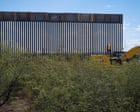
The federal courtroom battle over the remote Big Bend region of West Texas exposes a stark structural contradiction in modern border policy. When a federal district judge briefly halted construction on miles of steel bollards and patrol roads slicing through the rugged desert and national parkland, headlines framed the order as a temporary check on executive power. Yet the underlying mechanics of the dispute reveal a system where statutory authority designed for high-traffic migration corridors is deployed across landscapes with some of the lowest apprehension rates on the southern border.
For months, bulldozers and heavy machinery tore through terrain long treasured for its isolation. The Department of Homeland Security, utilizing statutory powers granted under decades-old immigration legislation, bypassed standard environmental and historic preservation reviews. This mechanism hinges on a specific legislative phrase: the authority to waive federal laws in designated areas of high illegal entry.
Herein lies the central friction point of the litigation. According to court filings, annual apprehensions across the massive Big Bend sector historically hover between a tiny fraction of a percent and roughly two percent of total border-wide crossings. Plaintiffs—including local river guides, conservation groups, and regional stakeholders—argued that applying sweeping waiver powers to a zone defined by sheer geographic barriers and sparse traffic stretches the statutory text past its breaking point.
The government countered with a different operational reality. Federal filings maintained that leaving hundreds of miles of rugged terrain unsealed invites shifting smuggling routes, forcing enforcement assets to play a perpetual game of geographic catch-up. Furthermore, administrators pointed to the immediate financial toll of judicial interference, citing daily construction suspension costs running into hundreds of thousands of dollars while equipment sat idle.
When the legal pendulum swung to the Supreme Court, the high court temporarily lifted the lower injunction, allowing heavy construction to roar back to life while the deeper questions of administrative authority wind through appellate review. The unsigned order underscored a recurring reality of modern infrastructure litigation: the judiciary is frequently reluctant to block sweeping executive projects on statutory interpretation grounds when national security and border management claims are invoked.
Beyond the dueling legal briefs lies a permanent alteration of a fragile ecosystem. Big Bend is not an urban checkpoint or a flat urban-adjacent boundary line; it is a complex tapestry of arid canyons, river corridors, and public lands where infrastructure projects leave permanent scars. Contractors pushing roads up steep grades and erecting thirty-foot steel barriers introduce artificial fragmentation into habitats that have remained relatively undisturbed for generations.
The administrative playbook relied upon by successive executive administrations treats geographic divergence as a secondary concern. By prioritizing speed and uniformity over localized environmental assessment, the federal apparatus ensures that remote sectors receive the exact same architectural solutions applied to high-volume metropolitan crossing points. Whether that uniform approach effectively curtails illicit transit through terrain already rendered perilous by sheer topography remains the central, unresolved question of the ongoing litigation.
As heavy machinery continues its advance across the West Texas horizon, the legal challenges grinding through the courts serve as a reminder that the physical barrier is only half the battle. The broader contest concerns how far executive power can stretch statutory definitions of crisis to reshape terrain that federal laws were originally enacted to protect.



