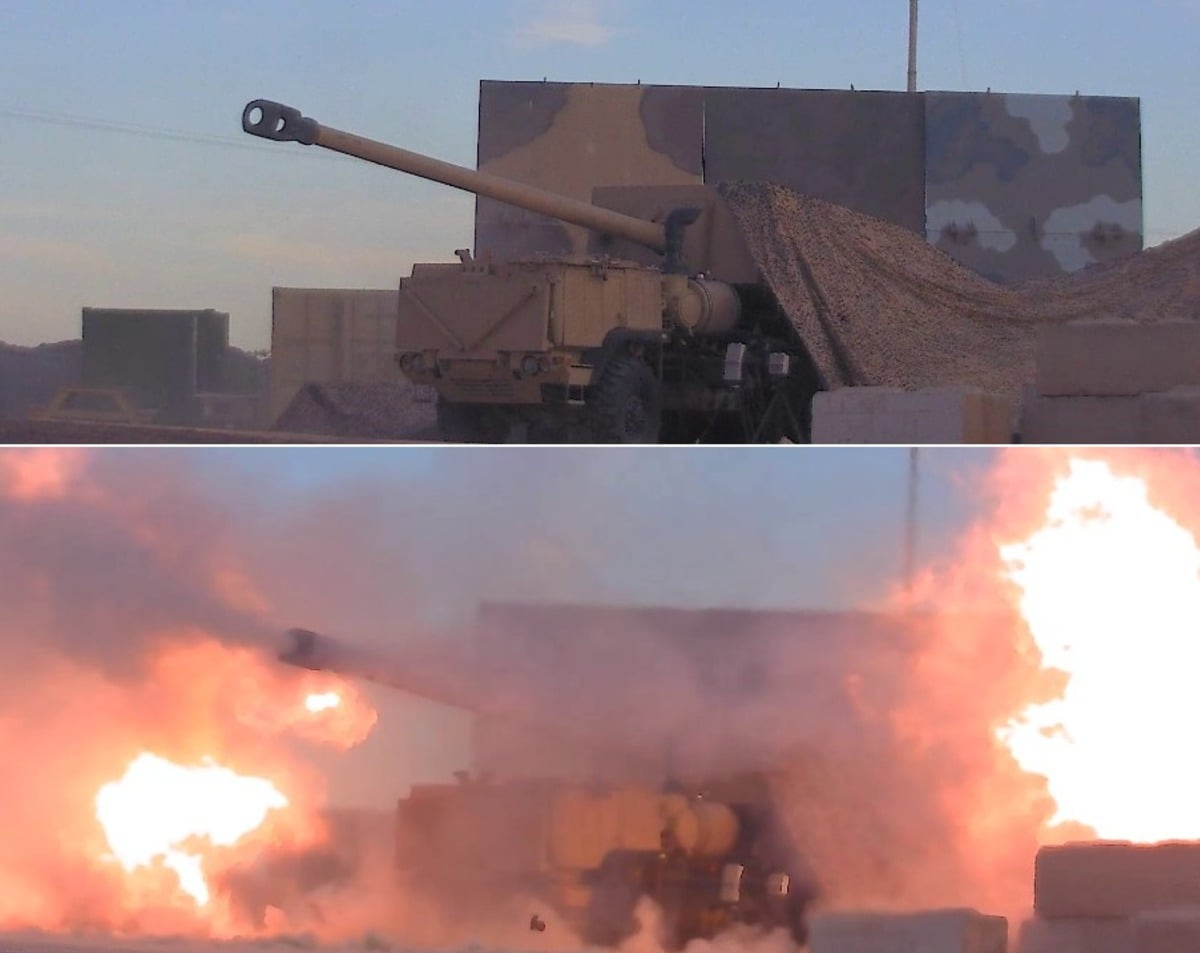
The traditional image of battlefield artillery is fundamentally broken. For decades, military planners relied on massive, tracked howitzers or towed big guns that required entire crews to stand out in the mud, handling heavy shells by hand. Those days are officially over. If you want proof, look no further than the recent live-fire footage circulating of the Multi-Domain Artillery Cannon, or MDAC, developed by BAE Systems.
It looks less like a traditional weapon of war and more like something out of a science fiction movie. Mounted on a heavy wheeled chassis, this automated system just showed the world what happens when you combine heavy 155 mm firepower with the speed, digital precision, and automation needed to survive a modern conflict.
The defense industry has been talking about updating ground systems for years. But seeing a fully automated wheeled cannon roll into position, fire high-velocity rounds, and prepare to move in seconds hits differently. It changes how we think about protecting troops, countering drones, and winning the artillery duel.
The Reality Behind the Wheeled Transformation
People often ask why the military is ditching tracked vehicles for wheeled ones. The answer comes down to speed and survival. In modern warfare, as soon as an artillery shell leaves the barrel, enemy radar tracks its trajectory. Within a minute, counter-battery fire is usually heading back toward the launch site.
If you are slow, you are dead. Tracked howitzers are heavily armored but notoriously sluggish on roads and mechanically complex to maintain. A wheeled platform can hit highway speeds, deploy instantly, fire its payload, and drive away before the first enemy shell lands.
The MDAC system takes this concept to the extreme. This isn't just an offensive weapon meant to level enemy lines miles away. It is a multi-domain platform designed to target things on the ground and in the air. BAE Systems engineered it to fire Hypervelocity Projectiles, which travel at supersonic speeds to intercept fast-moving threats like cruise missiles and large drone swarms.
Why Automation is the Real Priority
The most striking part of the live-fire video isn't the explosion at the muzzle. It is the complete lack of humans standing anywhere near the gun when it fires.
- Complete Crew Protection: Operators sit inside an armored cabin, completely isolated from the noise, toxic fumes, and incoming fire. Everything is handled via digital touchscreens and automated loading mechanics.
- Insane Fire Rates: Traditional crews get tired. Mechanical autoloaders don't. The system can cycle through heavy 155 mm ammunition with mechanical precision, maximizing firepower in short bursts.
- Minimal Footprint: You don't need a dozen soldiers to run a single gun anymore. A tiny crew can manage the entire system, meaning fewer lives are put at risk on the frontline.
The Tech Under the Hood
The magic happens when you couple a heavy gun barrel with a digital architecture. BAE Systems built this platform around an open digital fire control system. Instead of relying on old-school radio commands and manual coordinates, the cannon integrates directly with modern sensor networks, satellite data, and multi-function precision radars.
When an enemy drone or incoming missile is detected by a radar system miles away, the data transfers directly to the cannon. The automated turret calculates the intercept angle, aims, and fires a guided projectile within seconds. The round itself uses internal fins and a real-time data link to adjust its flight path in mid-air, chasing down targets at speeds reaching 1,300 meters per second.
This approach completely flips the economics of modern air defense. Right now, militaries are using million-dollar surface-to-air missiles to shoot down cheap kamikaze drones. It is a financial disaster. Firing guided artillery shells from a high-capacity magazine costs a fraction of the price, making it a sustainable way to fight off sustained aerial attacks.
The Logistics Nightmare Nobody Talks About
While the video footage looks impressive, operating a massive wheeled cannon comes with serious real-world trade-offs. Heavy wheeled vehicles struggle in deep mud compared to tracked counterparts. If you operate in thick, bogged-down terrain, wheels can turn into a massive liability.
Then there is the issue of barrel wear. Firing hypervelocity rounds at supersonic speeds creates immense heat and friction. The physical toll on a 155 mm barrel is severe. Military logistics teams will have to replace these barrels much more frequently than those on standard howitzers, creating a heavy burden on supply lines during a prolonged conflict.
Moving Toward a Fully Networked Battlefield
If you want to understand where military technology is heading, look at how these systems connect to each other. Isolated weapons are useless. The future belongs to platforms that talk to everything else in the sky and on the ground.
Militaries are actively shifting away from standalone hardware toward interconnected ecosystems. The goal is to have an infantry soldier with a tablet, an airborne drone, and a wheeled cannon miles away operating on the exact same digital map. When the drone spots a target, the cannon receives the coordinates instantly, without a single human voice needing to repeat coordinates over a static-filled radio.
If you are tracking defense tech trends, the next step is keeping an eye on how these automated wheeled systems perform in joint allied exercises over the next year. Watch how they integrate with existing radar infrastructure and whether the automated loading systems hold up under brutal field conditions. The hardware is impressive, but the software running it will ultimately determine who wins the next major conflict.