The air inside the lecture hall was heavy with the smell of old paper and damp wool. Outside, rain streaked the windows of the Ivy League campus, but inside, the silence was absolute. A professor stood at the podium, his notes untouched. For decades, this room had been a factory of consensus. The syllabus was predictable. The moral boundaries were clearly drawn. The generation before had sat in these exact wooden chairs, nodded at the same historical interpretations, and walked straight into jobs at the State Department, the think tanks, and the major newsrooms.
Then, a hand went up in the back row.
It wasn't a question about the exam. It was a challenge to the foundational narrative of American foreign policy. The student asking it wasn't an agitator from the fringe; she was the valedictorian of her high school, the daughter of a corporate lawyer, and an avid consumer of data. She didn’t just disagree. She brought receipts.
A quiet seismic shift is rattling the American establishment. For over half a century, a specific, bipartisan consensus on Israel and Palestine remained virtually untouchable within the halls of American power. To question it was a career death wish. Today, that consensus is not just fraying; among the nation's youth, it has utterly collapsed. The elite gatekeepers who managed this narrative for decades have lost their grip on the one demographic they needed most to secure their legacy: the future.
Historian Rashid Khalidi recently pointed out that the pro-Israel elite in the United States have lost the battle for the minds of the youth. This is not a temporary blip or a standard bout of campus rebellion. It is a fundamental realignment of American cultural and political gravity.
To understand how we got here, we have to look past the screaming headlines and the chaotic television news loops. We have to look at the quiet transformation of how young people see the world.
The Architecture of the Old Consensus
For generations, the American understanding of the Middle East was constructed like a classic Hollywood film. The roles were cast, the script was written, and the moral arc was predetermined. This narrative was forged in the shadow of the Second World War and reinforced through decades of carefully managed media representation.
Think of it as an invisible structural beam in a house. You don't see it every day, but it holds up the roof. That beam was the unquestioned assumption that American interests and Israeli policy were inextricably linked, morally and strategically.
This view was maintained by an incredibly effective apparatus. It wasn't a conspiracy; it was an ecosystem. It comprised elite universities, heavily funded Washington think tanks, bipartisan political action committees, and major media networks. Together, they established the boundaries of acceptable debate. If you stayed within those boundaries, you were deemed "serious." If you stepped outside them, you were labeled radical, naive, or worse.
But ecosystems require specific conditions to survive. They need isolation. They need control over the inputs.
For a long time, that control was absolute. A student in 1995 opened a textbook, watched the evening news on one of three major networks, and read the local paper. The information pipeline was narrow, predictable, and easily policed. The historical narrative presented was clean, stripped of the messy, violent contradictions that defined the actual reality on the ground in Gaza and the West Bank.
Then came the internet. Then came the smartphone. The pipeline burst.
The Death of the Gatekeeper
Consider the experience of a college student today. They do not wait for the morning paper to find out what happened on the other side of the world. They do not trust the sanitized language of press briefings.
Instead, they open an app and see a peer—someone their own age, speaking fluent English—broadcasting live from the rubble of a neighborhood. They see the raw, unedited, terrifying reality of military occupation in real-time. There is no anchor to soften the blow. There is no spokesperson to provide "context" that smooths over the horror.
This immediacy has destroyed the authority of the traditional gatekeepers. When a government official stands at a podium and offers a practiced, bureaucratic defense of an airstrike, and a student can simultaneously scroll through high-definition footage of the human cost of that exact strike, a profound cognitive dissonance occurs.
The student does not conclude that the situation is complicated. They conclude that the official is lying.
This shift has exposed a massive generational divide in how information is verified. Older Americans tend to trust institutions. They believe that if a story is in a major newspaper, it has undergone a rigorous process of validation. Younger Americans view those exact institutions with deep suspicion. They see them as tools of a corrupt status quo. For Gen Z and millennials, trust is horizontal, not vertical. It is built through perceived authenticity, direct witness, and decentralized networks.
The pro-Israel establishment relied heavily on vertical trust. They spent billions securing the allegiance of university presidents, politicians, and media executives. They built an formidable fortress at the top of society.
But while they were busy fortifying the roof, the ground beneath the building washed away.
The Language of the Unconvinced
It is a mistake to view the current campus protests and political shifts as merely emotional reactions. That is the comforting myth that the older generation tells itself to avoid facing the depth of their failure. They claim the youth are being manipulated by social media algorithms or outside agitators.
The reality is far more uncomfortable for the establishment: young people are applying the very tools of analysis that elite universities taught them to use.
Over the past two decades, American education has placed a heavy emphasis on frameworks of human rights, international law, intersectionality, and anti-colonialism. Students have been trained to look at power dynamics, to question who holds the gun and who is behind the wall.
When these students look at Israel and Palestine, they do not see the historical traumas of the 20th century that shaped their parents' worldviews. They do not see a fragile democracy surrounded by hostile states. They see one of the most technologically advanced militaries in the world enforcing a permanent, decades-long occupation over a stateless, disenfranchised population.
They are using the vocabulary provided by the modern academy to critique the actions of the state. They talk about international humanitarian law, Geneva Conventions, systemic oppression, and apartheid. These are not just buzzwords to them; they are the intellectual metrics by which they judge the world.
The old talking points simply fail to register against this framework. When the establishment uses rhetoric from the 1970s or 1990s, it sounds to young ears like a foreign language. It is a dialect of Cold War strategy and historical exceptionalism that feels completely irrelevant to a generation facing climate collapse, economic precariousness, and a profound skepticism of state violence.
The Costs of Confrontation
The reaction from the elite to this loss of control has been marked by panic. Because they can no longer win the argument, they have turned to coercion.
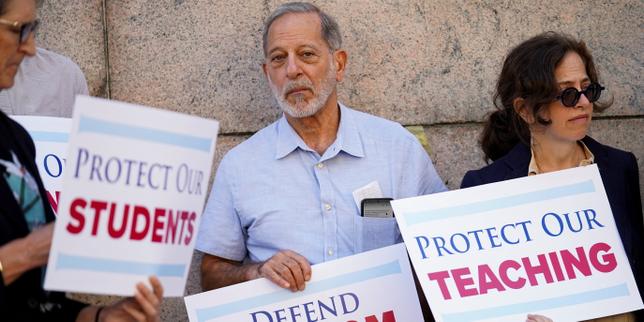
We have seen university donors withdraw hundreds of millions of dollars to force the hands of administrations. We have seen police forces in riot gear sweeping through peaceful campus greens, arresting students and faculty alike. We have seen blacklists created to deny employment to young people who signed petitions or spoke out.
This heavy-handed response has backfired spectacularly.
To a twenty-year-old student, watching a university president summon militarized police to arrest classmates for protesting a war does not demonstrate moral clarity. It demonstrates moral bankruptcy. It confirms their worst suspicions: that the institutions claiming to value free speech and critical thinking actually value order, funding, and political compliance above all else.
Every arrest, every cancelled commencement speech, and every threatened career has served to radicalize the broader student body. It has transformed a specific foreign policy debate into a domestic struggle over civil liberties and the right to dissent. The establishment thought that by turning up the pressure, they could force the youth back into line. Instead, they shattered whatever lingering legitimacy they possessed.
A New Political Calculus
The consequences of this shift are already rippling through the political landscape, and they will resonate for decades. The political class in Washington is currently operating on an expiration date.
The political figures who dominate the current landscape—leaders whose worldviews were formed during the Cold War or in the immediate aftermath of the 1967 war—are aging out. Behind them is a demographic tidal wave of voters who feel absolutely no emotional or historical allegiance to the Israeli state.
This is not a partisan issue. The shift is happening across the political spectrum, though it is most pronounced on the left. Young Democrats, a demographic crucial for the party's future survival, are overwhelmingly sympathetic to the Palestinian plight. They view the unconditional military and financial support provided by the United States not as a strategic necessity, but as complicity in human suffering.
Political strategists are terrified, and they should be. You can win an election by mobilizing your base, but you cannot sustain a foreign policy consensus when the entire pipeline of future leaders rejects its fundamental premises. The young lawyers, journalists, diplomats, and congressional aides entering the workforce today possess a radically different view of America's role in the world than the people they are replacing. They are less willing to accept double standards. They are more likely to demand that international law be applied universally, rather than selectively.
The View from the Quad
The rain eventually stopped on that Ivy League campus. The lecture hall emptied out. The students gathered on the damp grass of the quad, talking in low, intense voices.
If you look closely at these gatherings, you see something that terrifies the establishment more than any slogan or banner: diversity. These are not isolated groups of activists. These are coalitions. They are Black, white, Hispanic, Asian, Jewish, Muslim, and queer students standing together. They have integrated the Palestinian struggle into a broader, shared narrative of human dignity and resistance to unaccountable power.
The old strategy of division—of painting critics of Israeli policy as isolated extremists—no longer works when the critics look exactly like the diverse, multicultural future of America itself.
The pro-Israel elite lost the youth because they treated a human problem as a public relations problem. They thought they could fix the issue with better branding, more aggressive lobbying, and stricter campus speech codes. They failed to realize that the youth didn’t misunderstand the situation. They understood it all too well.
The ivy walls are still standing, but they no longer protect the secrets they used to. The narrative has broken open, and no amount of money, political pressure, or police force can put it back together. The future has already made up its mind.