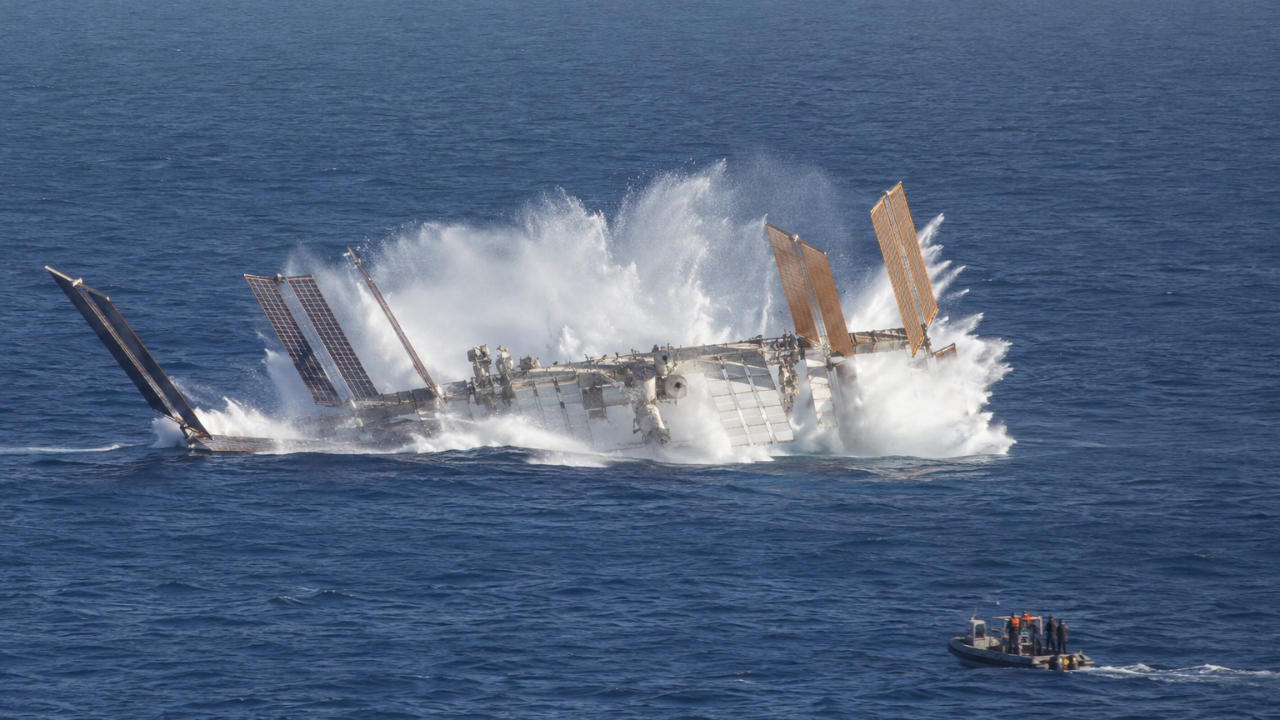
We've spent decades treating the deep ocean like a giant, invisible trash can for space hardware. Whenever a massive satellite, a spent rocket stage, or a defunct space station needs to retire, space agencies aim for a specific bullseye in the South Pacific. It's called Point Nemo. It's the most remote spot on Earth, sitting more than 1,600 miles away from any human settlement.
NASA plans to send the 420-ton International Space Station (ISS) down a fiery path to this exact spot in early 2031. They even handed Elon Musk's SpaceX an $843 million contract to build a massive United States Deorbit Vehicle (USDV) explicitly designed to push the football-field-sized station out of orbit.
But this time, the old "out of sight, out of mind" strategy isn't going down smoothly.
A growing chorus of marine scientists, legal experts, and environmental groups are calling foul. Mark Spalding, president of the Washington, D.C.-based conservation group The Ocean Foundation, went public with major concerns, pointing out a massive structural gap in international law that essentially gives space agencies a free pass to dump toxic metallic junk into the high seas without consequences.
The core conflict is simple. NASA is focused on saving human lives by ensuring a massive piece of space junk doesn't flatten a neighborhood. Marine advocates are focused on the long-term, unstudied consequences of dropping tons of titanium, aluminum, and toxic residue straight onto the seafloor. Both sides have a point, but right now, the ocean is losing.
The Brutal Physics of the World's Largest Reentry
Let's look at the numbers. The ISS is completely unmanageable if left to decay naturally. It orbits about 260 miles above us, constantly fighting atmospheric drag. Without regular boosts from docking cargo ships, it falls.
NASA evaluated every alternative. They looked at boosting it to a higher "graveyard orbit," but it requires too much fuel—hundreds of times more than a controlled deorbit. They looked at breaking it apart in space, but that requires dozens of dangerous spacewalks by astronauts who would have to manually disassemble highly pressurized, aging modules.
So, the plan is locked in. Starting around 2028, operators will let the station's altitude slowly drop. Then, in 2031, the SpaceX-built deorbit vehicle will fire its engines for a final, aggressive braking maneuver.
The station will rip through the upper atmosphere at roughly 17,000 miles per hour. The friction will generate temperatures hot enough to vaporize aluminum plumbing, solar arrays, and standard structural beams.
But the ISS isn't just made of soft metals. It contains heavy titanium fuel tanks, dense stainless steel docking mechanisms, and massive high-strength alloy structures. NASA openly admits that a significant percentage of the station will survive the fire. We're talking about tens of tons of jagged, scorched metal slamming into the Pacific Ocean at terminal velocity, creating a debris field that could stretch across 3,700 miles of open water.
The Blind Spot in Space Law
If a piece of the ISS falls on a house in Tokyo or Berlin, the legal framework is ironclad. Under the Space Liability Convention of 1972, the launching nation is absolutely liable for damages. You drop space junk on a country; you pay for it.
Just look at what happened when a piece of an old ISS battery pallet failed to burn up and smashed through a roof in Naples, Florida. The family sued NASA.
But the high seas belong to no one. Because Point Nemo sits in international waters, there's no sovereign government to claim property damage. Under current space law, targeting the open ocean means space agencies face zero legal obligations to clean up their mess, test the water for toxic chemical runoff, or pay a single cent in environmental remediation.
This legal void is clashing directly with modern ocean conservation efforts. Critics are pointing to the newly negotiated United Nations High Seas Treaty, also known as the BBNJ Agreement. This treaty legally binds nations to conduct thorough environmental impact assessments for any major activity in international waters where the ecological consequences are unknown.
Dropping a historic, 400-ton orbital laboratory loaded with decades of chemical residues, batteries, and exotic composite materials onto the seafloor fits that definition perfectly.
What Actually Happens to the Seafloor
Space agencies often defend Point Nemo by pointing out that it's a biological desert. The region sits inside the South Pacific Gyre, a massive rotating ocean current that blocks coastal nutrients from entering the area. Combine that with intense ultraviolet radiation at the surface, and you get incredibly low biodiversity.
But "low biodiversity" isn't zero biodiversity.
Deep-sea oceanographers have spent years discovering that even the most barren-looking abyssal plains host highly specialized ecosystems. Microbes, deep-sea crabs, and strange bottom-dwelling organisms rely on the slow fall of organic matter from the surface.
When a chunk of titanium alloy hits the seafloor, it doesn't just sit there innocently. Over decades, seawater corrodes these metals. Scientists are worried about heavy metal leaching, toxic propellant residues like hydrazine or nitrogen tetroxide that might survive inside sealed plumbing, and the physical destruction of benthic habitats.
We also have proof that the pollution starts long before the metal hits the water. Scientists from the National Oceanic and Atmospheric Administration (NOAA) verified that vaporized aluminum from reentering satellites is already lingering in our upper atmosphere. When the ISS burns, it will leave a massive streak of metallic ash suspended in the stratosphere, with completely unknown consequences for solar radiation reflection and ozone health.
The Real Issue is the Precedent
If the ISS were a one-time event, the marine ecosystem could probably absorb the blow. The problem is that the ISS deorbit isn't an isolated incident. It's the tip of a massive iceberg.
We're living through an unprecedented commercial space boom. Tens of thousands of low-Earth orbit satellites are being launched by private companies. These satellites have short lifespans—often just five to seven years. The industry's current gold standard for sustainability is "design for demise," which means engineering satellites to burn up completely in the atmosphere.
But even when they burn, the vaporized material stays in the environment. And for the larger structures—commercial space stations, heavy cargo ships, and massive rocket boosters—Point Nemo will remain the default dumping ground.
If we don't force space agencies to take accountability for the ocean footprint of the ISS now, we set a permanent precedent that the high seas are a lawless, free-for-all garbage dump for the space sector.
The Needed Course Correction
NASA isn't going to change its plan to deorbit the ISS. The risk of an uncontrolled reentry over a populated city like New York or Beijing is a humanitarian nightmare that nobody will gamble on. The station is coming down, and it's coming down in the water.
But the space community can no longer ignore the environmental cost of its operations. True space sustainability means looking down, not just up.
If you want to track this issue or push for actual accountability before the 2031 splashdown, look into the public demands being made by groups like The Ocean Foundation. They're pushing for three immediate, actionable changes:
- Full Material Disclosure: Forcing NASA and its international partners to publish a complete, line-by-line inventory of every chemical, composite, and heavy metal alloy expected to survive reentry and reach the seafloor.
- Comprehensive Environmental Impact Assessments: Treating the South Pacific splashdown zone with the same rigorous ecological scrutiny required for an offshore oil rig or an undersea cable project.
- A Legal Update to the London Protocol: Amending global marine pollution treaties to explicitly cover deliberate spacecraft disposal, closing the loophole that allows the high seas to be treated as an unpaid graveyard.
Space exploration has pushed human boundaries for generations, but we can't protect our orbital environment by destroying our marine environment. The clock is ticking toward 2031, and the space industry needs to clean up its legal and ecological act before the world's most famous spacecraft makes its final dive.