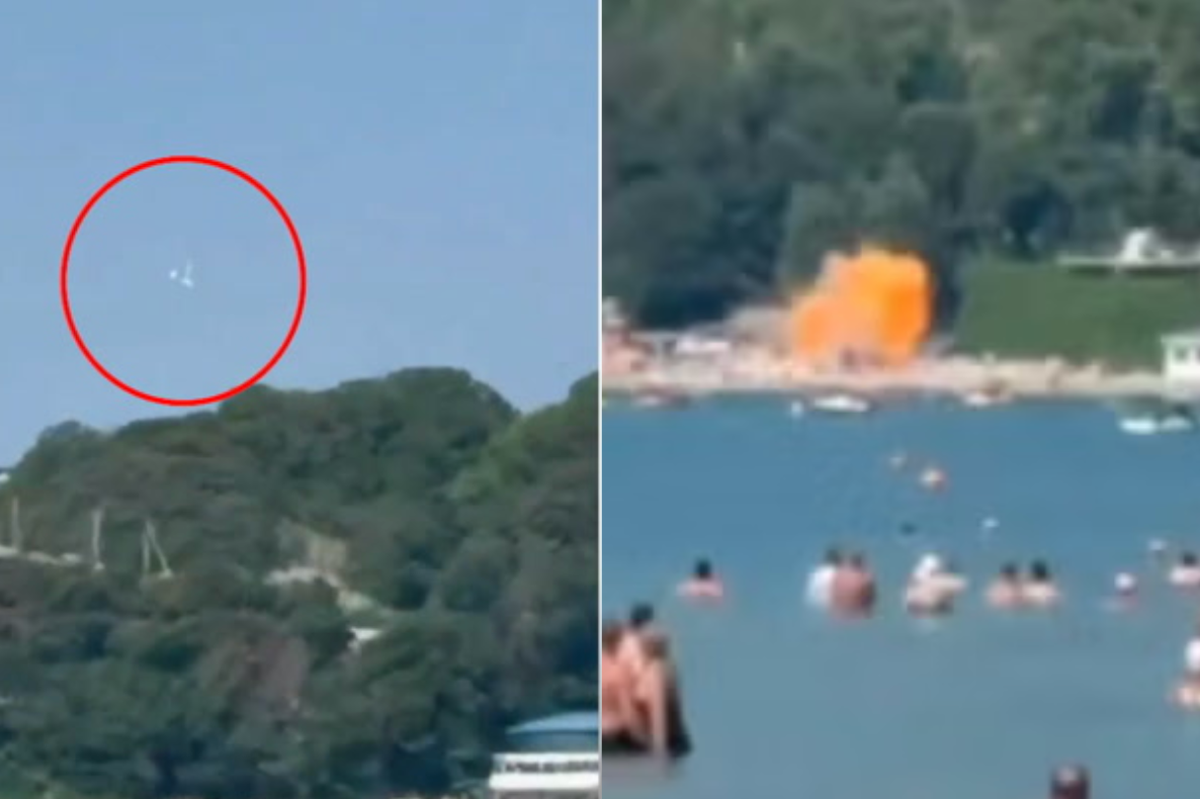
The standard media narrative surrounding the tragic strike on a crowded beach in Sevastopol is built on a foundation of lazy moral outrage and historical amnesia. When reports surfaced that a cluster-munition-tipped ATACMS missile detonated over civilians in Crimea, killing four including children, and injuring over a hundred, the automatic reflex of Western wire services was simple: condemn the tragedy as a senseless atrocity devoid of strategic context, or echo unverified Ministry of Defense press releases about targeting radar installations.
Both reactions miss the structural reality of modern total warfare.
Strip away the emotional manipulation, and you find a much colder, more uncomfortable truth. Modern industrial conflicts do not afford the luxury of clean battlefields. When a state integrates military command nodes, logistics hubs, and air defense batteries directly into dense urban tourism zones, the civilian shield ceases to be an accident of geography. It becomes a doctrine.
The Geography of Human Shielding
Let us define terms clearly. Crimea is not a civilian resort island operating under normal geopolitical conditions. Since 2014, it has functioned as the primary logistical staging ground, naval headquarters, and air power springboard for the Southern Military District of the Russian Federation. Every bridge, port, highway, and airfield on the peninsula serves a direct military function.
Yet, for years, the tourism apparatus has been actively weaponized by the occupying administration. Commercial sunbathers share coastlines with S-400 battery emplacements, radar arrays, and military barracks. When military planners target a radar installation or a missile staging area within a few kilometers of a populated coastline, they face a grim calculus governed by international humanitarian law and the brutal physics of high-speed ordnance.
The lazy consensus claims that striking near a beach is inherently disproportionate. This ignores the legal framework of proportionality under Additional Protocol I of the Geneva Conventions. Proportionality does not mean zero civilian casualties; it balances the anticipated military advantage against the expected incidental loss of civilian life. If an active military command center or air defense asset is located adjacent to a civilian gathering, the responsibility for those civilian lives rests primarily on the belligerent that placed military objectives within civilian areas.
Military analysts who ignore this dynamic are playing a dangerous game of PR management rather than strategic analysis. I have spent years analyzing targeting matrices in conflict zones, and the uncomfortable reality is that modern air defense interception changes the physics of warfare entirely.
The Physics of Interception and the Cluster Munition Fallacy
The Sevastopol incident was unique not because a missile was fired, but because of how it was intercepted. The weapon in question was an MGM-140 ATACMS equipped with submunitions—hundreds of pomegranate-sized bomblets designed to saturate a wide area.
When Russian air defense systems engaged the incoming missile at high altitude, the interceptor missile shredded the incoming projectile mid-air. What followed was pure physics, not malice. The submunitions, released from their housing by the kinetic disruption of the interception, rained down indiscriminately over the coastline below.
Here is where the technical consensus breaks down. Critics of the strike scream about the use of cluster munitions in populated areas. They are right to condemn the weapon class—cluster munitions are notoriously sloppy and leave unexploded ordnance that maims generations. But let us look at the mechanics honestly: ATACMS variants with submunitions are designed to destroy dispersed targets like parked aircraft, radar dishes, and vehicle columns over wide footprints.
If a missile is intercepted ten miles up, its payload disperses according to momentum and wind shear. The civilian casualties on the beach were the tragic result of an air defense interception occurring directly above a densely populated civilian zone.
Imagine a scenario where a ballistic missile is heading toward a military base nestled beside a residential neighborhood. The defender fires an interceptor. The debris footprint expands exponentially. Who bears the moral and legal liability for the falling shrapnel? The military that built the base next to the neighborhood, or the attacker trying to neutralize a legitimate threat?
In conventional media coverage, this nuance is entirely erased. The narrative demands a simplistic binary: innocent sunbathers versus ruthless attackers. Real warfare is a relentless chain of grim second- and third-order effects.
The Information Operations Playbook
Why did this specific incident receive wall-to-wall coverage while identical or deadlier strikes on Ukrainian cities go through daily rotations of normalization? Because the location was Crimea.
Moscow's information apparatus understood the propaganda value instantly. Framing the strike as an intentional terror attack on sunbathers serves a dual purpose: it shores up domestic support for a protracted war of attrition by painting the adversary as uniquely depraved, and it pressures Western capitals to restrict the use of long-range precision weapons.
We have seen this playbook before. Every time military supply lines are successfully disrupted by Western-supplied munitions, the narrative pivots immediately from military loss to civilian grievance. It is an effective strategy because human empathy is easily weaponized. Show a weeping parent on a beach, and the average television viewer stops asking operational questions about why anti-air batteries are parked next to a children's playground.
Let us be brutally honest about the hypocrisy here. War is a mechanism of mass destruction. Every single day, artillery duels across the Donbas reduce apartment complexes to dust. FAB glide bombs obliterate entire city blocks in Kharkiv and Sumy. Yet, a single intercepted missile scattering submunitions over a disputed tourism zone triggers emergency diplomatic demarches because it punctures the illusion that the occupier's homeland is immune to the costs of its own aggression.
The Strategic Reality No One Wants to Voice
If you launch a war of conquest, you forfeit the right to compartmentalize your territory into safe zones and combat zones. Logistics are combat. Infrastructure is combat. Tourism revenue generated in an annexed territory under military occupation is an economic pillar of the war machine.
To suggest that Ukrainian forces should simply refrain from striking military targets in Crimea because the occupying power chooses to interleave them with civilian leisure spots is to enshrine a perverse tactical advantage. It creates an invulnerability shield: park your tanks behind a hospital, your radar on a beach, and your ammunition depots in a residential suburb, and you can wage war with impunity.
No serious military strategist accepts that premise.
The contrarian truth of the Sevastopol beach strike is harsh: it was a tragic, predictable consequence of total war fought in a theater where civilian and military infrastructure have been deliberately fused by design. Until the underlying occupation ends, incidents of catastrophic collateral damage will remain a feature, not a bug, of the landscape.
Stop looking for monsters and heroes on a battlefield. Look only at the lines of supply, the geometry of interception, and the calculated choices of commanders who use their own people as human speed bumps.