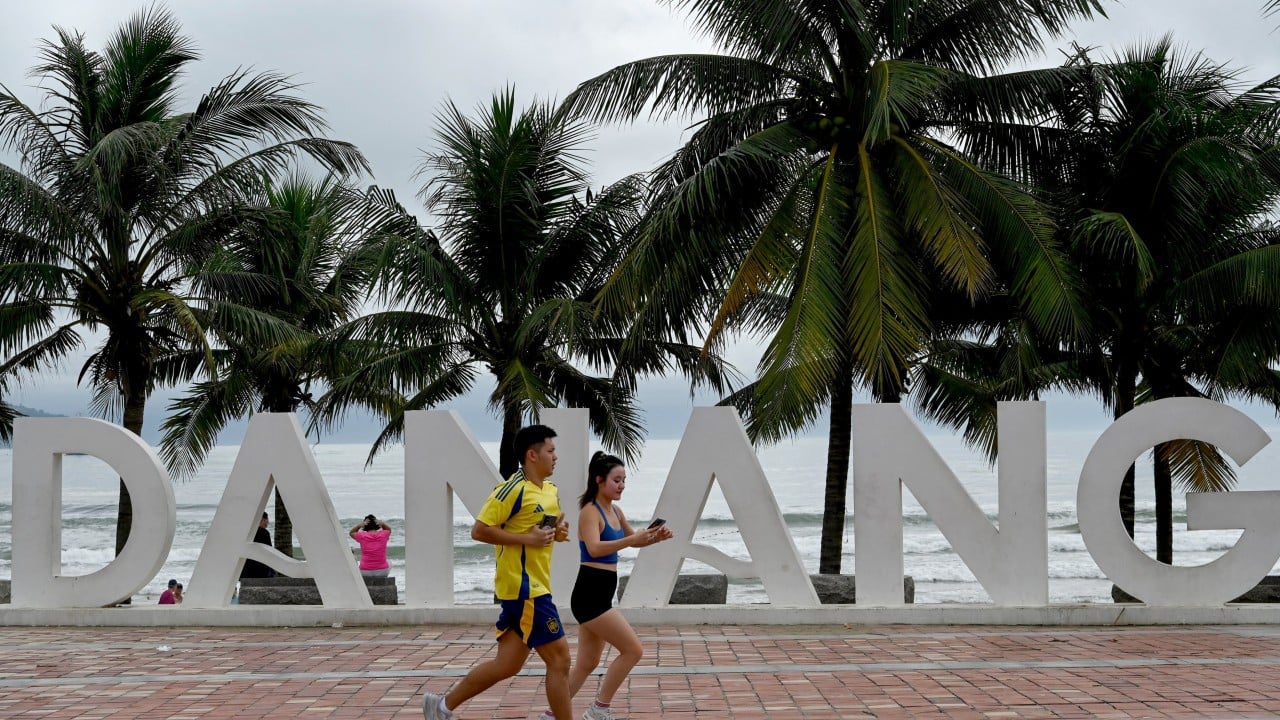
The transformation of Da Nang from a transit point for the ancient town of Hoi An into a "South Korean province" is not a coincidence of aesthetics, but a calculated alignment of infrastructure, currency arbitrage, and corporate clustering. To understand why Da Nang became the primary node for South Korean outbound travel, one must look past the beach photos and examine the underlying mechanics of supply chain tourism and the "K-V Model" (Korean-Vietnamese economic integration).
The concentration of South Korean visitors in Da Nang—peaking at over 50% of the city’s international arrivals in recent years—functions through a self-reinforcing loop. South Korean conglomerates like Samsung and LG established massive manufacturing bases in northern and southern Vietnam. This industrial footprint necessitated a secondary layer of service infrastructure, including direct flight paths and hospitality standards tailored to Korean preferences. Da Nang, situated geographically between the industrial poles of Hanoi and Ho Chi Minh City, became the strategic beneficiary of this corporate spillover.
The Three Pillars of the Da Nang Korean Monopoly
The dominance of this specific demographic is sustained by three structural advantages that competitors like Nha Trang or Phu Quoc have yet to replicate with the same density.
1. The Short-Haul Aviation Pipeline
Aviation logistics dictate the flow of tourism more than cultural affinity. The flight time from Seoul Incheon (ICN) to Da Nang (DAD) is approximately 4 hours and 30 minutes. This falls within the "critical short-haul window" for the South Korean market, which is characterized by a high-intensity work culture and limited vacation windows.
The entry of low-cost carriers (LCCs) such as Jeju Air, Jin Air, and T'way Air created a price war that dropped ticket costs to a level where a weekend in Da Nang became cheaper than a domestic trip to Jeju Island. This creates a "Cost Function of Accessibility" where the marginal cost of international travel is lower than the domestic alternative, despite the increased distance.
2. Infrastructure Homogeneity and Trust Networks
South Korean tourists operate within a high-trust, low-friction ecosystem. In Da Nang, this is manifested through "The Korean Stack":
- Payment Systems: Widespread adoption of Korean-friendly POS systems and the presence of Korean banks.
- Linguistic Saturation: A service workforce that prioritizes Korean language proficiency over English, specifically in the Son Tra and Ngu Hanh Son districts.
- Culinary Continuity: The density of authentic Korean cuisine (K-Food) allows travelers to experience a tropical environment without the "gastronomic stress" of radical diet changes.
3. The Golf-Resort Matrix
For the affluent South Korean male demographic and the growing "silver economy" (retirees), Da Nang offers a specific value proposition: the concentration of luxury golf courses designed by international names (Nicklaus, Norman) within a 30-minute radius of the city center. The green fees in Da Nang, while high by local standards, represent a 60% to 70% discount compared to premium courses in Seoul or Gyeonggi-do.
The Calculus of Spatial Preferences
South Korean urban planning favors high-density, mixed-use developments. When South Koreans visit Da Nang, they gravitate toward the "Korean Town" in the Pham Van Dong area. This is not merely a preference for proximity to their compatriots; it is a search for an urban morphology that mimics the convenience of Seoul.
Unlike Western tourists who often seek "authentic" or "gritty" experiences in the city center or rural outskirts, the South Korean traveler prioritizes the "New Urban" aesthetic. This explains the massive investment in high-rise condotels along the My Khe beach strip. These buildings provide the standardized, climate-controlled, and secure environments that match the expectations of the Seoul middle class.
Supply Side Dynamics: The Direct Sales Model
The "province" moniker is driven by a vertically integrated tourism model. Many of the large-scale tour operators in Da Nang are South Korean-owned or operated via local proxies. This creates a "closed-loop economy" where:
- The tourist books via a Korean platform (e.g., HanaTour, Mode Tour).
- The flight is on a Korean LCC.
- The transport and guide services are managed by Korean-speaking locals or expats.
- The itinerary prioritizes Korean-owned restaurants and souvenir shops.
This model maximizes "leakage"—a phenomenon where the economic benefits of tourism do not stay in the local economy but flow back to the country of origin. For Da Nang, the trade-off is high volume and high occupancy rates in exchange for a lower per-capita local multiplier effect compared to independent travelers.
The Vulnerability of Over-Reliance
The "South Korean province" status carries significant systemic risk. Dependency on a single source market makes the local economy hypersensitive to external shocks.
- Currency Volatility: If the Korean Won (KRW) depreciates significantly against the US Dollar or the Vietnamese Dong (VND), the cost-advantage of Da Nang evaporates instantly.
- Demographic Shifts: South Korea is facing a demographic collapse. While the "silver economy" is currently booming, the long-term pipeline of young travelers is shrinking.
- Geopolitical Friction: As seen with the THAAD missile dispute between South Korea and China, tourism can be used as a political lever. While Vietnam-South Korea relations are currently at a "Comprehensive Strategic Partnership" level, any shift in regional alignment could disrupt the flow of visitors.
Market Diversification as a Strategic Necessity
For Da Nang to sustain its growth, it must pivot from being a passive recipient of Korean outbound capital to an active diversifier of its tourism portfolio. This requires a re-engineering of the city's value proposition.
The current bottleneck is the "Commodity Trap." Da Nang is currently sold as a commodity—sun, sand, and cheap golf. To move up the value chain, the city must leverage its proximity to the Hue-Hoi An-My Son cultural triangle more aggressively. The goal should be to transform from a "South Korean playground" into a "Multimodal Southeast Asian Hub."
This involves:
- Targeting the "Digital Nomad" Tier: Developing high-speed internet infrastructure and long-term visa incentives to attract high-spending, non-seasonal residents from Europe and North America.
- MICE Tourism Expansion: Investing in larger convention centers to host international summits, reducing reliance on leisure cycles.
- Sustainable Vertical Integration: Encouraging local Vietnamese ownership of the "middle-ware" of tourism (booking platforms and logistics) to ensure a higher percentage of the KRW spend remains in the Quang Nam-Da Nang region.
The "South Korean province" phenomenon is a phase of rapid development, not a permanent state. The cities that survive the next decade of travel volatility will be those that use their current windfall to build a more resilient, multi-polar guest base. The data suggests that while the Korean influx provided the capital for Da Nang's skyline, the city's future depends on its ability to transcend its current identity.
Would you like me to analyze the comparative growth of Nha Trang's Russian-to-Chinese demographic shift to see how it mirrors the Da Nang model?