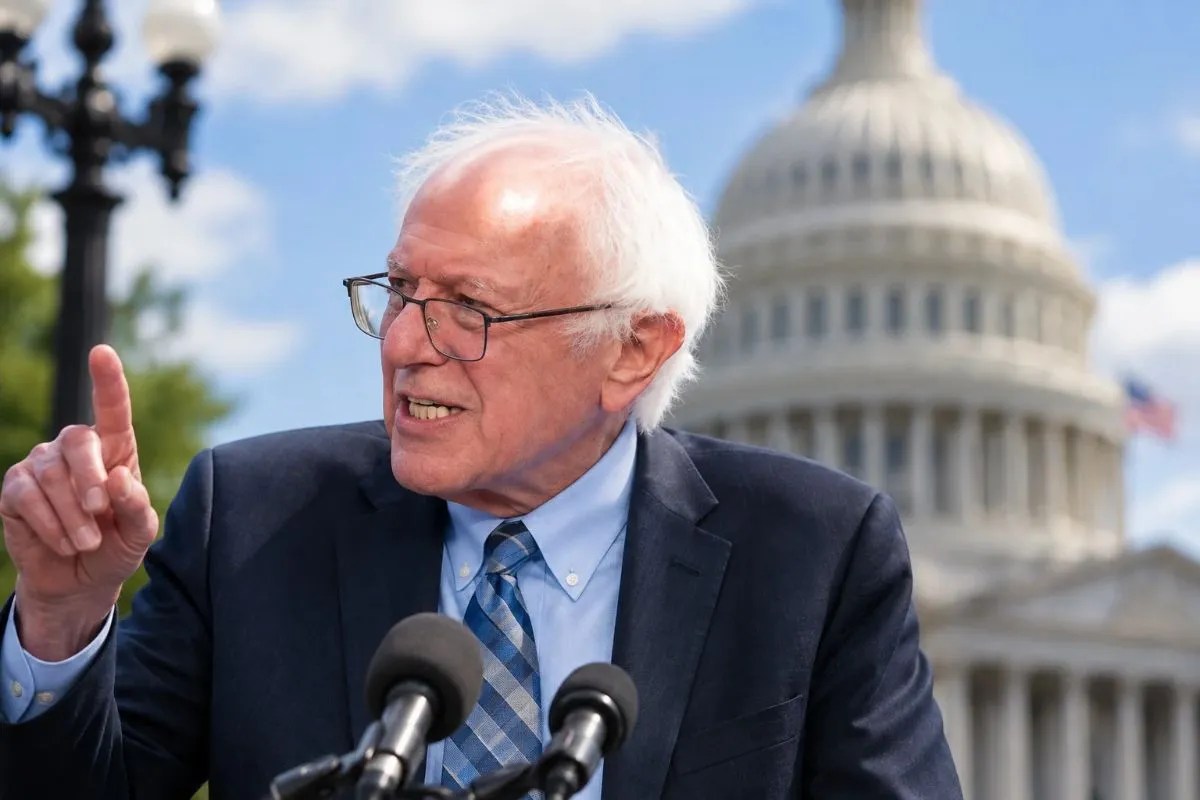
When the Central Elections Committee in Israel moved to disqualify major Arab-led political parties from participating in upcoming parliamentary elections, the shockwaves extended far beyond the immediate legislative chamber. US Senator Bernie Sanders seized on the exclusion to demand an immediate halt to American military assistance, framing the ban as a fatal blow to democratic representation for the twenty percent of the nation's population that is Palestinian. This confrontation highlights an intensifying collision between domestic electoral engineering in allied states and the foreign policy moral hazards confronting Western donors. For decades, billions of dollars in military aid flowed with minimal legislative friction. Now, the baseline conditions of democracy itself are fracturing that consensus.
The Anatomy of Electoral Gatekeeping
Electoral disqualifications are rarely isolated administrative events. They represent a calculated effort by incumbent factions to rewrite the rules of political survival. When an elections committee bars major factions representing a distinct ethnic or national minority, the action strikes at the core definition of pluralism. Democracy requires that the governed choose their representatives, not the other way around. By stripping millions of citizens of their recognized political vehicles, the system invites profound systemic instability. Observers who view these maneuvers as temporary procedural hiccups misread the long-term trajectory. Institutional exclusion calcifies over time, transforming tentative emergency measures into permanent architectural walls.
The mechanics of this exclusion rely on statutory instruments designed to police loyalty and state definition. Electoral laws often contain clauses penalizing platforms that allegedly challenge the character of the state. In practice, these clauses are weaponized against minority parties whose very presence challenges nationalist orthodoxies. When Arab-led lists are dragged before judicial or administrative panels, the evidentiary burden shifts awkwardly. Politicians facing elimination must prove their allegiance to criteria defined entirely by the dominant majority. This dynamic creates a stacked deck where minority political participation exists at the sufferance of electoral gatekeepers rather than as an unalienable right.
Power protects itself through procedure. Bureaucrats weaponize legal loopholes to achieve what demographic shifts threaten to accomplish at the ballot box. When major political blocs representing one-fifth of the electorate are scrubbed from voting rosters, the veneer of equal citizenship evaporates. The state demands compliance while denying representation. This contradiction breeds profound civic alienation. Citizens who find their votes declared illegal realize that the constitutional social contract has been unilaterally revoked by the ruling majority.
Washington and the Blank Check Paradox
Washington finds itself cornered by these developments. For generations, American foreign policy treated military aid as a sacred, unconditional compact. Policymakers argued that strategic stability in the Middle East required unquestioned material backing for regional allies, regardless of domestic political shifts. Sanders and a growing bloc of progressive lawmakers argue that this blank check philosophy directly implicates American taxpayers in democratic erosion. When an ally utilizes state apparatuses to disenfranchise a massive segment of its populace, continuing to fund its military apparatus becomes an untenable political and moral contradiction. The argument rests on a simple premise: foreign assistance cannot be decoupled from basic human rights and democratic norms.
Yet the legislative reality in the US Capitol remains a heavy barrier to radical reform. While moral indignation runs high among select progressive senators, the institutional inertia of the military-industrial complex and bipartisan defense orthodoxy remains formidable. Votes attempting to block specific arms packages or condition aid routinely fail on the floor. Lawmakers defending the status quo warn that destabilizing the alliance during a volatile regional conflict threatens broader security architectures. This friction creates a profound legislative stalemate. The executive branch prefers quiet diplomatic pressure, hoping to nudge allies away from authoritarian impulses without triggering public ruptures. Public pressure campaigns led by figures like Sanders disrupt this cautious diplomatic script by forcing recorded votes on uncomfortable truths.
Money talks louder than diplomatic memos. Billions in annual defense transfers provide Washington with immense latent influence, yet successive administrations hesitate to spend that capital on domestic political disputes abroad. The fear of appearing unsupportive of an ally in crisis overrides concerns over internal democratic decay. This hesitation sends a toxic signal. It communicates that electoral engineering and minority suppression carry zero strategic penalty as long as geopolitical alignment remains intact. The alliance becomes an accomplice to its own moral erosion.
The Legal Battlefield and Institutional Pushback
The judicial pushback adds another layer of complexity to the crisis. Following administrative bans, affected parties frequently appeal to higher courts, setting up a high-stakes duel between political gatekeepers and judicial review. In previous cycles, high courts have stepped in to overturn disqualifications, recognizing the extreme threat that wholesale minority disenfranchisement poses to constitutional legitimacy. However, relying on courts to rescue a buckling democratic framework is a precarious gamble. When the survival of political pluralism depends on the last-minute intervention of a single judicial body, the system is already in deep peril. Courts can invalidate a ban, but they cannot manufacture genuine social cohesion or heal the deep fractures exposed by the attempt.
Judges wear robes, but politics wears the armor. When administrative tribunals stacked with political appointees ban opposition parties, they test the limits of judicial independence. If the high court strikes down the ban, enraged nationalist factions decry judicial activism and demand legislative overrides. If the court upholds the ban, constitutional democracy suffers a terminal blow. The entire institutional architecture becomes a chessboard where basic civil rights are sacrificed for partisan advantage.
The struggle is fundamentally about who controls the definition of citizenship. If a state can legally declare a major minority party subversive simply because its members advocate for civic equality, then citizenship is stratified. First-class voters hold the monopoly on state power, while second-class voters are tolerated only so long as they remain politically invisible. This structural apartheid destroys the moral foundation of any state claiming to be the sole democracy in a turbulent region.
Economic Dependencies and Foreign Assistance
Examining the economic and strategic dependencies reveals why these political crises matter on a global scale. Modern military aid is not merely a transfer of hardware; it is an economic lifeline that underwrites the recipient's domestic budgetary flexibilities. By absorbing multi-billion-dollar defense expenditures, foreign assistance allows allied governments to allocate domestic revenues toward contentious projects, including land expansion, settlement infrastructure, and heightened security enforcement. Consequently, calls to condition or terminate military aid strike at the fiscal foundation supporting these policies. The debate is never purely about abstract democratic principles; it is a hard-nosed struggle over resource allocation and state direction.
Tanks and fighter jets cost money. When American taxpayers foot the bill for an ally's external defense, they inadvertently subsidize the domestic political repression executed by that same government. The fungibility of money means that every dollar saved on military procurement is a dollar liberated for internal security crackdowns and electoral manipulation. This financial umbilical cord binds Washington to actions its citizens abhor. Breaking that cord is not merely a symbolic gesture; it is an economic shock therapy designed to force a reckoning within the corridors of power.
Political strategists on all sides recognize that demographic realities cannot be legislated out of existence. Palestinian citizens comprise roughly one-fifth of the total population within the state's recognized borders. Attempting to render their political representation illegal or illegitimate does not make their presence vanish. It merely drives political expression underground, radicalizes communities, and eliminates peaceful, institutional channels for grievance resolution. History demonstrates with brutal clarity that when a state closes every legal door for minority self-determination, the resulting pressure finds alternative, often destructive, outlets. The ban is not a security measure; it is a mechanism for entrenching minority rule under the guise of democratic defense.
The Global Cost of Double Standards
The international implications stretch far beyond bilateral relations between Washington and its ally. Global powers watch these internal convulsions with calculating eyes. Competitors point to Western hypocrisy, noting the swift condemnation of democratic backsliding in rival nations contrasted with the quiet accommodation of similar behavior among strategic partners. This double standard erodes the moral authority of international human rights rhetoric. When human rights criteria are applied selectively based on geopolitical alignment, the entire framework of international law loses its binding credibility. Sanders and other critics tap into this broader disillusionment, arguing that consistency is the only path to restoring global trust.
Hypocrisy has a shelf life. When Western leaders lecture authoritarian regimes on human rights while signing off on weapons shipments used to enforce domestic disenfranchisement, the global South takes notice. The rules-based international order becomes a cynical punchline. Autocrats worldwide study these maneuvers, learning that democratic principles are negotiable provided an ally possesses sufficient strategic utility. This transactional degradation of global norms undermines long-term security far more than any regional conflict ever could.
Looking at the broader trajectory of political movements, the current friction marks a watershed moment. The days of unquestioned bipartisanship regarding foreign military commitments are drawing to a close. A younger generation of voters and lawmakers exhibits little patience for unconditional support of allied governments engaged in aggressive domestic crackdowns or expansionist conflicts. Even if immediate legislative measures to cut off funding fall short in the short term, the political cost of supporting these policies is rising exponentially. The conversation has shifted from whether aid should be debated to how long the status quo can survive under the weight of its own contradictions.
The institutional decay visible in these electoral battles serves as a warning for democracies worldwide. Democratic institutions do not collapse overnight through dramatic military coups; they erode slowly from within through the steady expansion of exclusionary rules, the neutering of minority representation, and the weaponization of legal frameworks against political adversaries. When a society accepts the exclusion of one group today to secure a temporary political victory, it establishes a dangerous precedent that will inevitably be turned against other groups tomorrow. The warning issued by foreign critics and domestic dissidents alike is stark. Once the baseline rules of fair play are discarded for short-term political convenience, returning to a functioning democratic consensus becomes nearly impossible.
The confrontation sparked by the electoral commission's attempt to erase minority representation from the ballot box lays bare the fundamental fragility of modern alliances. It forces an unavoidable reckoning between strategic convenience and foundational values. As the legal battles wind through courts and legislative chambers, the core question remains unanswered. Can a state maintain its claim to democracy while systematically denying political voice to a massive segment of its citizenry? The answer will define not only the future of domestic politics in the region but also the moral integrity of international partnerships for decades to come.