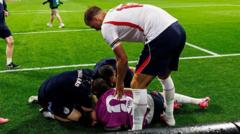
Football authorities are quietly preparing a sweeping directive to instruct players to stop jumping over pitchside perimeter hoardings during goal celebrations. The move comes as governing bodies scramble to mitigate escalating insurance liabilities and structural hazards at modern stadiums. While fans view the frantic leap into the crowd as the ultimate expression of passion, security directors see a multi-million-pound lawsuit waiting to happen. The era of the spontaneous, barrier-defying celebration is being systematically phased out under the guise of crowd control.
The immediate catalyst for this clampdown is a series of near-misses and under-reported injuries involving both players and spectators. When an attacker vaults a digital LED board, they are not just jumping a fence. They are leaping blindly into a high-density zone where concrete floors, metal camera rigs, and surging human bodies collide.
The Hidden Mechanics of the Pitchside Drop
Most modern stadiums feature a significant drop between the top of the advertising boards and the actual floor of the stands. This trench, often used by photographers and security personnel, creates a deceptive illusion of level ground. A player caught up in the euphoria of a late winner rarely calculates the physics of their landing.
They are jumping from a slick grass surface, clearing an obstacle roughly one meter high, and descending into an unpredictable space. The physical toll is immense. Knees and ankles absorb forces equivalent to multiple times the player's body weight, often on unforgiving concrete surfaces covered by thin rubber matting.
Beyond the skeletal risk to elite athletes worth tens of millions of pounds, the structural integrity of modern stadium infrastructure is a growing concern. The older, static wooden boards of the past have been entirely replaced by heavy, digitized LED screens. These units are packed with complex wiring, sharp metallic framing, and fragile glass-reinforced plastics.
When a player puts their full weight on these boards to vault over, they risk crushing the units or exposing live electrical components. More critically, the boards are not always anchored to withstand lateral force from behind. A squad of celebrating players rushing to join a teammate can easily topple these heavy units forward, pinning fans beneath them.
The Financial Undertow of the Celebration Ban
Club executives are privately driving this policy shift far more than the refereeing bodies. Insurance premiums for elite football clubs have skyrocketed over the past decade. A single major ligament tear suffered during a non-play incident—like jumping a hoarding—can void specific clauses in player insurance policies. If a club loses a star asset for nine months because of a reckless leap into the stands, the financial hit is catastrophic, and the insurers may refuse to pay out.
Furthermore, stadium operators face severe legal exposure. Under current premises liability laws, a stadium must ensure a safe environment for everyone inside the ground. If a surging crowd collapses a barrier because a player actively invited them forward by jumping into the stands, the club faces massive regulatory fines and civil lawsuits from injured spectators.
The Cultural Friction on the Touchline
This directive will inevitably face fierce resistance from players and traditionalists who believe the sport is losing its soul. The bond between the pitch and the terrace is the lifeblood of football culture. Forcing players to maintain a sterile distance of five yards from their supporters threatens to turn live matches into detached television spectacles.
Managers find themselves caught in a difficult position. Publicly, they must echo the safety mandates handed down by the leagues. Privately, they understand that emotional momentum wins football matches. A last-minute goal celebrated in the teeth of the home support builds a psychological resilience that tactical drills cannot replicate. Asking an adrenaline-fueled athlete to calculate safety margins in the ninety-fourth minute is fundamentally unrealistic.
The current disciplinary framework already punishes players who enter the crowd with a yellow card. This measure has failed as a deterrent. Players willingly accept a booking in exchange for a iconic career moment. The upcoming guidelines will shift the burden of enforcement away from the match referee and onto the clubs themselves, utilizing internal contractual fines and mandatory safety briefings to force compliance.
The Failure of the Current Yellow Card System
The existing rulebook relies on a flawed premise. It assumes an elite athlete cares about a yellow card in the immediate aftermath of scoring a crucial goal. They do not. The psychological state of a player scoring a winner triggers a massive dopamine hit that overrides long-term tactical considerations.
By making the restriction a workplace safety mandate rather than a sporting infraction, football authorities are changing the narrative. Clubs will be required to write these restrictions into the player code of conduct. Financial penalties will be deducted directly from weekly wages, a tactic that tends to grab an athlete's attention far more effectively than a referee’s notebook.
Implementing the Safe Zone
The proposed solution involves creating a clearly defined emotional neutral zone between the pitch perimeter and the stands. Some stadiums are already experimenting with wider technical moats and reinforced secondary barriers designed to keep fans back even if a player approaches the touchline.
However, these architectural changes are expensive and logistically impossible for older, traditional grounds with tight footprints. For clubs operating in historic stadiums, strict behavioral enforcement is the only viable path forward.
The sport is moving toward an era of hyper-regulated emotion. The images of iconic players balancing on top of barriers, embraced by dozens of ecstatic fans, are becoming artifacts of a less corporate era. As the financial stakes in elite football continue to swell, the tolerance for unscripted, risky behavior drops to zero. Players will learn to celebrate within the confines of the green grass, or they will face the financial consequences of defying the boardroom.