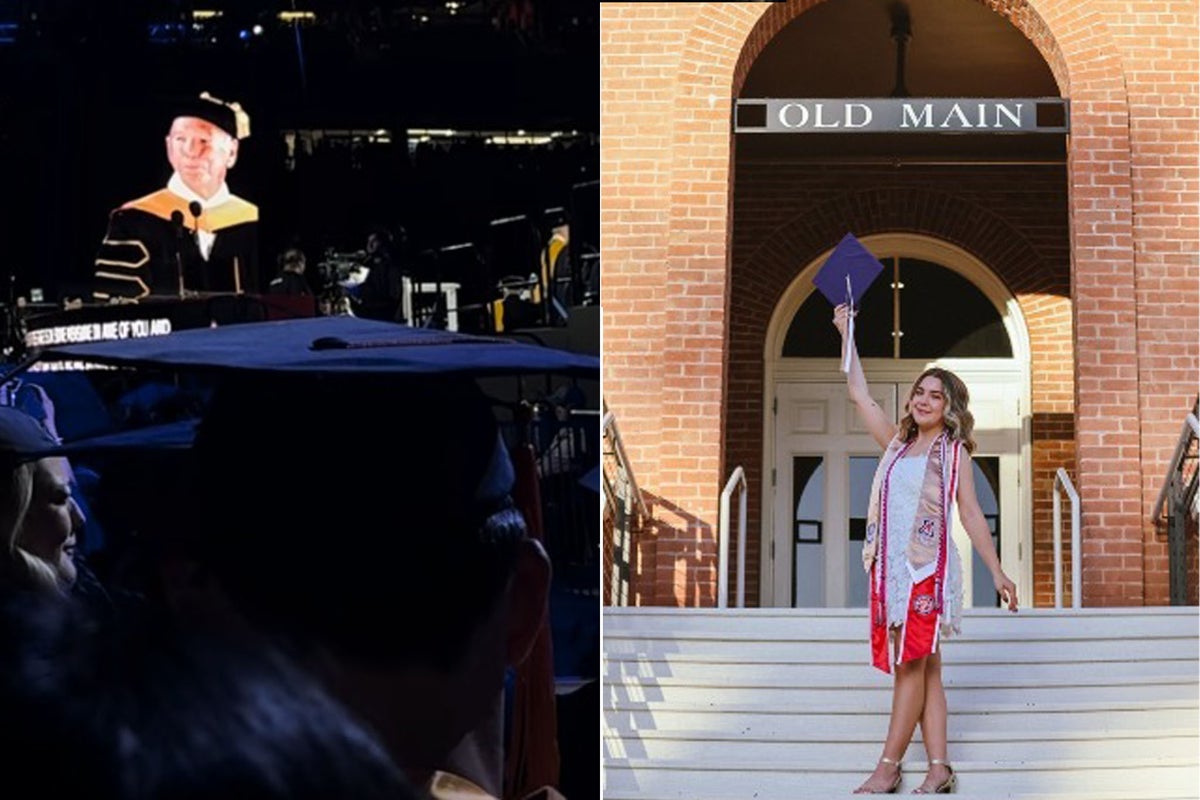
The air inside the stadium smelled of rain, cheap polyester gowns, and the distinct, metallic tang of anxiety.
Maya adjusted her mortarboard, the plastic edge digging into her forehead. For four years—years punctuated by a global pandemic, Zoom classes taken in pajamas from her childhood bedroom, and rent prices that felt like a bad joke—she had waited for this afternoon. Her parents were in row 22, blurms of camera lenses and waving hands. This was the finish line.
Then, the commencement speaker walked up to the podium.
He was a venture capitalist, sleek and aggressively hydrated. He began to speak. Within three minutes, the word hung in the air like smog. Artificial intelligence. He told the graduating class of 2024 that their degrees were historic artifacts. He told them they were entering a market where algorithms could draft their briefs, code their software, and design their buildings before they could even finish their first cup of corporate coffee. He called it an unprecedented opportunity.
Maya felt a heat rise in her throat. To her left, a classmate muttered something unprintable. To her right, someone started to clap—not in applause, but in a slow, rhythmic, mocking beat.
Boos rippled through the stadium. It started as a low murmur, a collective clearing of the throat, before swelling into a roar that swallowed the speaker’s microphone whole.
He looked shocked. He shouldn't have been.
The Audacity of the Algorithm
We are witnessing a quiet, furious rebellion on the sun-baked lawns of American universities.
From Duke to the University of California, graduation speakers are discovering that the standard, tech-utopian talking points no longer work. In fact, they are a liability. When a commencement speaker at a major university recently used an AI tool to generate part of his address—and proudly admitted it to the crowd—the response wasn't awe. It was a wall of hostile sound.
Why? Because the introduction of AI into a graduation ceremony is a profound failure of emotional reading.
Consider the mechanics of a commencement. It is one of the last remaining secular rituals of passage. It requires sacrifice. Families take out second mortgages. Students work midnight shifts at diners. They pull all-nighters until their eyes bleed to master concepts that are genuinely difficult. The diploma is not just a piece of paper; it is a receipt for human effort.
To stand before a group of people who have just paid that price and tell them that a machine can do their life's work faster, cheaper, and without sleeping is not inspiring. It is an insult.
It turns out that human beings do not want to be optimized on their wedding day, at their funerals, or at their graduations. Some spaces must remain stubbornly, inefficiently human.
The Phantom Colleague
Let us look at this clearly, without the marketing gloss of Silicon Valley.
The anxiety of these graduates is not born out of a fear of tools. This generation grew up with smartphones glued to their palms. They don't fear technology; they fear displacement. They fear the corporate structure that uses technology as a cudgel to lower wages and eliminate entry-level positions—the very rungs of the ladder they just spent a fortune trying to reach.
Imagine a young graphic designer. Let's call him Marcus.
Marcus spent his college years learning the nuances of typography, the weight of negative space, and the history of visual communication. He enters the job market and finds that three of the local agencies he applied to have downsized their junior staff. Why? Because the creative directors are now using prompt-based image generators to churn out ninety iterations of a logo in thirty seconds.
Marcus is told to pivot. He is told to become an "AI wrangler." But Marcus didn't fall in love with prompts. He fell in love with drawing.
This is the invisible stake. The current tech discourse treats human preference as an obstacle to be overcome. If a machine can write a poem, we are told to celebrate the machine, rather than asking why we wanted to automate the soul-affirming act of creation in the first place.
The logic of the market is cold: if $A$ takes ten hours and costs a salary, and $B$ takes ten seconds and costs a subscription fee, $B$ wins. But human culture does not operate on the math of efficiency. When we look at a painting by Rothko, we are not responding to the pigment density. We are responding to the man who stood in a studio in New York, wrestling with his own mind, throwing color at canvas until it felt like his own grief.
The Lie of the Soft Landing
Tech executives love to use the phrase "augmented humanity." They paint a picture of a harmonious future where the machine does the drudgery and humans are freed to do high-level strategic thinking.
It is a beautiful lie.
Anyone who has worked in an office in the last year knows what actually happens when an AI tool is introduced. The baseline expectation of productivity simply skyrockets. If a lawyer can now review five contracts an hour using automated summaries instead of one, their boss does not give them the remaining four hours to write poetry. They give them twenty-five more contracts.
The friction of life—the slow, messy, contemplative time where real insight is born—is being systematically scrubbed away.
At the podiums this spring, the speakers who fell flat were the ones who treated this shift as an inevitability to be embraced with a smile. They spoke from the perspective of the capital owners, the people who profit from the efficiency. They forgot who was sitting in the folding chairs.
The booing is not an anti-tech Luddite movement. It is a demand for dignity. It is twenty-two-year-olds saying, Look at me. I am here. My effort mattered.
When the Script Breaks
There were a few ceremonies this year where the script didn't hold, but for a different reason.
At one institution, a speaker abandoned her prepared remarks about the digital revolution entirely. She looked at the sea of black gowns, closed her binder, and spoke about the terrifying beauty of not knowing what comes next. She spoke about the time she failed her licensing exam, the time her first business collapsed, and the friends who sat on her kitchen floor with a box of cheap wine to help her piece her life back together.
She did not use the word optimization once. She did not mention data.
The applause was deafening.
We are starved for that specific, flawed vulnerability. We are drowning in a sea of synthetic text, deepfake voices, and algorithmic feeds that know our weaknesses better than our partners do. In a world where content is infinitely generated and cheap, authenticity becomes the rarest currency on Earth.
The speakers who were booed thought they were giving a lecture on the future. They didn't realize they were performing at a ceremony celebrating the past four years of human endurance.
Maya’s commencement speaker eventually finished his speech, cutting it short by two pages as the unrest in the stadium refused to die down. He slunk back to his seat, adjusting his tie, his face the color of a beet.
When Maya’s name was called, she walked across the wooden stage. The plywood groaned under her feet. She shook the dean's hand—it was warm, slightly sweaty, and entirely real.
She took her diploma, walked down the steps, and looked out at the crowd. Her father was crying, openly and without efficiency. Her mother was screaming her name so loud her voice cracked.
There was no algorithm for the heat of that afternoon. There was no code for the specific texture of their pride. The machines can have the data, but they will never have the afternoon the future refused to listen to them.



-annual-meeting.jpeg?width=1200&auto=webp&trim=0%2C0%2C0%2C0)