The morning bell at Ishikawa Prefectural High School did not ring.
Instead, a heavy, suffocating silence fell over the entire district. Outside, the rain from the previous night had left the asphalt slick and gleaming under a pale autumn sky. Inside, classrooms that should have been echoing with the chatter of teenagers unpacking lunches and complaining about math homework were entirely empty. Desks stood in perfect, haunting rows.
Nearly one hundred schools across the region locked their gates that morning. Thousands of children stayed home, peering through window blinds into the surrounding forests.
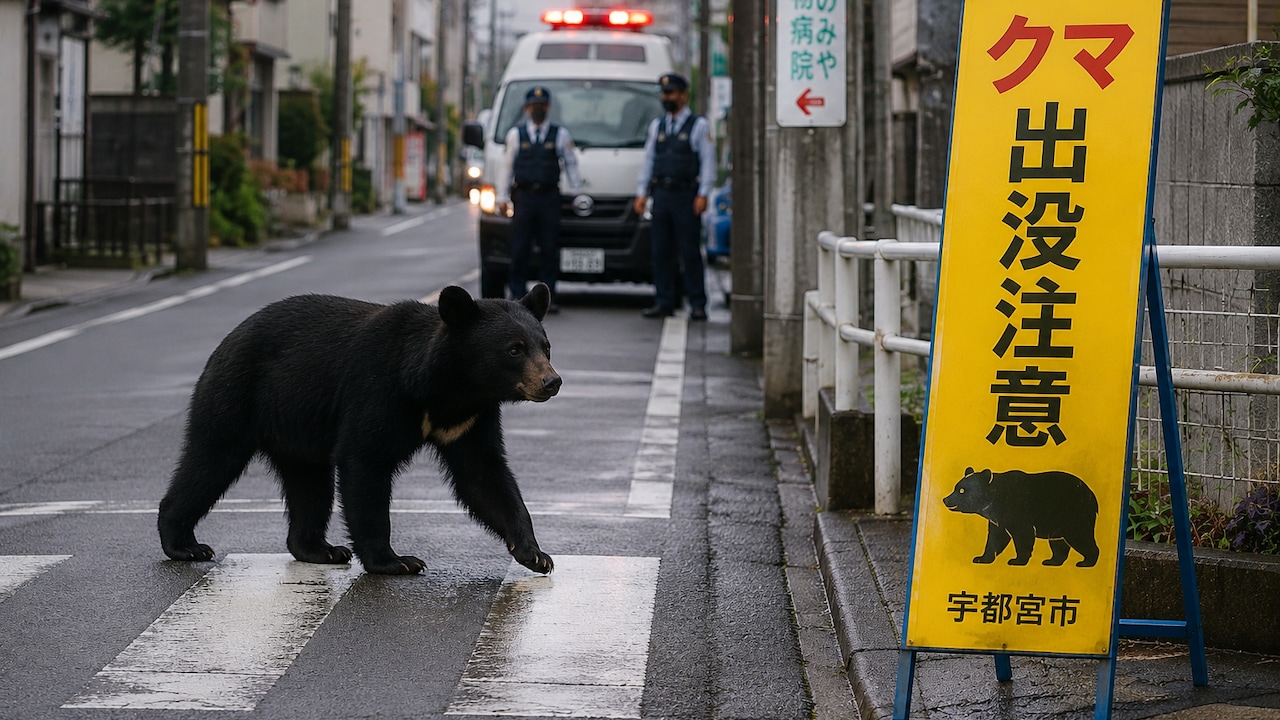
They were told to stay inside because of an intruder. But this was not a human threat. It was something older, heavier, and far more unpredictable. A single Asian black bear had crossed the invisible line separating the wilderness from human civilization, and in doing so, it paralyzed an entire modern prefecture.
To understand how a single animal can dismantle the daily infrastructure of a high-tech nation, you have to look beyond the sensational headlines. The wire services ran dry, punchy bullet points about public safety and wildlife management. They missed the true story. This is not just a report about animal control; it is a story about what happens when the boundaries we take for granted suddenly dissolve.
The Boundary on the Edge of the Woods
For centuries, rural Japan operated on a concept known as satoyama. The word literally translates to the zone where the foothills (yama) meet the flat land where people live (sato).
It was never a hard wall. It was a buffer. In the satoyama, villagers cut firewood, gathered mushrooms, and kept the undergrowth thin. The bears stayed up in the deep, old-growth forests where the acorns were plentiful. Humans stayed in the valley. There was a mutual, unspoken agreement built on mutual respect and a healthy amount of fear.
Now, imagine an elderly woman named Chieko. She is eighty-two years old, and she is one of only twelve permanent residents left in her mountainside hamlet. Her children moved to Tokyo thirty years ago for corporate jobs. Her neighbors have either passed away or moved to assisted living facilities closer to the coast.
When Chieko steps onto her porch, she looks at fields that used to be filled with rice and sweet potatoes. Today, those fields are overgrown with tall, golden grass and dense brush.
The buffer is gone.
Because the rural population is aging and shrinking at an unprecedented rate, the satoyama is reclaiming itself. The wilderness is marching down the mountain, right to Chieko’s back door. And following that wilderness are the bears.
When we look at the school closures, we are looking at the direct consequence of this demographic shift. It is a slow-motion collapse of human presence. When a village loses its people, it loses its noise, its fires, and its scent—all the things that historically signaled to a bear that a specific patch of land belonged to humans. Without those signals, a school playground looks less like a human institution and more like a convenient clearing filled with persimmon trees.
What the Mountain Forgets to Provide
Bears do not wander into human towns because they are malicious. They wander because they are desperate.
The Asian black bear relies heavily on hard mast—specifically acorns and beech nuts—to build up the fat reserves necessary for winter hibernation. In a good year, the forest floor is a banquet. But nature is volatile. Every few years, the oak and beech trees experience what botanists call a mast failure. The trees produce almost no nuts.
Consider the math of survival for a three-hundred-pound mammal. The caloric requirement is non-negotiable. If the mountain is bare, the bear must move, or it must starve.
Down in the valleys, human landscapes are practically radiating calories. Abandoned orchards are heavy with unpicked fruit. Residential garbage cans sit on curbs. Backyard vegetable patches offer easy, high-reward nutrition. To a hungry bear, the transition from the barren mountain to the fertile valley is not a conscious invasion. It is a logical, evolutionary navigation toward food.
But when that navigation path leads through a residential neighborhood, the results are catastrophic.
The tension in these communities is palpable. You can feel it in the way parents hold their children's hands a little tighter on the short walk to the bus stop, or how store owners lock their doors during the daytime. The fear isn't abstract. It is grounded in the sudden, violent realization that our modern insulation from nature is incredibly fragile.
The Sound of the Bell
The decision to close nearly one hundred schools was not made lightly. It represents a profound logistical nightmare for working parents, educators, and local governments. Yet, when a bear is sighted moving through a school district, the risk profile changes instantly.
Unlike the brown bears of Hokkaido, which are massive and tend to avoid humans unless provoked, the Asian black bear is smaller, highly agile, and notoriously easily startled. When cornered or surprised in an alleyway or a schoolyard, their instinct is not flight. It is a swift, defensive attack.
Local authorities faced a terrifying equation: hundreds of children walking to school in the early morning fog, moving silently through areas where visibility was compromised by overgrown vegetation, potentially crossing paths with an animal driven by caloric desperation.
The schools had to close.
But a closure is a temporary band-aid on a wound that requires stitches. While the children stayed indoors, local hunters—mostly men in their sixties and seventies, part of the dwindling number of licensed marksmen left in the rural areas—patrolled the perimeter of the towns. They moved through the brush with shotguns, their eyes scanning the treeline, searching for dark shapes against the autumn leaves.
This is the reality of the modern wildlife crisis in Japan. The defense of these towns falls on the shoulders of an aging generation using methods that feel increasingly disconnected from the digital world their grandchildren inhabit.
The Shifting Baseline
We often think of progress as a one-way street. We build roads, we erect towers, we lay fiber-optic cables, and we assume the land is permanently ours. We forget that the wilderness is always waiting at the edge of the clearing, watching for a moment of weakness, a dip in population, or an untended garden.
The empty classrooms of Ishikawa are a preview of a broader conversation that many post-industrial nations will eventually have to confront. What happens when we shrink? How do we manage our relationship with nature when we are no longer expanding outward, but retreating inward?
There are no easy answers. Some advocates call for better forest management and the creation of artificial corridors to keep wildlife away from urban centers. Others argue that the relocation of rural populations to denser, centralized cities is inevitable.
Meanwhile, Chieko sits on her porch, watching the treeline creep a few inches closer each year. She hears the wind rattle through the empty school down the road. She knows that the bear is not an enemy. It is simply a mirror, reflecting the changing reality of the valleys humans are slowly leaving behind.
The sun begins to set over Ishikawa, casting long, bruised shadows across the quiet playgrounds. The gates remain locked. Tomorrow, the children might return to their desks, or they might not. The mountain will decide.