The marble pillars of India's Lok Sabha have heard centuries of lofty rhetoric. They have echoed with the formal cadence of British common law, the soaring classical Hindi of post-independence visionaries, and the sharp, transactional barbs of modern party politics. But on a Tuesday in late July, the old house swallowed something entirely unexpected.
It swallowed the internet.
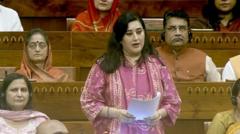
Members of Parliament stood beneath the great dome and traded insults forged not in political science textbooks, but in the rapid-fire scroll of Instagram reels and comment sections. The occasion was a marathon debate on an anti-paper leak amendment bill, a serious legislative response to a crisis that had paralyzed the nation's education system. Yet the vocabulary belonged entirely to teenagers staring at blue-lit screens.
"They were MIA," lawmakers declared, mapping military acronyms onto absent opposition leaders. "Then came FOMO."
Before the benches could settle, the word dropped: delulu.
To anyone over thirty tuning into the proceedings from a cramped living room in Noida or a tea stall in Patna, it must have sounded like a foreign dialect. But inside the chamber, the descent into generational slang was a symptom of a deeper tremor. The digital underground had finally breached the sanctuary of the state.
Consider how we arrived here. Months earlier, a Supreme Court hearing on the bitter realities of youth unemployment and exam failures yielded an unfortunate comparison. A high-ranking judicial voice likened desperate young job-seekers to cockroaches. It was a slip of the tongue meant to dismiss, a casual dehumanization tossed into the public record.
Instead of breaking, the youth of India caught the word in mid-air, turned it over, and wore it like armor.
Within days, millions mobilized under the banner of the Cockroach Janta Party. It was satire with teeth. They took a slur designed to render them invisible and marched it straight to the heart of New Delhi. They carried red roses and copies of the constitution, offering a polite surrealism while police batons and tear gas waited at the barricades. They organized hunger strikes that stretched for weeks, forcing the country to look at an education pipeline choked by systemic corruption and leaking exam papers.
By the time the dust settled and the former education minister tendered his resignation, the political establishment realized a terrifying truth. They were no longer speaking the language of the electorate.
So, when the monsoon session of Parliament convened to debate the legislative fixes for the NEET-UG examination crises, the ruling benches and the opposition engaged in a strange linguistic mimicry. They tried on Gen Z slang like ill-fitting suits, hoping to prove they were listening.
"Where Congress created a policy vacuum, Modi clocked it," stated ruling party MPs, borrowing a phrase that means noticing or calling something out with absolute precision.
From the opposing side, the pushback came with equal theatricality. Leaders warned the government not to get caught in its own delusions, insisting that changing the camera angles on promotional videos would never fix the structural rot beneath.
Yet veteran lawmakers watched the linguistic gymnastics with visible exhaustion. Senior leaders took to the floor to plead for sobriety, reminding the house that they were debating the future of millions of students, not compiling an entry for a youth dictionary. The juxtaposition was jarring. Here were venerable politicians, steeped in decades of legislative procedure, awkwardly weaponizing internet shorthand because the streets outside had proven entirely unpredictable.
The slang was never really about the words. It was about translation.
When young citizens mobilize through decentralized digital networks, adopting absurdist humor to bypass traditional political hierarchies, they create a cultural moat. Traditional power structures struggle to cross it. By dragging terms like clock it and delulu into the sacred registry of parliamentary Hansard, India's politicians were attempting to bridge a chasm that widening economic anxiety and systemic frustration had blown wide open.
The youth watching from home were unimpressed by the vocabulary exercise. They did not care whether an opposition leader could successfully deploy an acronym or whether a minister could drop a cultural reference. They wanted to know why the source code of the system kept breaking. They wanted to know why sitting exams felt like playing a rigged game where the questions were sold before the ink had dried.
The parliamentary debate eventually wound down. The amendments were tabled, speeches were logged into the permanent record, and the politicians returned to their offices. But the echo remained.
Language shifts when power shifts. When the margins learn how to laugh at the insults of the center, the center loses its monopoly on gravity.
The street remembers. The digital feeds archive every misspoken phrase and awkward attempt at cool. And somewhere out there, beneath the hum of a ceiling fan in a sweltering apartment, a young student closes a textbook, picks up a phone, and starts typing the next sentence.
India 'cockroach' group says will not march again because police will 'hurt youth'
This video captures footage from the ground in New Delhi as thousands of demonstrators and supporters of the youth-led movement gathered near parliament to demand systemic educational reforms.
http://googleusercontent.com/youtube_content/1