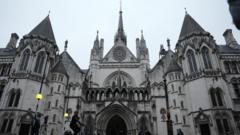
The long-running legal battle between high-profile celebrities and Associated Newspapers Limited (ANL) has hit a strange and messy snag. At the center of this storm is Gavin Burrows, a private investigator who once built a career on the very tactics—phone hacking, blagging, and illegal surveillance—now being litigated in London’s High Court. Burrows has recently been forced to defend himself against allegations that he "switched sides," moving from a key witness for the claimants to a potential asset for the defense.
This is not just a procedural squabble. It is a glimpse into the murky underworld of Fleet Street’s historical information-gathering machine. When a man who knows where the bodies are buried suddenly changes his tune, it threatens to derail a case involving Prince Harry, Elton John, and Baroness Doreen Lawrence. The credibility of the entire litigation rests on the testimony of individuals whose professional lives were defined by deception.
The Architect of Intrusion
To understand why Burrows’ current stance matters, one must look at his role in the original ecosystem of the British tabloids. He wasn't just a casual observer. He was a specialist. For years, the "dark arts" of private investigation were the lifeblood of the Sunday papers. If a journalist needed a medical record, a flight manifest, or a private phone number, they called a man like Burrows.
In the early stages of the current lawsuit against the publisher of the Daily Mail and The Mail on Sunday, Burrows provided witness statements that were devastating. He claimed he was commissioned by the newspapers to conduct widespread illegal activity. These statements formed a significant part of the bedrock for the claimants' argument that ANL’s senior management knew about, and even encouraged, criminal behavior to get scoops.
Now, the narrative has shifted. ANL has produced evidence, including a signed statement from Burrows, in which he distances himself from his previous claims. He now suggests he was pressured or incentivized to provide his initial testimony against the publisher. This reversal creates a legal paradox. If he lied then, can he be trusted now? If he is lying now, what does that say about the influence of a powerful media corporation over its former contractors?
The Mechanics of the U Turn
Legal battles of this magnitude are rarely won on a single "smoking gun." They are wars of attrition fought through witness credibility. By casting doubt on Burrows, ANL isn't just defending its own reputation; it is attacking the foundation of the claimants' evidence.
The defense argues that the claimants’ legal team essentially "bought" or coerced Burrows’ cooperation. Burrows himself has claimed in recent filings that he felt he was being used as a pawn in a larger vendetta against the Mail. This transition from star witness to hostile entity is a classic intelligence maneuver. It creates "gray mail"—a situation where the evidence becomes so tainted by the character of the witness that it becomes radioactive in a courtroom.
Critics of the publisher suggest a different motive. They point to the immense resources at ANL’s disposal and the potential for a "carrot and stick" approach to witness management. In the insular world of private investigators and former tabloid staff, loyalty is often a fluid concept, dictated by who is currently paying the bills or who poses the greatest threat to one's future livelihood.
Credibility in a House of Mirrors
The High Court is currently grappling with whether these claims of "side-switching" are enough to throw out key parts of the case. Mr. Justice Fancourt, the judge overseeing the litigation, has to peel back layers of professional dishonesty to find a kernel of truth.
The problem is systemic. The claimants—Harry, John, Lawrence, and others—allege that their lives were picked apart by illegal means. To prove this, they must rely on the testimony of the people who did the picking. This creates an inherent instability in the evidence. A private investigator who admits to breaking the law for twenty years for a paycheck is, by definition, a person whose word is for sale.
When Burrows denies switching sides and instead claims he is "setting the record straight," he is playing a high-stakes game. If the court finds he has committed perjury in either his original statements or his new ones, he faces significant jail time. Yet, he continues to navigate this middle ground, asserting that his previous cooperation was a mistake born of external pressure.
Beyond the Tabloid Tactics
This case is more than a celebrity circus. It is a test of the UK’s statute of limitations and the "discovery" rule. ANL’s primary defense, beyond denying the hacking took place, is that the claims were brought too late. They argue that the claimants could have, and should have, known about the alleged intrusions years ago.
The testimony of people like Burrows is vital to overcoming this hurdle. If the claimants can prove that the publisher actively concealed its wrongdoing—using "front" companies and anonymous payments to investigators—then the clock on the statute of limitations resets. This is why Burrows’ credibility is the hill both sides are willing to die on. If his evidence that the Mail hid its tracks is discredited, the entire case could be dismissed on a technicality before it ever reaches a full trial.
The Influence of the Publisher
Associated Newspapers is not a typical defendant. It is one of the most powerful media entities in the English-speaking world. Its ability to shape public perception through its titles is unmatched. Throughout this litigation, the Mail has maintained a stance of total defiance, labeling the allegations as "preposterous" and "unsubstantiated."
The pressure on witnesses in these cases is immense. It is not just about legal fees; it is about social and professional standing. For a private investigator whose client list once included the biggest names in the media, turning on those clients is a form of professional suicide. The recent "clarifications" from Burrows may simply be a late-stage realization of the consequences of his initial cooperation.
A War of Attrition
As the proceedings continue, we are seeing a shift in strategy. The focus has moved away from the specific instances of hacking and toward the conduct of the legal teams themselves. ANL has accused the claimants' lawyers of "egregious" behavior in how they obtained witness statements. This is a diversionary tactic designed to move the spotlight away from the alleged crimes of the 1990s and 2000s and onto the procedural mechanics of 2024 and 2025.
The reality of the situation is that neither side emerges from this looking particularly clean. The claimants are forced to rely on the word of confessed criminals. The defendant is forced to rely on the "corrected" word of those same criminals to save its skin. It is a hall of mirrors where every reflection is distorted by decades of mutual suspicion and industrial-scale surveillance.
The legal system is built on the assumption that witnesses have a fixed version of the truth. Gavin Burrows has demonstrated that in the world of private intelligence, the truth is often a commodity that can be traded, retracted, or "refined" depending on the prevailing winds.
Find the original contracts between the investigators and the news desks. Trace the money. In a world where words are cheap and witness statements are fluid, the only thing that doesn't lie is a bank transfer. Unless those records are produced, this trial will remain a contest of who can tell the most convincing version of a lie.