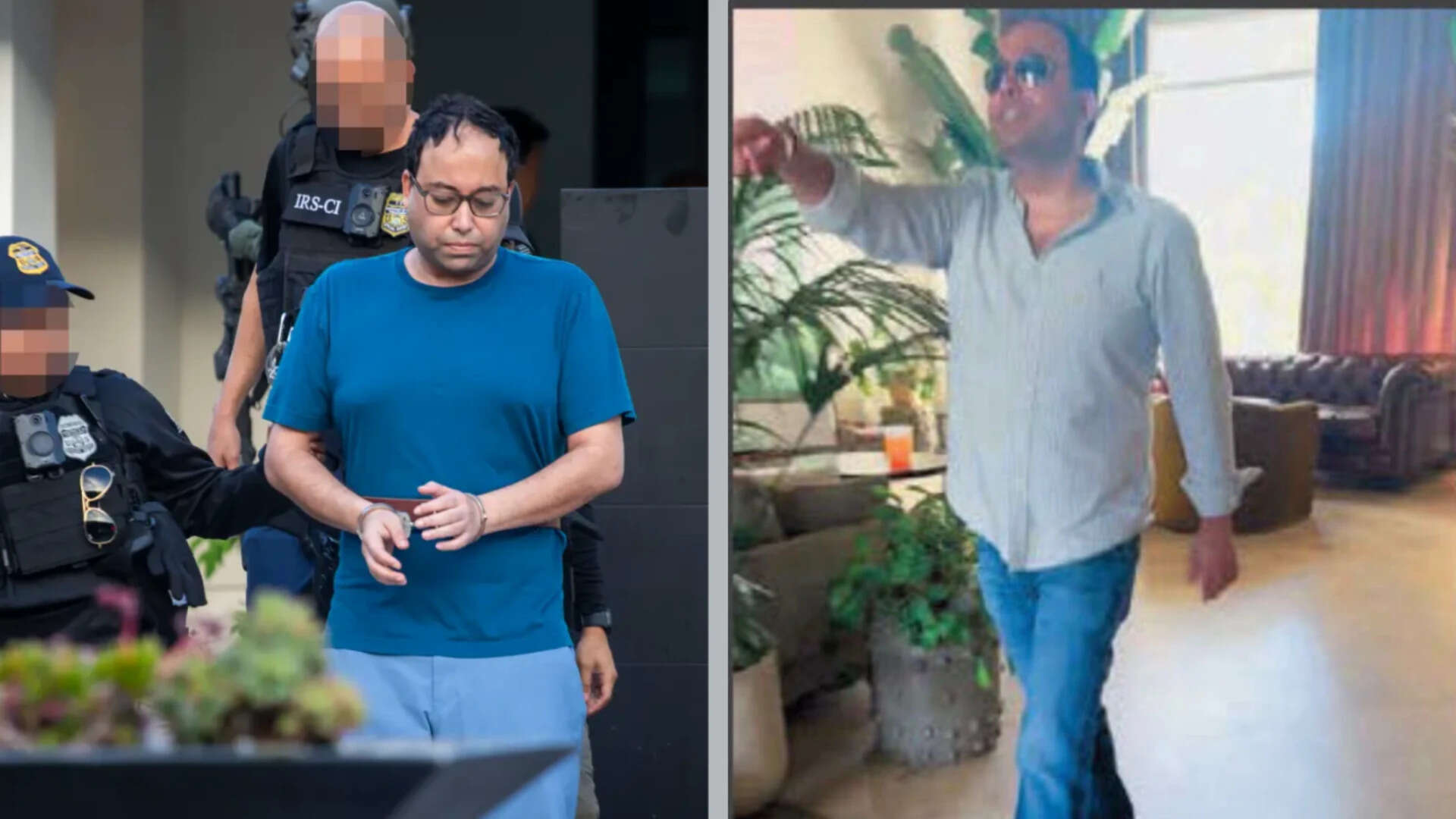
A dawn raid by armed federal agents in the ultra-exclusive neighborhood of Corona del Mar doesn't happen every day. But when it does, it usually uncovers a story that sounds like a Hollywood thriller. That's exactly what went down in Newport Beach, California, when 44-year-old Mahender Makhijani was led out of his mansion in handcuffs, wearing his pajamas.
Federal prosecutors just hit the Indian-origin financier with severe bank fraud charges. The headline figure is staggering. We are talking about a $100 million scheme. But the real story isn't just about the money. It's about how he allegedly kept his empire together. The federal complaint paints a dark picture of a double life filled with luxury cars, private jets, organized intimidation, drug-fueled parties, and the systematic blackmail of his own associates and bank employees.
Here is the truth behind the headlines and what the authorities say really happened inside Makhijani's Newport Beach operation.
The 100 Million Dollar Adobe Forgery Scheme
If you think a $100 million bank fraud requires a sophisticated, highly technical cyberattack, think again. According to the federal affidavit filed in the U.S. District Court in Santa Ana, Makhijani used something much more mundane: Adobe software.
Makhijani controlled Cantor Group V LLC, a lending firm based in Newport Beach. The company had a sweet deal with a federally insured bank. The bank advanced nearly $100 million so Cantor could fund real estate loans. But there was a strict catch. The bank required that Cantor hold the absolute first-lien position on the properties used as collateral. That meant if things went south, the bank got paid back first.
Between September 2024 and April 2025, Makhijani realized he didn't actually have those top-priority rights. Other creditors were ahead of him in line. Instead of coming clean, prosecutors say he and a subordinate manually edited the title insurance documents using Adobe.
To hide their tracks and trick the bank, they had to wipe out the digital footprint of their edits. They did this by altering the file metadata. Sometimes they even printed out the forged documents and rescanned them to make them look like pristine, unedited originals. Makhijani didn't stop there. He jumped on phone calls with bank representatives and sent over spreadsheets with fabricated explanations to cover up the title discrepancies. The bank fell for it, keeping the cash flowing based on total fiction.
Sex Workers Drugs and Corporate Blackmail
The financial fraud is only half the story. The federal complaint takes a wild turn into how Makhijani allegedly maintained compliance from the people around him. He didn't just rely on corporate nondisclosure agreements. He used leverage.
Witness statements reveal that Makhijani regularly hosted lavish, private gatherings involving drugs and sex workers. He made sure these events were attended by his subordinates, associates, and critically, bank employees.
Once the parties were over, the fun ended. Makhijani reportedly used what happened at these gatherings as a tool for extortion. If an employee or an associate stepped out of line, or if someone questioned the financial discrepancies, Makhijani allegedly held their behavior at these parties over their heads. It was a calculated blackmail operation designed to keep everyone quiet and under his thumb.
A Reign of Intimidation and Mob Style Tactics
When blackmail wasn't enough, Makhijani allegedly resorted to raw intimidation and threats of violence. He ran his businesses less like a Newport Beach investment firm and more like a street gang.
Subordinates who showed signs of hesitation were met with terrifying threats. Witnesses told investigators that Makhijani explicitly threatened to kill employees who disobeyed him. He would tell them he'd put their families on the street and leave their kids on welfare.
He didn't reserve his anger just for internal staff. He went after business rivals with shocking aggression. During a nasty corporate dispute over the iconic Hotel Laguna in 2023, security personnel tied to Makhijani engaged in physical clashes with workers at the property, forcing the historic hotel to temporarily shut down.
In other instances, he directed his associates to break into competing businesses, smash windows, and seize legal documents. Prosecutors even note video evidence showing Makhijani dressed in high-end designer clothing, calmly directing his crew as they assaulted security guards.
To completely break his opponents, he used psychological warfare. He sent associates to place fake eviction notices at the homes of a rival's family members. He even rented a mobile billboard to drive around town displaying photos of an opponent, publicly accusing them of robbery and corruption.
Where Did the Money Go
Makhijani lived an undeniably flashy lifestyle. He rolled around Orange County in a Bentley, a Porsche, and a Mercedes G-Wagon. He traveled almost exclusively by private jet and wore nothing but designer labels. He bought two massive, side-by-side coastal mansions in Corona del Mar, keeping one entirely for his in-laws.
Yet, despite his arrest, the federal government has a massive problem. They can't find the missing $100 million.
The money has completely vanished into a complex web of shell companies and layered transfers. The criminal complaint notes that while Makhijani clearly commands significant financial resources, the government hasn't been able to fully trace them. Prosecutors openly state that these assets are almost certainly hidden under names that aren't his own.
The Total Collapse of an Empire
The federal arrest is the final blow to an empire that had already been cracking in the civil courts. Just weeks before the FBI knocked on his door, Makhijani suffered a catastrophic loss in a private JAMS arbitration case.
A prominent Laguna Beach real estate developer, Mohammad Honarkar, had partnered with Makhijani back in 2021 during a period of intense pandemic-related financial pressure. Makhijani promised a $30 million capital contribution to take control of a massive, $382 million Southern California property portfolio.
Instead of helping, Makhijani used the properties as leverage to pile on hundreds of millions of dollars in new debt to fund his own ventures. The promised $30 million was never paid. Properties fell into foreclosure and receivership, dragging down regional banks with them. Makhijani even used armed guards to stage a forceful takeover of Honarkar's properties.
The arbitrator didn't hold back, finding by clear and convincing evidence that Makhijani committed severe fraud, title manipulation, and contractual breaches. The final ruling awarded Honarkar a mind-boggling $1.34 billion in damages.
What Happens Next
Makhijani is currently facing a statutory maximum sentence of 30 years in federal prison for bank fraud. Because he previously bragged to associates that he would flee to India if the law ever caught up with him, federal prosecutors are highly likely to push for him to be held without bail as a severe flight risk.
If you are a business owner or an investor, there's a harsh lesson to take away from the downfall of Cantor Group V. Flashy lifestyles and coastal mansions can hide massive operational rot. Always conduct independent, third-party audits of title documents and asset collaterals. Never rely on spreadsheets or digital PDFs provided directly by a partner without verifying the underlying metadata and original county records. The federal court case in Santa Ana is just getting started, and as the IRS and FBI dig deeper into those untraceable accounts, more names are bound to drop.