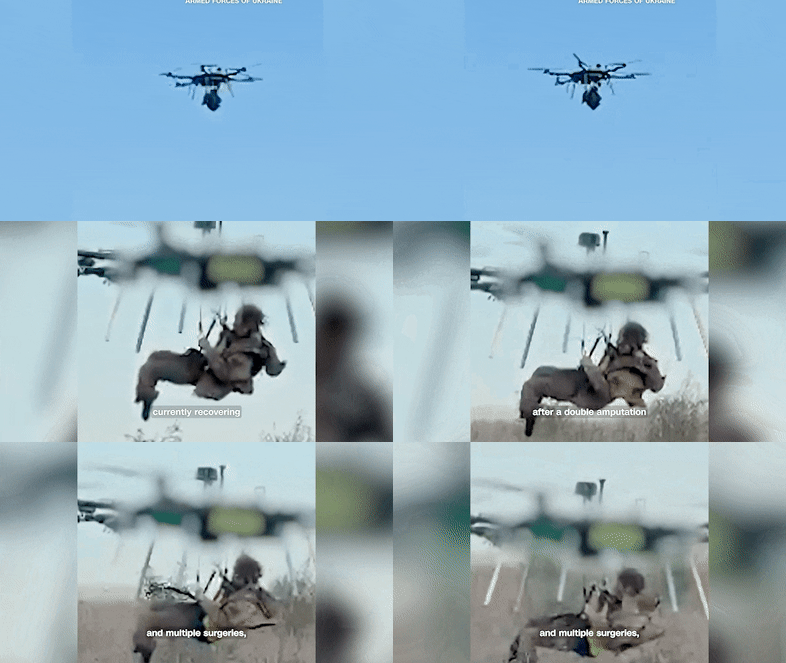
A headline screams about a wounded soldier pulled off a front line by a drone in a "world first." Applause breaks out on defense LinkedIn. Grant proposals get dusted off. Everyone acts like combat medicine just crossed a finish line.
It didn't. Not even close.
Watching defense reporters celebrate an unmanned casualty evacuation headline feels like watching someone cheer a paper airplane because it stayed aloft for ten seconds in a hallway. Yes, the physics work. Yes, a large multirotor or VTOL airframe can lift a human payload or a stabilized litter across short distances. No, that does not mean front-line medical evacuation is solved, scalable, or ready for a real high-intensity conflict.
I have watched defense contractors burn tens of millions of dollars chasing flashy autonomy demos while ignoring the grueling reality of trauma care under fire. A controlled test or a carefully staged extraction tells you what a machine can lift on a good day. It tells you almost nothing about keeping a bleeding human being alive when the sky is contested, GPS is jammed, and the nearest surgical team is forty minutes away.
The lazy consensus goes something like this: manned helicopters are expensive and vulnerable to air defenses, drones are unmanned and expendable, therefore putting a stretcher on a big drone equals safer, faster medical evacuation.
Sounds neat on a slide deck. Falls apart on contact with reality.
The Myth of the "World First" Extraction
Defense PR loves a "world first." Put a dummy or a volunteer—or even a real casualty in a permissive or semi-permissive pocket—on an unmanned platform, fly it out, cut a thirty-second clip with dramatic music, and call it a revolution.
Here is the catch nobody wants to put in the press release: lifting a load is the easy part. Keeping a trauma patient alive in transit is the hard part.
In military medicine, evacuation isn't just transportation. It is rolling resuscitation. A severely wounded soldier doesn't just need a taxi ride to a Role 2 or Role 3 facility; they need airway management, hemorrhage control, blood products, pain management, thermal regulation, and constant monitoring when their physiological state can crash in ninety seconds.
When a flight medic sits next to a patient inside a UH-60 Black Hawk or an HH-60 Pave Hawk, that medic has hands on the patient, eyes on the vitals, and judgment in real time. If a chest seal fails, if a tourniquet slips, if a patient vomits and risks aspiration, or if shock deepens, a human being can react immediately. A drone on a pre-planned waypoint cannot feel a drop in radial pulse. A remote operator watching a low-bandwidth video feed through electronic warfare noise cannot palpate a wound or clear an airway through a camera lens.
Calling a single successful lift a breakthrough confuses a proof of mobility with a clinical capability. Those are not the same thing. Not even in the same zip code.
Why People Ask the Wrong Questions About Unmanned Medevac
Whenever a story like this trends, the surrounding questions follow a predictable script. Let's strip away the polite phrasing and look at what people are actually asking.
"Will drones replace medical helicopters?"
No. Not in the foreseeable future, and treating this as a binary replacement is a trap.
Helicopters carry heavy medical gear, multiple crew members, and clinical specialists who can start damage-control resuscitation in the air. Heavy-lift unmanned systems have strict payload-versus-range trade-offs, acoustic and thermal signatures that draw attention, and zero onboard clinical hands.
A more honest question is: where can unmanned systems take pressure off manned aircraft without degrading patient survival? Resupply of blood, plasma, and trauma kits? High-risk extraction from pockets where sending a manned crew is an unacceptable gamble? Moving less critical casualties from forward aid stations to rear staging points? Those are real roles. Replacing the flying ICU is fantasy.
"How fast can a drone evacuate a wounded soldier?"
Faster on paper than a ground ambulance weaving through damaged terrain or mines. Slower—or stuck—when weather turns ugly, airspace gets crowded with loitering munitions, or command-and-control links get chewed up by jamming.
Speed measured from liftoff to landing means very little if the patient waits forty-five minutes for point-of-injury stabilization, sits under cover while drones get routed around air defenses, or arrives without ongoing resuscitation. Survival in trauma depends on the total time to definitive care and effective interventions along the way, not a stopwatch starting when rotors spin up.
"Are unmanned medevac aircraft safe for wounded troops?"
Safe is a loaded word in a war zone. Less risky to a flight crew? Sure—nobody in the cockpit is taking small-arms fire or shrapnel if the aircraft goes down. Safer for the patient? That depends entirely on what happens when things go wrong.
Think about what a wounded soldier experiences strapped to an unmanned aircraft. Loud rotor wash or turbine noise. Vibration. Cold air at altitude. Confinement. No reassuring voice. No human eyes checking whether a strap is cutting off circulation or whether the patient is slipping into hypovolemic shock. For a soldier with a head injury, blast trauma, or catastrophic blood loss, an unmanned ride can be terrifying and clinically unforgiving.
The Mechanics They Gloss Over
To understand why these headlines overpromise, look at the engineering and clinical trade-offs sitting underneath them.
Payload, Power, and Range Are a Brutal Triangle
A human adult plus body armor, gear, and medical equipment easily pushes past 100 to 130 kilograms. Add medical monitors, oxygen, or blood transport containers, and the weight climbs fast.
Battery-powered multirotors hit range walls quickly because moving that much mass requires serious power. Hybrid or turbine VTOL designs buy endurance and range, but they bring mechanical complexity, heat signatures, fuel logistics, and higher cost. Every extra kilogram of medical gear or armor protection steals range or payload margin. Engineering doesn't care about press releases; conservation of energy and mass always collect their tax.
Electronic Warfare and Contested Skies
Modern battlefields are saturated with sensors, reconnaissance quads, electronic warfare jammers, and air defenses. An unmanned evacuation craft isn't floating through empty blue sky. It is operating in an environment where navigation signals can be spoofed or lost, datalinks can drop, and airspace deconfliction is a nightmare.
If a cargo drone loses its link, it might loiter, return home, or ditch. If a casualty drone loses its link while carrying a bleeding soldier, "return to base" is a terrible outcome. Autonomous obstacle and threat avoidance for a human-carrying medical platform faces a much higher bar than autonomous delivery of a box of ammunition.
The Clinical Bottleneck Nobody Wants to Fund
Defense budgets love shiny hardware. Shiny hardware gets ribbon cuttings, test flights, and trade-show booths. Far less glamorous—and far more decisive for survival—is forward trauma care, prolonged field care training, blood supply logistics at scale, and ruggedized medical equipment that works under vibration and electromagnetic interference.
I have seen programs pour millions into airframe prototypes while skimming over rigorous clinical testing in realistic shock and vibration environments. You can build a sleek airframe in two years. Validating medical devices and care protocols that keep unstable patients alive in dynamic flight takes years of unglamorous work.
The Downside of My Own Contrarian Take
Being a skeptic has its blind spots, and I'll own mine straight up.
Push too hard against early unmanned evacuation milestones, and you risk sounding like the cavalry officer who swore horses would always outlast tanks or the aviation purist who dismissed early rotary aircraft as death traps. Necessity in war accelerates ugly, imperfect technologies faster than peacetime committees ever predict. A system that looks clunky and limited today can mature into a vital tool once battle-tested under harsh conditions.
Also, dismissing a "world first" as PR can blind you to real operational value. Even if an unmanned medevac system can only handle specific injury profiles, short hops, or austere environments where manned aircraft cannot fly, saving even a small fraction of troops who otherwise had zero evacuation option matters enormously on the ground.
Imagine a Scenario Where...
Imagine a scenario where a platoon takes heavy indirect fire in a contested sector. Two soldiers are hit—one with severe extremity bleeding and early shock, another with a penetrating torso wound. Low clouds sit over the ridgeline, electronic jammers are active, and friendly air defenses are covering nearby corridors.
A manned medevac helicopter faces a grim calculation: flying into that envelope risks losing a multi-million-dollar aircraft and a trained crew. A ground vehicle faces mines and craters. Meanwhile, a heavy unmanned evacuation drone sits a few kilometers back.
Even if that drone gets the wounded soldiers out of the immediate kill zone, look at what still has to happen: someone at the point of injury still has to stop the bleeding and package the casualties properly; someone on the receiving end still has to run rapid triage and resuscitation; and the aircraft still has to navigate contested airspace without getting swatted down or going blind. The drone is a link in a chain, not the whole chain.
What Actually Works Instead
If you actually care about getting wounded troops off the front line alive—rather than racking up applause for another demo—stop treating unmanned medevac as a silver bullet and focus on what moves survival needles.
- Treat unmanned evacuation as a specialized tool, not a replacement. Match the platform to realistic missions: short-range extraction from denied pockets, casualty movement between echelons, and medical resupply. Design around clear clinical boundaries rather than pretending a machine can do everything a flight medic does.
- Invest in remote and automated clinical support before bragging about the airframe. If no medic is onboard, figure out ruggedized physiological monitoring, automated ventilators, warming systems, and clear handover protocols so the receiving team isn't flying blind when the hatch opens.
- Train and equip the front line for longer holding times. Evacuation will never be instant on every battlefield. Drilling tourniquet application, hemostatic packing, airway control, and prolonged field care saves lives whether a drone arrives in twelve minutes or a ground team arrives in an hour.
- Measure clinical outcomes, not novelty. Stop grading programs by whether a flight happened for the first time. Grade them on payload reliability under jamming, patient stability during transit, turnaround time, and real-world survivability.
A drone lifting a wounded soldier makes for a great headline. Surviving the fight takes a lot more than a headline.