Unilateral secondary trade barriers do not eliminate demand; they merely redirect and re-price risk across the global supply chain. The recent legislative initiative in the United States, backed by a bipartisan Senate coalition and supported by the administration, proposes up to a 100 percent tariff on the top five importers of Russian energy. While designed to restrict the capital flows funding Moscow's military efforts, the mechanism ignores the fundamental price elasticities of global energy and the structural pathways of sovereign trade defense.
By analyzing the mechanics of this policy, the limits of Western secondary sanctions, and the defensive countermeasures available to Beijing, we can see the deep structural friction points that make economic coercion of this scale highly volatile and ultimately self-limiting.
The Three Structural Pillars of the Secondary Sanctions Bill
The updated legislative proposal represents a tactical shift from blanket economic exclusion to targeted trade penalties. By replacing the previously proposed 500 percent tariff with a structured cap, the policy attempts to establish a predictable, high-impact framework. The operational core of this bill relies on three specific criteria.
- The Concentration Threshold: The bill targets the top five sovereign buyers of Russian crude oil, natural gas, uranium, and refined petroleum products. By limiting the scope to the largest buyers, the policy attempts to minimize systemic inflation in smaller, developing economies while directly penalizing high-volume trade partners like China and India.
- The Fifteen Percent Exemption Clause: Sovereigns that derive less than 15 percent of their total energy imports from Russian sources are exempt from these penalties, provided they demonstrate verifiable, systematic reductions in their import volumes over time.
- Executive Discretionary Waivers: The executive branch retains the unilateral authority to suspend, modify, or lift the tariffs if the administration determines that doing so serves the economic or security interests of the United States.
While these pillars are intended to give the executive branch maximum strategic flexibility, they create immediate economic distortions. The implementation of a 100 percent tariff on a major trading partner does not operate in a vacuum. It alters the entire cost structure of international shipping, insurance, and currency settlement.
The Asymmetrical Friction of Energy Re-Routing
To understand why a 100 percent tariff is difficult to enforce, one must evaluate the cost function of global crude oil distribution. The global energy market is highly liquid and fungible. When the West attempts to restrict access to specific barrels, it triggers an immediate arbitrage game.
The Cost of Re-Routing and Arbitrage
When the United States threatens a 100 percent tariff on Chinese imports if Beijing continues to purchase Russian energy, the economic calculation for Chinese state-owned enterprises (SOEs) and independent refiners changes. However, the result is rarely a complete halt in purchases. Instead, it leads to a strategic re-routing of supply chains through intermediate jurisdictions.
[Russian Production] ──> [Intermediate Blending / Refining] ──> [Chinese Refining]
                                (Non-Tariffed Sovereign)
This re-routing occurs through several distinct mechanisms:
- Transshipment and Blending: Russian crude is frequently shipped to third-party nations outside the top five list, where it is blended with other grades or refined into petroleum products. Once the chemical composition or country of origin is legally altered, the product enters the global market free of the primary tariff threat.
- The Rise of Non-Aligned Maritime Fleets: The restriction of Western maritime insurance and shipping services has led to the permanent establishment of an independent, non-aligned tanker fleet. This fleet operates entirely outside the jurisdiction of G7 regulatory frameworks, utilizing non-Western insurance pools and alternative satellite tracking systems.
- The Shadow Premium: The cost of operating these alternative logistics networks is essentially a tax on Russian production. It forces Moscow to sell its energy at a discount relative to Brent crude, but it does not stop the physical flow of the commodity to demand centers in Asia.
The fundamental limitation of the US bill is that it assumes the targeted importers will choose to protect their export access to the US market by abandoning cheap energy. For a manufacturing superpower like China, the economic utility of low-cost, secure land-border energy from Russia often outweighs the marginal risk of US tariff retaliation, particularly when defensive financial architectures are already in place.
Beijing's Defensive Toolkit: Neutralizing Long-Arm Tariffs
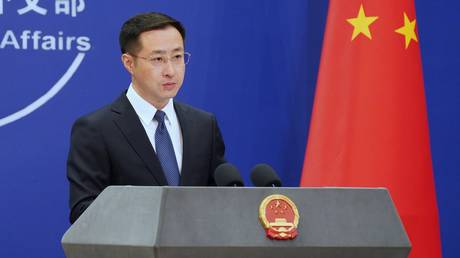
China’s response to the proposed US legislation—articulated by Foreign Ministry spokesperson Lin Jian as a commitment to take "all necessary measures" to protect domestic enterprises—is backed by a sophisticated regulatory and financial infrastructure designed to absorb external economic shocks.
                        ┌──────────────────────────────┐
                        │   China's Trade Defense      │
                        └──────────────┬───────────────┘
                                       │
         ┌─────────────────────────────┼─────────────────────────────┐
         ▼                             ▼                             ▼
┌──────────────────┐         ┌──────────────────┐         ┌──────────────────┐
│ Financial        │         │ Legal            │         │ Supply Chain     │
│ Isolation        │         │ Countermeasures  │         │ Diversification  │
└────────┬─────────┘         └────────┬─────────┘         └────────┬─────────┘
         │                            │                            │
  - CIPS expansion             - Anti-Sanctions Law         - Strategic reserves
  - Renminbi settlement        - Blocking statutes          - Alternative pipelines
1. Financial Isolation and Non-Dollar Clearing
The primary vulnerability of any sovereign facing US secondary sanctions is exposure to the clearing systems of the US dollar. To neutralize this vulnerability, China has systematically expanded its alternative financial plumbing.
- The Cross-Border Interbank Payment System (CIPS): While CIPS still relies on the SWIFT messaging protocol for a portion of its international transactions, it has developed independent, direct-point communication channels that bypass Western financial intermediaries entirely.
- Bilateral Renminbi Settlement: The share of China-Russia bilateral trade settled in Renminbi (RMB) and Rubles has climbed to nearly 100 percent. By removing the US dollar from the transaction loop, both nations prevent the US Office of Foreign Assets Control (OFAC) from directly monitoring or blocking payments.
- Non-Sanctioned Financial Intermediaries: To insulate major state banks from secondary sanctions, Beijing utilizes smaller, regional banks with zero US footprint or dollar exposure to handle the financial transactions related to Russian energy imports. If the US sanctions these entities, the systemic impact on the global financial system is negligible, and the banks' operations continue unimpeded within domestic borders.
2. Legal and Regulatory Countermeasures
In recent years, Beijing has codified a series of laws that force domestic and foreign companies operating within its borders to reject foreign sanctions.
- The Anti-Foreign Sanctions Law: This statute provides the legal basis for Chinese courts and regulators to penalize any enterprise—including foreign multinationals—that complies with US secondary sanctions to the detriment of Chinese entities.
- The Blocking Statute: Similar to the European Union's blocking regulation, this mechanism allows the Chinese government to declare foreign sanctions null and void within its sovereign jurisdiction, protecting domestic companies from complying with US dictates.
These legal structures create a "double-bind" for multinational corporations operating in China. If they comply with US tariffs and sanctions by terminating contracts with Russian energy buyers, they face severe regulatory penalties, asset seizures, or market exclusion within China.
Why the Economics of the 100 Percent Tariff Threat Fail
A tariff is fundamentally a tax on the domestic consumer of the importing nation, not just a penalty on the foreign exporter. If the United States imposes a 100 percent tariff on Chinese manufactured goods or industrial inputs as a penalty for Beijing purchasing Russian energy, the economic fallout will propagate rapidly through the US economy.
The Elasticity Bottleneck
The US manufacturing base remains heavily dependent on Chinese intermediate inputs, including critical minerals, active pharmaceutical ingredients, and electronic components. Imposing a 100 percent tariff on these goods would trigger a massive supply-side shock.
- Inability to Substitute: For many critical components, alternative supply chains in North America or allied nations do not exist at scale. The time required to build equivalent domestic manufacturing capacity is measured in years, if not decades.
- Inflationary Amplification: Imposing high tariffs on Chinese goods to punish energy imports would directly feed into domestic US inflation. US businesses would face choice between absorbing the cost, which destroys margins, or passing the cost to consumers, which erodes purchasing power.
- Unintended Subsidies: If the bill successfully forces China to reduce its purchases of Russian oil, that oil must find other buyers or be shut in. A sudden reduction in global oil supply would drive international crude prices significantly higher. This spike would increase the revenues flowing to Moscow for its remaining exports, completely undermining the stated objective of the legislation.
This dynamic explains why the legislation grants the US President broad waiver authority. The executive branch needs a mechanism to avoid triggering an domestic economic crisis in the pursuit of geopolitical goals. However, the frequent use of waivers signals to market participants that the tariff threat lacks credibility, reducing its effectiveness as a deterrent.
Strategic Forecast: The Fragmentation of the Global Energy Trade
The push for a 100 percent tariff on third-party energy buyers marks a clear inflection point in global trade policy. Rather than forcing compliance, this aggressive stance accelerates the creation of a permanently bifurcated global economy.
The international energy market is dividing into two separate ecosystems: a Western-aligned system characterized by strict transparency, high compliance costs, and G7 pricing limits; and an independent, non-aligned system that prioritizes volume, security, and alternative currency settlement.
As Washington continues to expand the use of secondary economic tools, the marginal return on these sanctions will decline. The defensive financial architectures and alternative supply lines established by major powers like China are no longer temporary workarounds. They are structural realities.
Over the next decade, the primary risk for global businesses will not be navigating the compliance requirements of a unified trade system, but managing the operational friction between these two competing, incompatible economic orders. Corporations must adapt by decoupling their regional supply chains, establishing independent financing nodes, and accepting that the era of a single, highly efficient global market has ended.