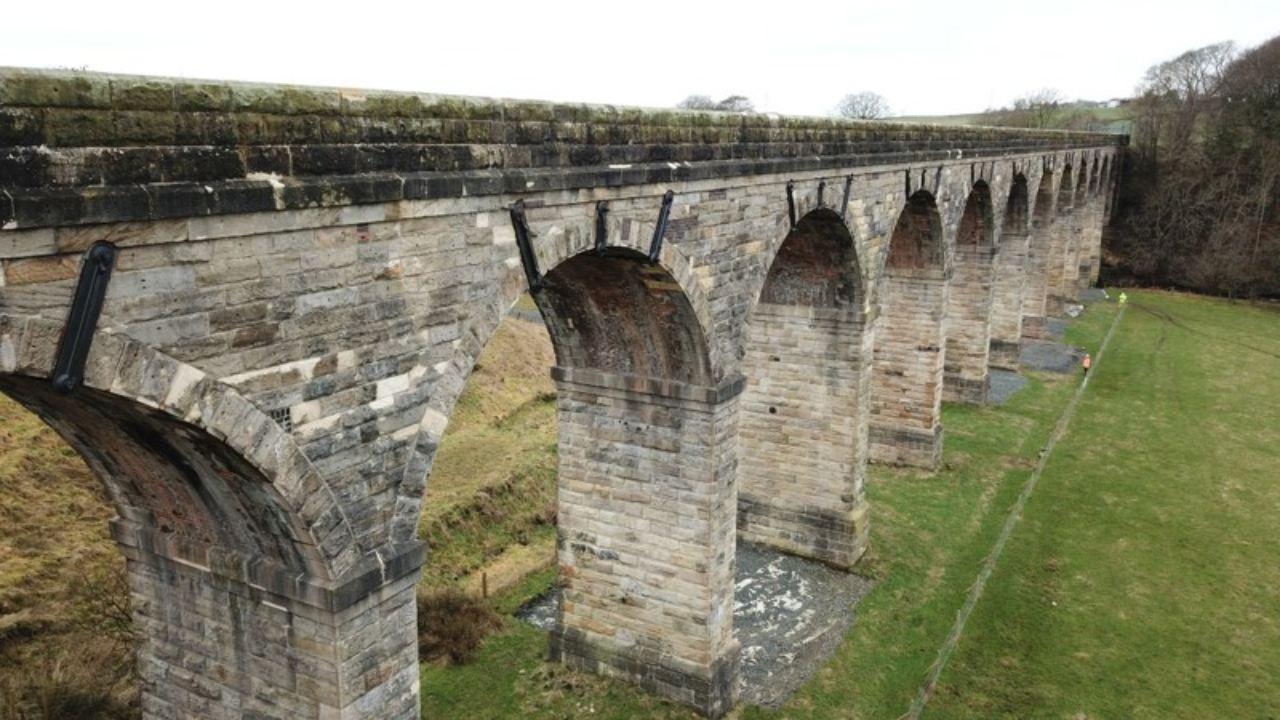
Allocating £2 million to rehabilitate an 1854 Scottish railway viaduct while integrating concealed bat roosts is not a charity exercise in wildlife preservation; it is a calculated risk-mitigation strategy designed to prevent statutory work stoppages and structural degradation. Standard reporting frames these dual-purpose infrastructure interventions as quaint compromises between industrial heritage and environmentalism. That framing misses the operational reality. In modern civil engineering, ecological integration is a direct function of regulatory compliance costs, thermal mass dynamics, and lifecycle asset management. When managing 19th-century masonry assets across the United Kingdom, failing to engineer habitats into the structural fabric turns protected species into a severe financial liability.
The Regulatory Cost Function of Protected Habitats
To understand the capital allocation behind a £2 million viaduct restoration, one must first analyze the legal constraints governing European Protected Species (EPS) under UK and Scottish law. All bat species in Scotland are strictly protected under the Conservation (Natural Habitats, &c.) Regulations 1994. Disturbing a roost—even unintentionally during essential structural maintenance—constitutes a criminal offense.
In traditional infrastructure projects, ecological compliance is treated as an externalized hurdle cleared prior to mobilization. On 19th-century masonry structures, this linear approach fails. Lime mortar joints degrade over a 170-year lifecycle, creating deep fissures, voids, and micro-cavities within the spandrel walls and arch rings. Bats exploit these structural defects as roosting sites. If a contractor simply repoints the masonry without mitigation, they destroy an active roost, triggering immediate statutory enforcement, site shutdowns, and project delays that easily exceed the cost of the restoration itself.
The capital expenditure of £2 million breaks down into three distinct operational layers:
- Structural Stabilization: Core drilling, grouting, and repointing with breathable lime mortar to restore load-bearing capacity and prevent water ingress.
- Ecological Licensing and Mitigation: Pre-construction emergence surveys, seasonal work restrictions, and the acquisition of a NatureScot derogation license.
- Permanent Habitat Integration: Designing and installing concealed, maintenance-free roosting chambers directly into the masonry envelope.
By embedding the roosts permanently into the structure, the asset owner converts an unpredictable operational bottleneck into a fixed capital cost. Future inspection and maintenance cycles can proceed without repeating the multi-year ecological licensing loop, because the protected habitat is mapped, isolated, and structurally self-contained.
Thermodynamic and Structural Mechanics of Masonry Roosts
A viaduct built in 1854 possesses specific physical properties that make it uniquely suited—and uniquely vulnerable—to biological colonization. Constructed primarily of dressed stone, rubble infill, and hydraulic lime mortar, these structures exhibit high thermal mass. They absorb solar radiation slowly during the day and release heat gradually at night, buffering internal cavities against rapid ambient temperature swings.
For insectivorous bats, particularly species like the Common Pipistrelle (Pipistrellus pipistrellus) or Daubenton’s bat (Myotis daubentonii), which frequently forage along the river corridors spanned by railway viaducts, thermal stability is the primary determinant of roost viability. A roost must maintain stable humidity and avoid freezing temperatures during winter torpor while offering warmer microclimates for maternity colonies in summer.
Traditional bat boxes bolted to the exterior of a bridge fail on two fronts:
- Thermal Volatility: Thin timber or woodcrete walls lack the mass to buffer Scottish temperature extremes, resulting in high mortality or abandonment.
- Maintenance Liability: Exterior attachments degrade under freeze-thaw cycles, create snag points for debris during flood events, and require periodic removal during structural bridge inspections.
Concealing the roosts within the viaduct solves both engineering problems. By carving out dedicated chambers behind the face stones or utilizing existing non-structural voids within the abutments, engineers exploit the viaduct’s natural thermal inertia. The stone exterior shields the internal cavity from wind chill and direct precipitation.
However, integrating a void into a load-bearing masonry structure introduces mechanical risks that require precise management:
- Moisture Migration: Bats generate metabolic moisture and guano. If trapped against stone or lime mortar, acidic waste and condensation accelerate localized chemical weathering and freeze-thaw spalling.
- Load Path Disruption: Removing rubble infill or stone blocks to create a cavity alters the compressive stress distribution across the arch or pier.
- Access Geometry: Entry slits must be narrow enough (typically 15mm to 20mm) to exclude avian predators and prevent wind-driven rain from penetrating the chamber, yet positioned away from active rail vibrations and water runoff channels.
Engineers mitigate these risks by lining concealed chambers with inert, non-absorbent materials—such as specialized concrete-wood composites or slate baffles—separated from the structural masonry by a damp-proof membrane. This isolates the biological waste from the historic stonework while preserving the thermal transfer from the surrounding stone mass.
The Lifecycle Economics of Heritage Rail Assets
The £2 million price tag must be evaluated against the replacement cost of the asset and the operational penalties of network disruption. Constructing a new multi-span rail viaduct across a Scottish valley today requires tens of millions of pounds in capital, years of environmental impact assessments, and massive embodied carbon expenditure. Extending the service life of an 1854 structure by another century through targeted masonry intervention yields an exceptional return on invested capital.
In asset management terms, Network Rail and regional heritage trusts operate under strict availability mandates. A single day of unplanned line closure on an active passenger or freight route incurs tens of thousands of pounds in delay attribution penalties. Even on disused lines converted into active travel corridors or heritage railways, structural failure creates catastrophic public liability and blocks vital regional transport links.
The ecological integration acts as an insurance policy for asset availability. Consider the counterfactual scenario: an asset manager executes a purely utilitarian masonry repair, sealing all cracks and crevices to maximize water resistance. Within three years, natural thermal expansion and micro-cracking create new fissures. Bats colonize the unmapped voids. When the next five-year detailed examination (DEX) identifies structural movement requiring intervention, engineers discover an active maternity roost directly over the failure point. Work halts entirely between May and August—the peak window for masonry repair in northern climates where lime mortar cannot be laid in freezing winter temperatures.
By proactively engineering designated, high-quality roosts into the viaduct during the £2 million overhaul, engineers concentrate the bat population into known, structurally safe zones. The rest of the masonry envelope can then be fully sealed and weatherproofed without violating conservation laws.
Operational Bottlenecks and Structural Limitations
While integrated ecological engineering represents a significant advancement over ad-hoc mitigation, it is not a universal solution. Practitioners managing similar civil engineering retrofits face four distinct constraints:
- Seasonal Construction Windows: Lime mortar requires ambient temperatures consistently above 5°C to cure properly without frost damage. Simultaneously, ecological licenses restrict noisy or intrusive work during peak bat maternity seasons (summer) and hibernation periods (winter). This leaves narrow transitional windows in spring and autumn for heavy structural work, compressing project schedules and driving up labor costs.
- Acoustic and Vibration Interference: On active high-speed or heavy-freight lines, dynamic axle loads generate low-frequency vibrations through the masonry. While bats tolerate consistent background noise surprisingly well, sudden structural resonance can cause roost abandonment, rendering the ecological investment useless if the chamber is placed too close to the trackbed rather than deep within the piers or abutments.
- Inspection Blind Spots: Concealed chambers cannot be easily accessed by standard visual inspection teams. Verifying structural integrity behind a sealed roost lining requires non-destructive testing methods, such as ground-penetrating radar (GPR) or endoscopic cameras deployed strictly outside sensitive ecological windows.
- Hydrological Vulnerability: Viaducts span rivers and valleys, placing lower abutment roosts at risk during extreme flood events. As climate shifts increase peak rainfall intensity in Scotland, engineers must calculate 1-in-200-year flood levels before siting concealed chambers in lower piers, lest they create an ecological trap that drowns hibernating colonies.
Strategic Execution for Infrastructure Asset Managers
Asset owners managing aging masonry infrastructure—whether rail viaducts, canal aqueducts, or highway bridges—must abandon the outdated model of treating ecology as a post-design compliance checklist. Regulatory frameworks across the UK and Europe are tightening toward mandatory Biodiversity Net Gain (BNG) metrics, making ecological integration a baseline requirement for capital project approval.
To execute these projects within budget and schedule constraints, engineering leads must implement three operational protocols:
- Front-Load Non-Destructive Diagnostics: Deploy endoscopic cameras, thermal imaging, and acoustic detectors at least 12 months prior to tendering construction contracts. Mapping the exact internal void structure and baseline biological occupancy eliminates the most common cause of mid-project variation orders and contractor standby charges.
- Standardize Modular Roost Inserts: Stop commissioning bespoke, on-site stone carving for every habitat requirement. Specify prefabricated, thermally conductive masonry inserts that match standard ashlar block dimensions. This allows stonemasons to swap out degraded stones for self-contained roost units during routine repointing without recalculating load paths.
- Decouple Habitat Zones from High-Maintenance Components: Never locate concealed roosts adjacent to drainage downpipes, expansion joints, or bearing plates. Isolate ecological features within static, high-mass zones like spandrel walls and upper abutments, ensuring that routine mechanical maintenance never triggers a statutory species disturbance.