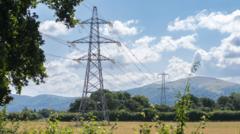
Linear infrastructure projects—such as high-voltage electricity transmission lines—frequently encounter a structural bottleneck: the friction between statutory entry powers and private property rights. The recent decision by Mrs Justice Jefford at the Cardiff Civil Justice Centre, granting a judicial review to over 300 farmers and landowners against Green GEN Cymru, exposes the financial and operational vulnerabilities of using aggressive statutory mechanisms to secure land access.
The core dispute centers on 200 kilometers of proposed overhead pylon routes spanning Powys, Ceredigion, Carmarthenshire, Montgomeryshire, and into Shropshire. Rather than a mere local property dispute, this case serves as a precise model for analyzing the regulatory risks, cost functions, and asset utilization delays that occur when infrastructure firms miscalculate local opposition and statutory limits.
The Cost Function of Infrastructure Delays
For an infrastructure developer, time is a highly sensitive variable within the capital expenditure (CapEx) calculation. The total cost of an infrastructure project is not merely the sum of raw materials and labor; it is highly dependent on the duration of asset underutilization and extended pre-construction phases.
The project's financial risk profile can be modeled through three distinct components:
- Pre-Construction Carrying Costs: The ongoing capital required to maintain engineering teams, environmental consultants, and legal counsel while physical access is blocked.
- The Cost of Capital: The longer a project remains in the planning or litigation phase, the higher the compounding interest on debt facilities, lowering the project's Net Present Value (NPV).
- Regulatory Penalty Risk: Transmission operators face strict grid-connection deadlines. Delays in connecting new renewable generation capacity can result in severe contractual and regulatory penalties.
Green GEN Cymru attempted to mitigate these risks by deploying Section 172 of the Housing and Planning Act 2016. This statute allows acquiring authorities to enter private land to execute surveys and valuations. The strategic objective was clear: accelerate the pre-construction phase by bypassing prolonged voluntary negotiations.
The firm's reliance on Section 172 created a profound counter-risk. By bypassing the traditional relationship-building phase, the developer triggered a collective legal defense response from community groups like Justice for Wales and the Campaign for the Protection of Rural Wales (CPRW). The resultant High Court undertaking—wherein Green GEN Cymru pledged not to enter land under these powers until an urgent interim relief hearing—effectively froze field operations, transforming an intended shortcut into a operational bottleneck.
Structural Flaws in Statutory Entry Compliance
The judicial review was granted on four distinct legal and operational grounds. These grounds reflect the specific friction points where corporate execution failed to align with statutory boundaries.
The Abuse of Discretionary Power
Acquiring authority status does not grant an infrastructure firm absolute sovereignty over private property. The court found it arguable that the firm executed its entry notices with unreasonable aggressive tactics. From an operational management perspective, utilizing field agents without transparent scheduling or communication protocols creates a high-variance environment. This variance often escalates into legal injunctions that completely halt data collection.
Procedural Impropriety
Statutory entry requires strict adherence to notification windows, precise geographical definitions of the land to be surveyed, and clear articulations of the scope of work. When an infrastructure firm issues boilerplate or overly broad notices, it fails the threshold of procedural transparency. The operational fallout is immediate: landowners can legally deny entry based on technical non-compliance, forcing the firm to re-issue notices and restart statutory clocks.
Biosecurity and Biodiversity Vulnerabilities
Agricultural land is an active economic asset with strict risk management parameters, particularly regarding pathogen control and ecological preservation. Forcing entry without demonstrating robust biosecurity protocols (e.g., vehicle disinfection to prevent disease transmission across farms) introduces severe operational risks to the landowner. The court's recognition of this ground highlights that infrastructure firms cannot treat commercial agricultural assets as passive terrain; they must treat them as highly regulated, high-risk operational environments.
Human Rights and Property Protection
Under the European Convention on Human Rights (specifically Article 1 of the First Protocol, protecting the peaceful enjoyment of possessions), any state-sanctioned intrusion by a public or quasi-public body must be proportionate. The legal challenge successfully argued that the firm’s methods crossed the line from a necessary public infrastructure intrusion to an disproportionate violation of private rights.
The Operational Alternative: Voluntary Access Frameworks
The structural breakdown in Wales demonstrates that statutory coercion is often less efficient than structured, market-rate voluntary access frameworks. When an infrastructure firm replaces coercion with a transparent commercial negotiation framework, the risk matrix shifts favorably.
The following table delineates the operational trade-offs between the Coercive Statutory Path and the Collaborative Commercial Path:
| Operational Variable | Coercive Statutory Path (Section 172) | Collaborative Commercial Path (Voluntary Access) |
|---|---|---|
| Initial Transaction Cost | Low (Standardized statutory notices) | Moderate (Negotiation of individual access fees) |
| Timeline Predictability | High risk of sudden, indefinite legal freezes | Linear, predictable timeline based on contract signing |
| Data Collection Quality | Poor (Hostile environments, restricted windows) | High (Cooperative landowners, comprehensive access) |
| Long-Term Litigious Risk | High (Judicial reviews, compensation disputes) | Low (Contractually bound dispute resolution) |
| Public Relations Capital | Heavily depleted (Triggers organized resistance) | Maintained (Local economic alignment) |
The collaborative path relies on treating the landowner as an essential vendor in the supply chain rather than an obstacle. By establishing standardized compensation rates for survey access, providing transparent biosecurity guarantees, and utilizing clear digital scheduling platforms, developers can systematically eliminate the friction points that lead to High Court injunctions.
The structural limitation of the collaborative approach is its vulnerability to holdout land parcels. In any linear project, a single non-cooperative property owner can break the continuity of the entire route. This reality means that statutory powers should never be discarded entirely; instead, they must be reserved strictly as a mechanism of last resort for uncooperative holdouts, rather than deployed as a baseline operational strategy for the entire project footprint.
The Strategic Shift in Infrastructure Risk Management
The granting of this judicial review signals a shifting paradigm for utility firms and energy developers across the United Kingdom. Linear infrastructure execution must evolve past the assumption that energy transition mandates grant an automatic pass through private property protections.
The final strategic play for infrastructure developers involves a re-allocation of pre-construction budgets. Capital must be shifted away from back-end litigation defense and front-loaded into robust, localized land agent teams who operate under strict codes of conduct. If a firm fails to price the cost of local compliance and biosecurity protocols into its initial operational model, the legal system will inevitably enforce those costs through project delays, damaged corporate reputations, and vacated statutory access powers. Developers who adapt by building transparent, high-compliance access frameworks will secure a distinct competitive advantage in executing the grid modernization required for the coming decades.