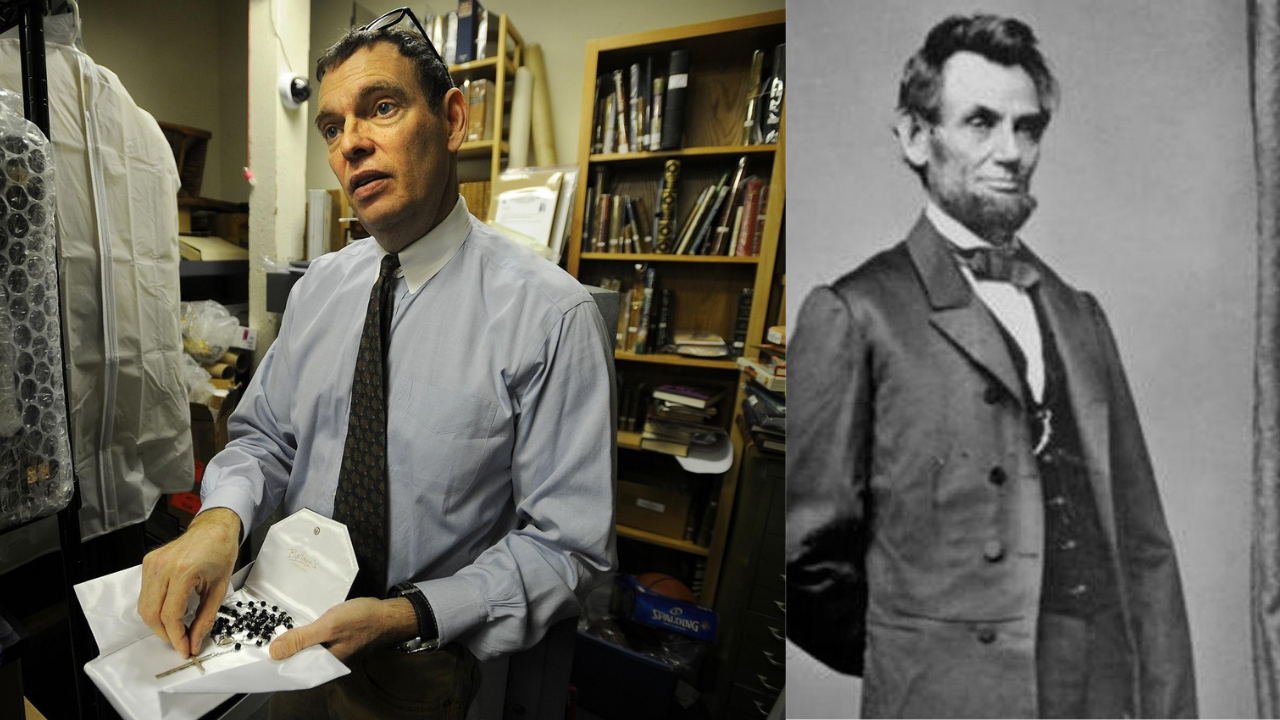
The alternative asset market operates on scarcity, provenance, and psychological friction. While traditional collectors allocate capital toward fine art, rare manuscripts, or numismatics, a distinct niche exists within historical hair collecting, often categorized under hairwork or celebrity relic acquisition. Analyzing a major collector such as John Reznikoff reveals the structural mechanics of how human biological artifacts acquire six-figure valuations. This analysis deconstructs the valuation model, supply constraints, and market dynamics governing historical hair as a financialized collectible.
The Valuation Framework of Biological Relics
Evaluating a strand of hair from an American president or historical figure requires a departure from standard asset pricing models. Unlike corporate equity or real estate, biological relics possess no intrinsic utility cash flows. Their market price is strictly a function of three variables: authentication certainty, historical significance of the subject, and physical preservation state.
Authentication remains the primary risk vector in this asset class. Because biological material lacks the standardized markers of minted coins or signed documents, valuation relies heavily on unbroken provenance trails. A lock of hair accompanied by a documented chain of custody from contemporary witnesses, estate sales, or institutional archives commands an exponential premium over unverified strands. The cost of authentication forms a high barrier to entry, insulating established portfolios from counterfeit influxes.
Significance operates on a power law distribution. Hair associated with figures who shaped geopolitical shifts or constitutional frameworks commands outsized valuations compared to minor historical actors. Abraham Lincoln or George Washington represent apex assets within the American historical artifact ecosystem. The market prices the historical gravity of the individual directly into the biological sample, converting physical mass into symbolic capital.
Supply Constraints and the Zero Elasticity of Historical Matter
The supply curve for historical hair is entirely vertical. No additional units can be produced, and the existing inventory degrades over time due to environmental factors such as humidity, light exposure, and organic breakdown.
Price / Valuation
      ^
      |                 / (Inelastic Supply Curve)
      |                /
      |               /
      |              /
      |             /
      |            /
      |           /
      +-------------------------> Quantity Available
This absolute scarcity creates unique market dynamics:
- Irreversible Degradation: Every handling event or environmental fluctuation introduces microscopic entropy, reducing the total pool of pristine biological material.
- Survivorship Bias: Surviving locks are disproportionately those that were preserved in controlled archival conditions, such as locket compartments or presentation frames commissioned by immediate contemporaries.
- Fragmentability: Hair can be divided into microscopic samples for DNA extraction or display, allowing collectors to trade fractional units while retaining the master corpus.
When supply is strictly fixed, shifts in institutional demand generate rapid price appreciation. As museums compete with private collectors for authenticated relics, the clearing price for premier specimens rises independently of broader economic cycles.
Market Liquidity and Transaction Friction
Alternative asset classes face liquidity constraints, and historical hair exhibits extreme illiquidity. The secondary market lacks continuous price discovery mechanisms like public exchanges. Transactions occur primarily through specialized auction houses, private treaty sales, or estate liquidations.
The bid-ask spread in this market is exceptionally wide. A collector seeking immediate liquidity may find only a handful of qualified buyers globally. Consequently, capital allocation into this asset class requires a multi-year investment horizon.
Transaction friction is compounded by specialized storage requirements. Preserving biological artifacts requires climate-controlled environments to prevent protein degradation, adding ongoing operational costs that traditional financial assets do not incur. The net present value of a collection must factor in these maintenance expenditures against projected terminal values at liquidation.
Institutional Demand Versus Private Accumulation
The buyer demographic splits into two distinct categories, each driving different pricing behaviors:
- Private Speculators and Collectors: Individuals seeking unique status symbols or tangible assets uncorrelated with public equity markets. Their acquisition criteria often include emotional resonance alongside historical pedigree.
- Institutional Archives and Museums: Universities, historical societies, and presidential libraries acquiring assets for permanent public exhibition. Institutions operate with different capital cost structures and longer holding periods, effectively removing acquired assets from active circulation permanently.
As institutional buyers absorb available inventory, the remaining float available to private speculators shrinks. This dynamic concentrates market power among early-stage aggregators who secured dominant positions before mainstream alternative asset recognition took hold.
Portfolio Risk Management for Biological Assets
Allocating capital to historical relics introduces non-standard risk vectors that require systematic mitigation.
Counterfeit risk represents the capital loss probability. Mitigation requires deploying multi-spectral imaging, microscopic examination, and, where permissible, mitochondrial DNA profiling against known descendant lineages to establish biological consistency.
Regulatory shifts also present latent risks. Changing cultural norms around the display and trade of human remains or biological derivatives can suddenly alter legal compliance frameworks across international jurisdictions. A prudent strategy accounts for potential legislative changes that could restrict cross-border transit of biological artifacts.
The historical relic market rewards systematic provenance tracking, deep capital reserves to weather illiquidity cycles, and rigorous authentication protocols. Biological artifacts remain extreme manifestations of sentiment-driven valuation, where physical scarcity intersects directly with collective historical memory.