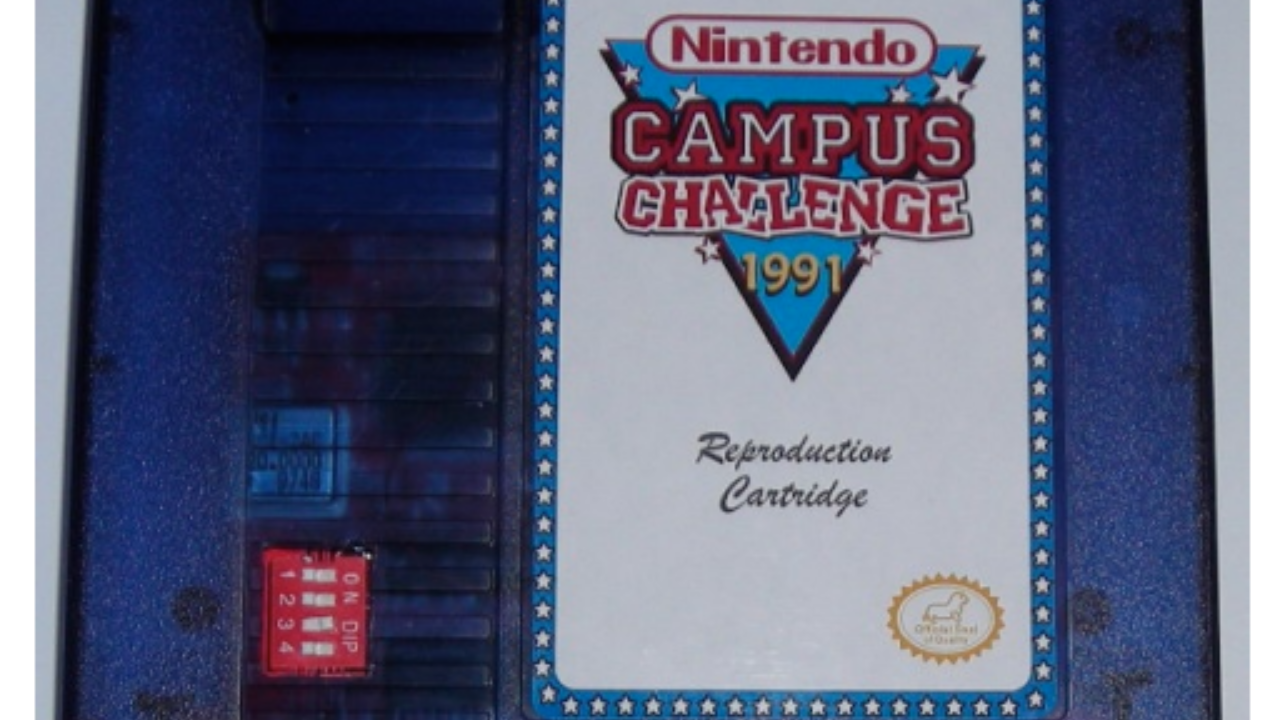
The value of vintage digital artifacts is governed not by their functional utility, but by the structural parameters of their initial distribution and the subsequent degradation curves of their physical substrates. When a physical medium is intentionally manufactured for a transient corporate promotional event and systematically scheduled for destruction, its economic profile shifts from consumer hardware to a hyper-scarce speculative asset. The 1991 Nintendo Campus Challenge cartridge represents a pristine case study in how corporate risk mitigation collides with secondary market scarcity dynamics to generate exponential asset valuation.
The Industrial Mechanics of Forced Scarcity
Scarcity in consumer electronics is typically an accidental byproduct of production bottlenecks or supply chain shocks. In the context of promotional competition hardware, however, scarcity is engineered by design. In 1991, Nintendo of America deployed custom multi-game competition cartridges across university campuses and state fairs to capture demographic mindshare and generate marketing momentum. These cartridges contained a customized, timed compilation featuring modified versions of Super Mario Bros 3, PinBot, and Dr Mario.
From an operational standpoint, maintaining these cartridges post-event presented a negative expected value for the corporation. Storing, inventorying, and servicing obsolete demonstration hardware incurred overhead without generating incremental revenue. More critically, allowing competition-exclusive software into open circulation risked brand dilution or unauthorized reverse-engineering of proprietary tournament tracking code. The corporate strategy was therefore absolute liquidation and destruction. Units were recalled, rendered inert, or physically dismantled.
This creates a primary economic bottleneck: the total addressable supply is artificially bounded by execution failure. When an institution mandates the eradication of an entire production run, any surviving unit functions as an industrial anomaly. The 2006 garage sale discovery of a 1991 Nintendo Campus Challenge cartridge, which subsequently commanded $20,100 at auction, is a direct outcome of this operational leak. A single inventory item evaded the destruction protocol, transforming a worthless piece of redundant plastic into a localized monopoly asset.
The Valuation Function of Unique Provenance
Valuing a unique historical artifact requires separating intrinsic utility from provenance-derived scarcity. The underlying silicon and read-only memory chips on a Nintendo Campus Challenge cartridge carry negligible utility value. Their ability to execute code is functionally identical to standard retail cartridges, and in fact, the software is constrained by a strict competitive timer. The valuation mechanism relies entirely on provenance verification and authentication against historical corporate records.
Three distinct risk variables dictate the pricing curve of such anomalies:
- Authentication Friction: The cost and difficulty of proving that a prototype or competition cartridge is genuine rather than a homebrew reproduction. Because the ROM code was never publicly distributed, authenticating the binary hash against known corporate archives is mandatory to clear institutional and high-net-worth collector hurdles.
- Physical Degradation Rates: The vulnerability of erasable programmable read-only memory chips and internal lithium batteries to bit rot and physical trauma over decades of unconditioned storage. A surviving unit found in a garage sale carries high variance in functional integrity.
- Liquidity Constraints: The thinness of the market for five-figure niche collectibles. Unlike standardized liquid equities, a rare gaming cartridge lacks continuous price discovery, meaning realized value is heavily dependent on auction house visibility and localized buyer competition at a specific point in time.
When the garage sale find sold for $20,100 in 2006, it established a baseline for institutionalized retro-gaming speculation. It proved that the collector market was willing to price in the historical narrative of corporate destruction alongside the physical object itself.
Secondary Market Dynamics and The Collector Equilibrium
The transition of promotional hardware from trash to high-value asset class alters the behavior of internal corporate stakeholders and external finders. When assets that were historically discarded suddenly command thousands or tens of thousands of dollars, the incentive structure surrounding corporate archives shifts. Employees are less likely to treat obsolete test kits or competition builds as refuse, introducing an influx of secondary supply that can theoretically depress valuations.
However, the 1991 Nintendo Campus Challenge hardware remains exceptionally insulated due to the strictness of the original purge. Unlike retail games produced in the hundreds of thousands, competition cartridges operated under strict logistical custody. The survivors are statistically near-zero. Consequently, increases in market awareness do not trigger supply surges; instead, they compress the bid-ask spread among elite collectors, driving valuations higher as institutional capital enters the hobby.
The interplay between institutional destruction protocols and consumer salvage creates a permanent asymmetry. The corporation optimizes for short-term legal and operational closure, while the secondary market optimizes for long-term historical completeness.
Strategic Allocation of Retro-Asset Capital
Deploying capital into hyper-scarce gaming hardware demands a rigorous evaluation of asset class risks. Traditional financial models break down when applied to unique artifacts because cash flow generation is zero. Returns are entirely reliant on the greater fool theory mediated by cultural preservation trends.
To evaluate a potential acquisition in this tier, capital allocators must bypass superficial nostalgia and execute a multi-variable audit:
- Verify the physical circuit board against known factory specifications to eliminate counterfeit ROM swaps.
- Assess historical documentation trails, including photographic evidence of discovery context and chain of custody.
- Calculate the opportunity cost of holding an illiquid physical asset compared to alternative alternative asset classes with yield generation.
- Model the downside risk of market sentiment shifts away from physical retro hardware toward digital preservation formats.
Scarcity driven by corporate oversight is an unrepeatable historical accident. As retro markets mature, the premium on hardware that survived intentional corporate destruction will continue to bifurcate from standard collector items, rewarding those who treat historical artifacts through the lens of industrial rarity rather than emotional attachment.