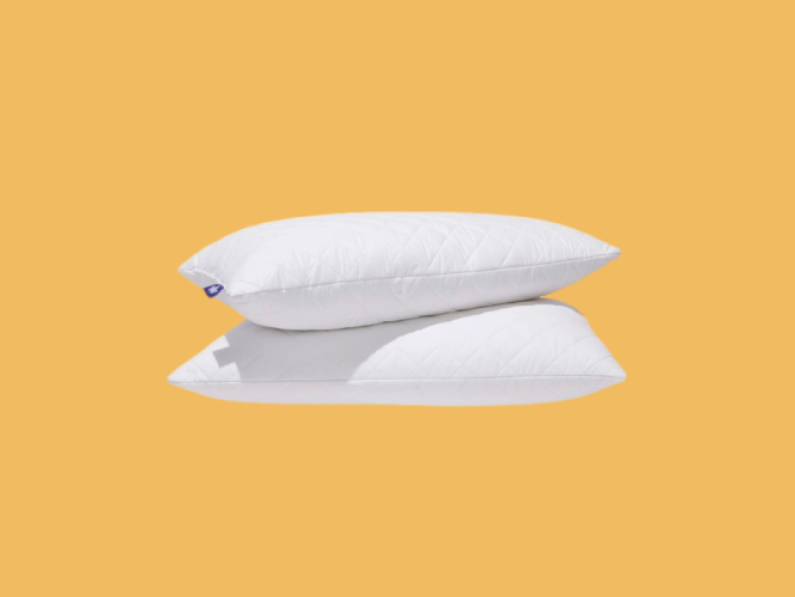
We spend a third of our lives horizontal, yet we treat the equipment for that time as an afterthought. We obsess over the ergonomics of a desk chair we sit in for six hours or the suspension of a car we drive for forty minutes. But when it comes to the eight-hour stretch where our spine is supposed to decompress and our brain literally washes itself of toxins, we settle for whatever lumpy rectangle was on sale at the department store.
It is a silent, nightly conflict. Your head weighs roughly eleven pounds. That is the weight of a bowling ball. For sixteen hours a day, your neck muscles and vertebrae work in a sophisticated architectural dance to keep that bowling ball upright. When you finally lay down, those muscles are screaming for a ceasefire. If your pillow is too high, you are essentially spending the night in a permanent, forced nod. If it is too low, your neck collapses toward the mattress, pinching nerves and overstretching tendons.
You wake up with that familiar, dull ache at the base of your skull. You call it "sleeping wrong." But you didn't sleep wrong. You were equipped wrong.
The Side Sleeper and the Gap of Agony
Consider Sarah. She is a side sleeper, like 74% of the population. When Sarah lies down on her side, there is a structural void between her ear and the tip of her shoulder. This is the "Gap of Agony." If her pillow is soft and dainty, her head drops. This puts her cervical spine into a lateral bend that would be considered a torture position in any other context.
For the Canadian side sleeper, the goal isn't just softness. It is loft. You need a pillow that acts as a structural bridge.
The Logan & Cove Luxury Pillow is often the victor in this category because it understands the physics of the shoulder. It uses a core of shredded memory foam and microfiber that can be added or removed. It mimics the density of a firm cloud. When Sarah rests her head, the pillow fills that gap entirely, keeping her nose aligned with her breastbone. Her muscles finally go slack. The war ends.
If she prefers something more traditional, the Douglas Adjustable Pillow offers a similar customization. The "human element" here is the realization that no two shoulders are the same width. A rugby player needs a different bridge than a prima ballerina. If you aren't adjusting the height of your pillow, you are gambling with your vertebrae.
The Back Sleeper and the Curve of Tension
Then there is the back sleeper—the person attempting the most "natural" posture. In theory, this is the healthiest way to sleep. In practice, it is a disaster if the pillow is too thick.
Imagine lying on the floor and having someone put their hand under your heels and lift them six inches. Your lower back would arch and ache. The same thing happens to your neck when a back sleeper uses a "fluffy" pillow. It pushes the chin toward the chest, obstructing the airway and straining the posterior neck muscles.
The back sleeper needs a cradle, not a mountain. They need something like the GhostPillow Lavender. It is engineered with a contoured memory foam that dips in the center. It supports the natural "C" curve of the neck while letting the back of the skull sit lower. It smells faintly of lavender, which sounds like a gimmick until you realize that your olfactory system is the only sense that doesn't sleep. It’s a sensory tether to relaxation.
The Stomach Sleeper and the Necessary Evil
We have to be honest about stomach sleeping. It is, from a physiological standpoint, a catastrophe. To breathe while on your stomach, you must turn your head 90 degrees to the side. You are essentially holding a "look behind you" pose for several hours. This stresses the facet joints of the spine and can lead to chronic tingling in the arms.
But habits are iron. If you cannot stop sleeping on your stomach, your pillow choice is a matter of harm reduction. You need the thinnest possible barrier between your face and the mattress. Anything thick will force your neck into an even more exaggerated, painful extension.
The Endy Pillow is a favorite in the Canadian market for this specific struggle. Because it uses shredded foam, a stomach sleeper can unzip the casing and remove nearly two-thirds of the fill. They are left with a whisper of a pillow—just enough to provide a soft surface for the cheek without cranking the neck toward the ceiling. It is the pillow for the person who actually hates pillows.
The Great Canadian Climate Variable
There is a factor we often ignore in the showroom: the temperature. Canada is a land of thermal extremes. A memory foam pillow that feels like a marshmallow in a 22°C store might turn into a brick in a bedroom that drops to 16°C in a Calgary January.
Standard memory foam is temperature-sensitive. It firms up when cold. If you like a cool room but hate a hard pillow, you have to look toward hybrid materials.
The Polysleep Pillow utilizes a specialized antimicrobial foam that maintains its structural integrity regardless of the thermostat. It also features a unique "foldable" internal structure. You can literally roll it up or flatten it out to find the exact millimeter of support you need. It acknowledges that humans are messy, changing creatures. We get hot, we get cold, we get restless.
The Invisible Stakes of the "Micro-Wakeup"
We often think that if we don't remember waking up, we slept through the night. This is a fallacy. When your pillow loses its support at 3:00 AM, your body registers the discomfort. You don't fully wake up, but you enter a "micro-wakeup." You shift. You punch the pillow to fluff it back to life. You roll over.
Every time this happens, you are kicked out of REM sleep or deep Stage 3 sleep. This is where the real damage occurs. Stage 3 is when your body repairs tissue and boosts immune function. REM is when you process emotions and solidify memories.
When you skimp on a pillow, you aren't just saving fifty dollars. You are taxing your cognitive clarity the next morning. You are choosing to be 10% more irritable, 15% less focused, and significantly more prone to "brain fog." The pillow isn't a bedroom accessory; it is a neurological tool.
The Lifecycle of a Dead Pillow
There is a grim reality to the pillows currently residing on most Canadian beds. They are biological archives. Over two years, a pillow accumulates dead skin cells, oils, and a thriving population of dust mites. In some cases, up to a third of an old pillow's weight can be attributed to this debris.
This isn't just a "gross" thought. It’s a respiratory one. If you wake up with a stuffy nose or "morning allergies," your pillow is likely the culprit.
The Silk & Snow Pillow addresses this with a focus on cleanliness and airflow. Using a combination of shredded memory foam and a down-alternative microfiber, it allows air to circulate through the core. This keeps the environment dry—and dust mites loathe dry environments. The cover is a heavy, high-quality cotton that can be stripped and washed at high temperatures.
The Geometry of the Soul
We tend to look at pillows as soft things. We should look at them as geometric solutions.
If you are a side sleeper with broad shoulders, you are a rectangle looking for a square.
If you are a back sleeper, you are a curve looking for a cradle.
If you are a stomach sleeper, you are a flat plane looking for a sliver.
Most people go to a store and squeeze a pillow with their hands. This is useless. Your hands do not have the same weight or pressure points as your skull. You wouldn't test a pair of running shoes by sticking your hands in them; you shouldn't test a pillow by poking it.
The move toward adjustable pillows—like those from Douglas or Endy—is the most significant shift in sleep health in decades. It moves the power from the manufacturer to the sleeper. It admits that "one size fits all" is a lie told by companies that want to simplify their supply chain.
The Morning After
Imagine a morning where the first sensation isn't the need to crack your neck.
Imagine swinging your legs out of bed and feeling a lightness in your traps and shoulders, rather than that leaden tension that usually requires three cups of coffee to ignore. This isn't a luxury. It is the baseline of how a human being is supposed to function.
The right pillow won't fix a broken life, but it will give you the physical foundation to handle one. It is the silent partner in your ambition. When the lights go out and the Canadian winter howls against the window, the only thing that matters is the six inches of material between your heavy head and the cold world.
Stop fighting your skeleton. Give it the support it has been begging for since you were a child. The bridge to a better version of yourself is stuffed with foam, silk, and intention. It is waiting for you to lay your head down.
The bowling ball is heavy. It is time to let someone else hold it.