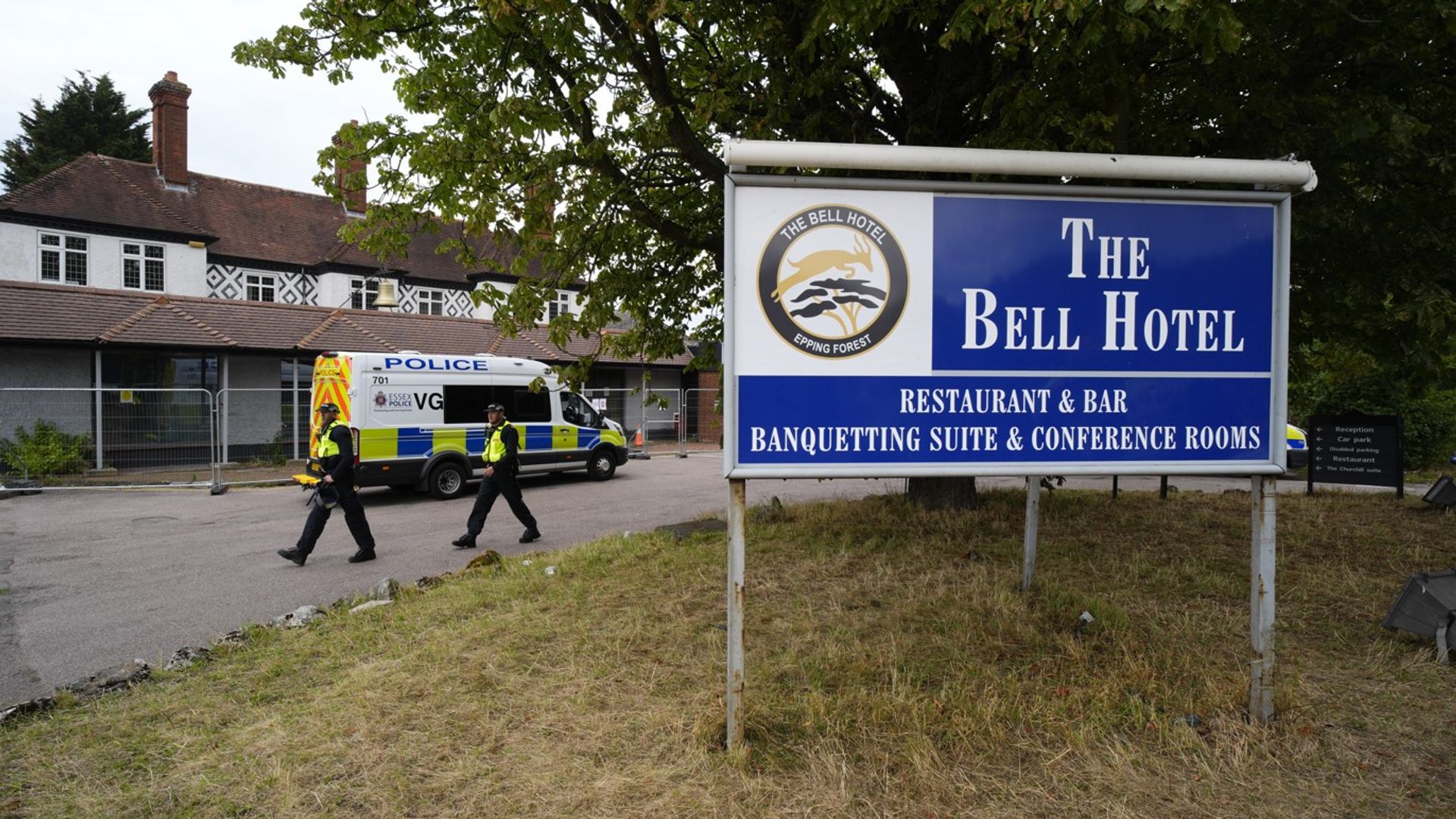
The gravel driveway of the Bell Hotel in Epping is quiet today. For the first time in months, there are no flashing police lights, no megaphones shattering the Essex evening, and no anxious faces peering out from behind upstairs curtains. Only the security guards remain, pacing the perimeter in high-visibility jackets, watching the rain hit the asphalt.
The building is entirely empty.
In a stark, sudden operation, the Home Office cleared every single resident from the property. They did it swiftly, citing fire safety regulations as the immediate catalyst. Even the Epping Forest District Council, which had spent the better part of the last year fighting a bitter, multi-layered legal battle over the building’s usage, was caught completely off guard. They found out only after the buses had gone.
To look at the official press releases, you would think this was merely a matter of bureaucratic sorting—a triumph of policy, or a technical fix for an unsuitable building. The government frames it as part of a broader, clinical initiative to reduce hotel asylum populations. But bureaucratic language has a way of smoothing over the jagged edges of human reality. It strips away the noise, the fear, and the profound unease that has gripped this corner of Essex for a generation.
The Friction of Two Truths
To understand what happened at the Bell Hotel, you have to step away from the court documents and stand on the High Street. Imagine a lifelong resident—let us call her Margaret. She has lived in Epping for forty years. She remembers the Bell as a place for wedding receptions, Sunday roasts, and familiar faces.
When the hotel was repurposed to house hundreds of young men from across the globe, the psychological geography of her home shifted overnight. Then came the flashpoint. Last year, a resident of the hotel committed a horrific sexual assault against a local fourteen-year-old girl.
For Margaret and thousands of her neighbors, abstract political debates evaporated. The threat felt immediate, visceral, and close to home. The protests that followed were massive, angry, and occasionally violent. The chants of "save our kids" were not just political slogans; they were the sound of a community pushed to its absolute psychological limit, feeling utterly abandoned by a distant central government that had dropped a global crisis onto their doorstep without their consent.
But look across the driveway to another hypothetical figure: Khadar, a young man who fled a conflict zone, crossed a continent, and ended up in a small room in Essex. For months, his entire world was bounded by those four walls and the terrifying sound of angry crowds outside. He did not commit a crime. He was simply waiting for a piece of paper to tell him if he had a future. When the crowds gathered, he pulled his blinds shut, listening to voices calling for his expulsion, terrified that the glass would shatter.
Both of these people were trapped in the exact same geographic space, yet they inhabited entirely different universes of fear.
The Illusion of Control
The local council tried to use the law to heal the fracture. They sought injunctions, arguing that using a commercial hotel as a long-term asylum facility breached planning regulations. It was a desperate attempt to regain control of a local environment that felt increasingly volatile. But the legal machinery of the state is blind to local heartbreak. The High Court, and later the Court of Appeal, dismissed the council's bids, ruling that the use of the hotel was legal and necessary under national policy.
The system kept grinding on, oblivious to the fact that the hotel had become what lawyers called a "feeding ground for unrest".
Then, with the stroke of a pen, the Home Office bypassed the legal deadlock entirely. They invoked fire safety—a cold, unarguable technicality—to achieve in a single morning what months of community outrage and local government litigation could not.
The residents were packed onto buses and moved to basic accommodation elsewhere, likely ex-military sites. The problem was not solved; it was merely relocated. The tension was not resolved; it was just unplugged.
The Quiet That Follows
The departure of the residents leaves behind an eerie vacuum. For the critics of the hotel program, this is a victory, an assertion that a small town cannot be forced to absorb the pressures of a broken global immigration apparatus indefinitely. For the advocates, it is a reminder of the profound instability faced by people who are moved like chess pieces across a map, with no say in their own destiny.
The Bell Hotel stands silent now, its windows dark. The protests will stop. The counter-protests will fade away. The police will redeploy their resources elsewhere. But the underlying fractures in Epping—and in dozens of towns just like it across the country—remain completely untouched.
We are left with an empty building, a traumatized community trying to find its footing, and a group of displaced people waking up in a new, unfamiliar room, waiting for the next decision to be made for them.
The buses have left, but the ghosts of the conflict still linger on the quiet Essex tarmac.
Epping Bell Hotel Asylum Crisis
This broadcast offers a rare, direct perspective from an asylum seeker who lived inside the hotel during the height of the legal battles and local tensions.