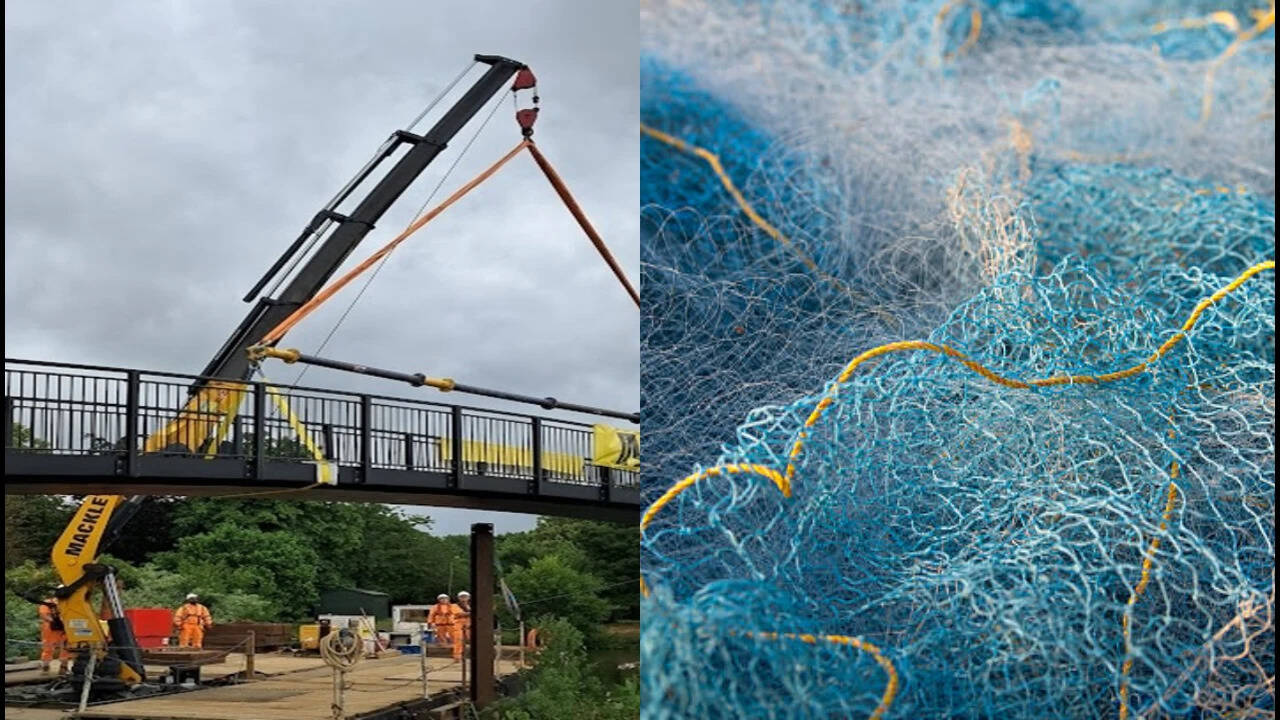
Modern civil engineering operates on a linear extraction model that prioritizes virgin material procurement over structural upcycling. When municipal authorities specify construction components, the economic incentives favor newly synthesized polymers or mined aggregates, externalizing the environmental cost of disposal. The deployment of a 16-metre pedestrian footbridge constructed from decommissioned commercial fishing nets in England challenges this paradigm by substituting virgin petrochemical inputs with recovered marine high-density polyethylene. Evaluating this case requires examining the material science of degraded polymers, the mechanical thresholds of structural elements, and the supply chain constraints governing waste recovery.
The Material Science of Marine Polymer Degradation
Discarded commercial fishing nets are predominantly composed of high-density polyethylene, nylon, or polypropylene. Prolonged exposure to ultraviolet radiation and marine salinity induces polymer chain scission, photo-oxidation, and mechanical abrasion. These environmental stressors reduce molecular weight and introduce surface embrittlement, rendering standard polymer processing unpredictable.
To transform degraded marine plastic into a structural asset, the recovery pipeline must account for heterogeneity. Commercial nets frequently contain metallic rigging elements, biological fouling, and mixed polymer fractions. The remediation sequence requires thermal washing, shredding, and compounding with stabilizers to arrest ongoing degradation.
Virgin high-density polyethylene exhibits predictable tensile strength and melt flow indices. Recycled marine polymer, conversely, presents a variance in crystallinity. Structural engineers cannot rely on nominal material data sheets when specifying recovered inputs; they must apply probabilistic safety margins that accommodate batch-to-batch variation in polymer chain length. The footbridge functions not because the material matches virgin specifications, but because the engineering design compensates for lower tensile predictability through over-dimensioning and geometric optimization.
Structural Typology and Load Path Mechanics
Spanning 16 metres without intermediate supports introduces specific bending moments and shear stresses that dictate the geometry of the load-bearing members. Traditional pedestrian bridges utilize steel trusses or reinforced concrete beams, where mass provides dampening against dynamic live loads like foot traffic.
A polymer-based structural element behaves differently under load. Thermoplastics exhibit viscoelastic creep, meaning continuous stress induces time-dependent permanent deformation. To mitigate creep in a 16-metre span, the bridge design avoids simple rectangular beam profiles in favor of hollow structural sections or composite configurations that maximize the second moment of area while minimizing mass.
The structural components are manufactured through rotational molding or extrusion techniques, shaping the processed netting into thick-walled profiles. These profiles distribute compressive forces along the upper chords while tensile stresses are managed through internal reinforcing integration. The mechanical stiffness of the footbridge relies on the geometric distribution of material rather than brute-force mass density. Deflection limits under maximum operational loads dictate the cross-sectional geometry, ensuring that the low elastic modulus of the recycled polymer does not result in excessive vertical displacement or harmonic vibration under pedestrian traffic.
The Economic and Logistical Cost Function
Scaling circular infrastructure from a bespoke demonstration project to a repeatable municipal standard involves overcoming a complex logistical cost function. The economic viability of marine plastic recovery is constrained by collection density, sorting labor, and transport overhead.
Fishing nets are notoriously difficult to aggregate at scale. Operating networks of port collection bins, incentivizing commercial fishers to return gear rather than discard it at sea, and executing manual dismantling of multi-material gear represent high fixed costs. The market price of virgin high-density polyethylene establishes a ceiling for recycled polymer economics. When virgin resin prices drop, the financial incentive for municipal procurement of recycled alternatives evaporates unless policy mandates or carbon-tax structures penalize virgin material usage.
Total Project Cost = Collection + Sorting + Compounding + Manufacturing + Verification - Carbon Offset Credit
In the case of the English footbridge, the economics were subsidized by environmental grants and corporate sustainability initiatives aimed at lifecycle analysis marketing. For this construction methodology to transition from a public relations asset to a standard municipal procurement category, the processing supply chain must achieve industrial economies of scale. Automated optical sorting and AI-driven polymer identification can reduce the labor burden of sorting marine waste, narrowing the cost gap between virgin and recovered inputs.
Carbon Accounting and Lifecycle Boundaries
The environmental justification for utilizing marine plastic rests on comparative lifecycle assessment metrics. Standard structural materials carry significant embodied carbon footprints. Primary steel production requires blast furnace reduction of iron ore, releasing metric tons of carbon dioxide per ton of output. Portland cement manufacturing involves the calcination of limestone, an inherently carbon-intensive chemical reaction.
Repurposing marine plastic avoids the emissions associated with virgin petrochemical synthesis, but the net carbon balance depends heavily on operational boundaries.
- Collection and Transport Phase: Marine collection vessels, trucking waste to processing plants, and shipping polymer pellets to molding facilities consume fossil fuels, adding baseline emissions.
- Processing and Compounding Phase: Thermal extrusion and stabilization require electrical energy input, which may or may not be derived from renewable grids.
- Displacement Phase: The carbon offset is realized when the structural element displaces a high-emission alternative like structural steel over a 50-year design life.
The net carbon savings of the 16-metre footbridge are real, but they represent a localized reduction rather than a systemic fix to industrial material flows. The global volume of discarded fishing nets—often termed ghost gear—represents a fraction of total global plastic waste. While structural upcycling removes high-impact marine debris from aquatic ecosystems, the absolute tonnage processed via civil engineering projects remains small relative to total polymer production.
Regulatory Compliance and Risk Allocation
Civil infrastructure is governed by stringent building codes and liability frameworks designed around traditional materials. Introducing non-standard polymers into load-bearing applications forces municipal risk assessors to confront regulatory ambiguity.
Standardized testing protocols for structural timber, concrete, and steel are codified by international standards organizations. Equivalent standards for structural elements manufactured from heterogeneous marine waste are nascent. Engineers signing off on a polymer footbridge assume professional liability for long-term creep, UV degradation under sustained loading, and fire resistance. Thermoplastics present distinct fire safety challenges compared to non-combustible steel or concrete; flame retardant additives must be compounded into the polymer matrix without compromising mechanical integrity.
Risk is managed through conservative engineering assumptions. By limiting the span to 16 metres and restricting the structure to pedestrian rather than vehicular traffic, the engineering team bounds the consequence of failure. As field data accumulates regarding the long-term weathering and structural integrity of marine-polymer composites, regulatory bodies will develop standardized certification pathways, lowering the administrative friction for future installations.
Scaling Municipal Circularity
The integration of waste polymers into public works highlights a structural shift in how municipal assets are procured. True circularity requires designing infrastructure with disassembly and subsequent recycling embedded in the initial specifications.
To scale this approach beyond isolated footbridges, regional authorities must establish centralized material banks that aggregate waste streams into predictable feedstock grades. Civil engineering curricula must incorporate polymer mechanics alongside traditional concrete and steel design modules. When structural designers possess fluency in thermoplastic behavior, material recovery facilities can transition from waste management centers to primary material suppliers for the construction sector.
Establish long-term municipal procurement quotas for certified recycled-content structural elements to guarantee baseline demand and stabilize private investment in processing infrastructure.