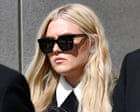
Conspiracy theories don't need facts to grow. They just need empty space. That's exactly why Erika Kirk, the widow of conservative activist Charlie Kirk, just filed an aggressive legal motion in a Utah courtroom. She wants every piece of evidence linked to her husband's assassination put on full display for the public. No closed doors, no hidden files, and no redacted viewing.
Charlie Kirk was shot and killed last September during an event at Utah Valley University. The high-profile nature of his death immediately triggered an explosion of online rumors, theories, and intense political finger-pointing. Right now, a preliminary hearing is happening in Provo, Utah, where a judge is deciding whether the 23-year-old suspect, Tyler Robinson, will stand trial for aggravated murder.
Erika Kirk isn't sitting back quietly. Her latest legal move targets a weird, frustrating reality of the court system: evidence is being admitted into the record, but people in the gallery—including Kirk's own family—can't actually see it. It turns out that keeping things in the dark is a great way to fuel Internet rumors, and Erika wants to shut that down before it gets worse.
The Fight for Total Courtroom Transparency
During the third day of the preliminary hearing, Erika Kirk's attorney, Jeffrey Neiman, dropped a three-page filing that takes direct aim at how the court handles evidence. The core argument is simple: you can't truly "bear witness" to a trial if the state is hiding the exhibits from your line of sight.
According to the filing, Erika and Charlie's grieving parents traveled to the Fourth District Court to see the process unfold. Instead, they found themselves sitting in a room where items were formally accepted into evidence but kept hidden from the public gallery. Neiman argued this setup directly violates Utah laws meant to protect the rights of crime victims and their representatives.
"They were present in body, yet denied the very thing their presence was meant to secure: their ability to meaningfully observe the preliminary hearing," the document states.
It goes on to make a bigger point about the world we live in. When people don't see the evidence with their own eyes, they start making things up. The filing explicitly warns that without complete openness, speculation and wild conspiracy theories about the assassination will keep spreading across the internet.
Neiman told State District Judge Tony Graf that blocking the public and the family from viewing these materials creates deep doubt and distrust in the judicial system.
Hidden Videos and Roof Evidence Behind Closed Doors
So, what exactly is the court keeping out of sight? The filing didn't name every specific item, but the weeklong hearing has already featured some incredibly sensitive and graphic material.
Prosecutors have video footage showing the chaotic moments when Charlie Kirk was shot while answering a question on campus. Because of its graphic nature, the state hasn't broadcast those clips publicly. The defense team, led by attorney Michael Burt, has also clashed with prosecutors over other surveillance videos. The state tried to present compiled footage showing Robinson walking onto campus and climbing onto a roof, but prosecutors added circled highlights, blurs, and zooms to make the suspect easier to spot. The defense complained that these edits could unfairly bias a future jury, prompting Judge Graf to initially block the altered videos until clean copies could be prepared.
There's also a messy fight over physical and forensic items found near the scene, including:
- A screwdriver left behind on the university campus roof.
- A Mauser 98 rifle discovered hidden in nearby woods.
- The towel the rifle was wrapped in.
- DNA evidence and ballistics tests that the defense claims don't conclusively match a bullet fragment taken from Kirk's body.
When the state introduces these items, they talk about them, but they don't always hold them up or display them on screens for the family or reporters to scrutinize. For Erika Kirk, that lack of direct visual access is a major problem.
The Push to Keep a Roommate's Confession Secret
The fight over what the public gets to see goes beyond physical weapons and security tapes. Robinson’s defense team is also fighting hard to bury a recorded interview with Lance Twiggs, Robinson’s roommate and romantic partner.
Twiggs spoke to investigators twice—once right after the September 10 killing, and again in April 2026. He was granted full immunity from prosecution in exchange for his statements. Prosecutors have a massive piece of evidence from him: a handwritten note Robinson allegedly left for Twiggs that reads, "I had the opportunity to take out Charlie Kirk and I'm going to take it." Robinson also allegedly texted Twiggs that he was sick of Kirk's "hatred."
Defense attorney Richard Novak tried to stop the state from playing Twiggs's interview in open court during this preliminary phase. He argues that prosecutors are trying to frame Twiggs's statements as an absolute confession by Robinson, which could ruin the defendant's chances of getting a fair trial down the road.
What Happens Next in Provo
This week isn't a full trial. Prosecutors don't have to prove Robinson is guilty beyond a reasonable doubt yet. They just have to show Judge Graf that they have enough probable cause to move the case forward. Given the DNA evidence, the security tapes, and the written notes, legal experts think the state has a very strong hand.
If Judge Graf decides the evidence is sufficient, Robinson will be formally arraigned, and the state will pursue the death penalty. Prosecutors are arguing for capital punishment based on the aggravating factor that the shooting happened at a crowded campus event, endangering thousands of people.
Erika Kirk's push for total transparency is an aggressive, smart strategy. She knows that in 2026, high-profile political court cases get torn apart by internet commentators looking for any gap in the narrative. By demanding that every single video, forensic report, and weapon be shown completely in the open, she's trying to lock down the facts before the narrative gets hijacked. Judge Graf hasn't ruled on her motion yet, but her message to the court is loud and clear: stop hiding the exhibits and let the world see the raw truth. If you want to follow the next steps of the proceeding, pay attention to whether the judge forces prosecutors to put those clean, unedited campus surveillance tapes on the public monitors tomorrow.