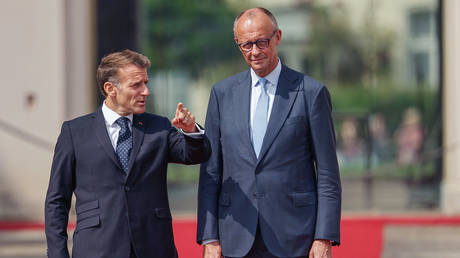
Brussels is finally waking up to an uncomfortable reality. For two decades, European capitals treated economic integration with China as an irreversible tide, assuming that commercial interdependence would inevitably translate into shared political norms. That complacency has shattered. Paris and Berlin are now pushing for an emergency trade instrument that officials privately describe as a commercial kill switch. This mechanism would allow the European Union to sever vital industrial supply chains, block critical technology transfers, and freeze financial assets belonging to state-backed foreign actors almost overnight if trade coercion crosses a threshold of economic hostility.
The demand for this emergency power did not materialize in a vacuum. Trade policy veterans watching the European Commission over recent years recognize a distinct shift from bureaucratic hand-wringing to genuine strategic alarm. Beijing’s dominance over critical raw materials, combined with aggressive state subsidies flooding European markets with heavily discounted electric vehicles and green technology, has left legacy manufacturing sectors exposed. When a single external power controls the refining capacity for over ninety percent of crucial rare earth elements, standard tariffs and diplomatic protests are mere paper shields. Policymakers in Western Europe realize they need an instrument capable of executing an immediate circuit breaker before domestic industrial capacity is permanently hollowed out. In other news, we also covered: Why A Widening US Trade Deficit Means America Is Winning.
The Mechanics of Economic Severance
Designing a functional commercial kill switch requires navigating a labyrinth of legal, political, and operational hurdles that would make any trade lawyer shudder. The European Union is an institution built on consensus, slow deliberation, and procedural checks. Crafting a tool that can bypass months of diplomatic stalling while remaining legally defensible under World Trade Organization rules is an immense structural challenge.
A viable emergency mechanism must operate on a dual track. First, it requires automated early-warning indicators that measure sudden drops in market access or coordinated economic retaliation against individual member states. Second, it demands a fast-track voting procedure within the European Council that strips national vetoes away from individual governments that might be vulnerable to bilateral financial leverage by Beijing. The Economist has also covered this important subject in extensive detail.
Consider a hypothetical scenario where a major European semiconductor manufacturer is suddenly hit with export bans on essential processing chemicals originating in Asia, ostensibly due to a localized regulatory dispute. Under current rules, coordinating a unified European response takes months of tedious diplomatic posturing, during which vulnerable supply chains experience catastrophic failure. A dedicated emergency instrument would empower the European Commission to implement immediate counter-measures, restricting reciprocal market access within seventy-two hours.
Industrial Vulnerability and the Overcapacity Crisis
To understand why Franco-German leadership is driving this hardline stance, one must look at the brutal arithmetic of industrial overcapacity. Chinese state-directed manufacturing output has outpaced domestic consumption by staggering margins, forcing industrial conglomerates to dump excess goods onto global markets at prices that defy traditional market logic. European automakers, chemical producers, and machinery manufacturers cannot compete against subsidized balance sheets backed by an authoritarian state apparatus.
This is not a temporary cyclical downturn. It is a structural divergence. European firms operate under strict labor laws, expensive environmental mandates, and high energy costs resulting from the decoupling from Russian gas. Competing against competitors who face none of these overhead burdens while enjoying preferential credit lines is mathematically unsustainable. The proposed trade intervention acts as a blunt acknowledgment that traditional free-market principles cannot survive when confronted with weaponized state capitalism.
Resistance Within the Bloc
Not every European capital is eager to pull the trigger. Export-heavy economies, particularly those with deep manufacturing ties to Asian supply chains, view aggressive interventionist policies with profound anxiety. These nations fear retaliatory tariffs targeting their luxury goods, machinery, and automotive exports, which could trigger a severe domestic recession.
This internal friction exposes the fundamental fragility of the European project when facing external geopolitical pressure. Consensus is difficult to forge when one nation's industrial base is being systematically dismantled while another's export portfolio is thriving on short-term trade volume. Overcoming this internal paralysis requires a radical realignment of political will in capitals that have historically prioritized short-term commercial gains over long-term geopolitical sovereignty.
The Global Ripple Effects
Implementing a functional trade kill switch will fundamentally alter the architecture of international commerce. If Brussels demonstrates the capacity to lock out targeted economic actors at a moment's notice, global multinational corporations will be forced into an unprecedented restructuring of their operational footprints. Dual-sourcing will no longer be a cautious risk-management strategy; it will become a mandatory requirement for survival.
Financial markets are already pricing in this era of fragmented globalization. Capital allocation is shifting away from cross-border efficiency toward regional resilience. The era of frictionless global trade built on mutual trust is dead. In its place rises a system of armed trade, where economic interdependence is treated as a strategic vulnerability rather than a diplomatic bond. The Franco-German demand for an emergency switch marks the formal acknowledgment that the old rules no longer apply.