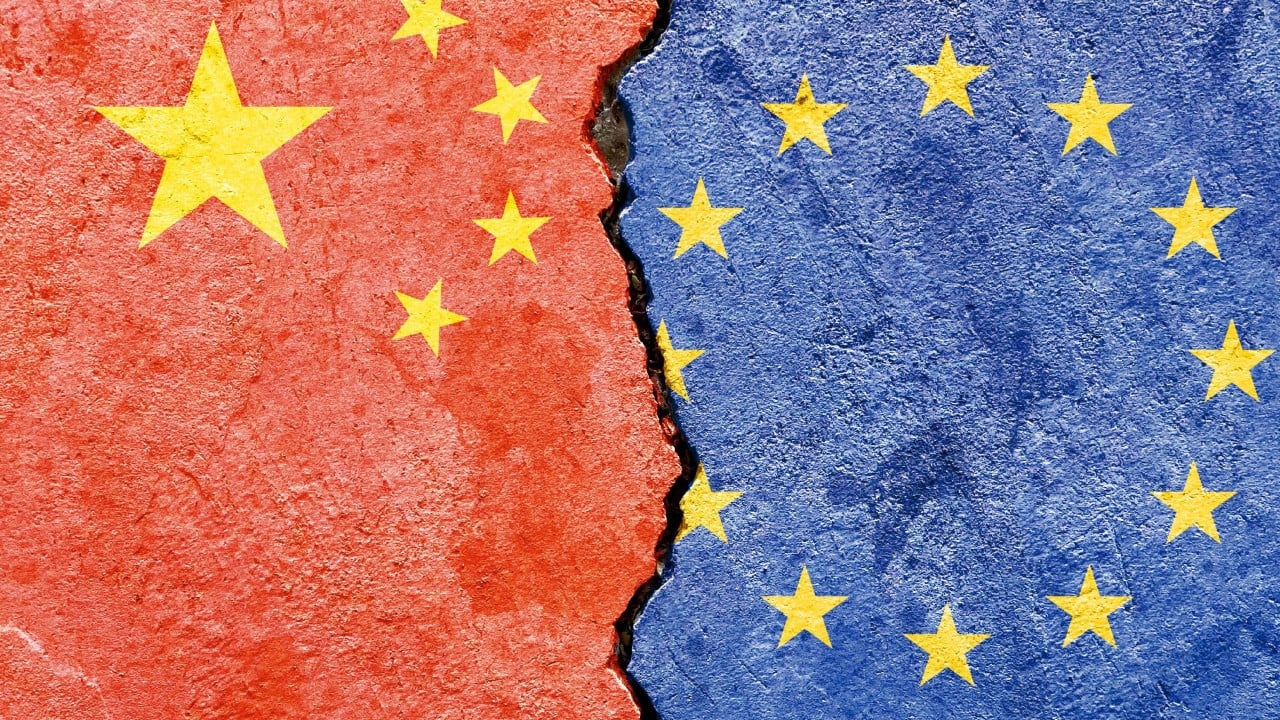
The lazy consensus echoing through the corridors of Brussels is that Europe has finally woken up, grown a spine, and officially ended its "naive" partnership with Beijing. Insiders love this narrative. It paints a picture of a newly unified continent boldly decoupling—or "de-risking"—to protect its sovereign industrial base.
It is a comforting bedtime story. It is also entirely wrong. You might also find this connected coverage interesting: The Geometry of Geo-Economic Mediation: Quantifying Hong Kong’s Structural Utility in APEC and Global Governance.
The premise that Europe can simply flip a switch from "partner" to "competitor" ignores the brutal reality of supply chain architecture. Europe is not decoupling from China; it is merely paying third-party intermediaries to hide its dependency. By treating geopolitics as a moral crusade rather than a balance sheet problem, European policymakers are systematically hollowed out by their own rhetoric. The real threat to Europe's economic sovereignty isn't Beijing's ambition. It is Brussels' economic illiteracy.
The Phantom Decoupling: Tracking the Transshipment Shell Game
When a European official boasts about reducing imports from China, look at the surging import data from Vietnam, Mexico, or India. As extensively documented in recent reports by The Economist, the effects are widespread.
The mechanics of modern manufacturing mean that "Made in Vietnam" is frequently just "Assembled in Vietnam using 90% Chinese components." This is the transshipment shell game, and Western trade data is blind to it.
Consider the automotive sector. Europe wants to build a domestic electric vehicle industry to rival BYD and Geely. To do this, Brussels levies tariffs on Chinese EVs. The intended result? A resurgence of European manufacturing. The actual result? European automakers still import the lithium-iron-phosphate (LFP) battery cells, the refined anode materials, and the permanent magnets directly from Chinese supply chains.
[Chinese Raw Materials & Components] ➔ [Southeast Asian/Mexican Intermediary Assembly] ➔ [European Final Market]
You cannot tariff your way out of a resource monopoly. China controls roughly 60% of global lithium refining, 70% of cobalt, and a staggering 90% of rare earth elements. When Europe bans the finished Chinese product but relies entirely on Chinese upstream inputs, it doesn't achieve strategic autonomy. It achieves a higher invoice price for the exact same dependency.
I have watched corporate boards burn millions of Euros trying to map "China-free" supply chains for industrial machinery. The conclusion is always the same: you can remove the Chinese logo, but you cannot remove the Chinese sub-components without making the final product economically unviable.
Dismantling the "People Also Ask" Flawed Premises
The public debate around this shift is warped by bad questions. Let's answer them with actual market logic rather than political spin.
Can Europe replace Chinese manufacturing with Friend-shoring?
No. The term "friend-shoring" is a geopolitical fantasy. It assumes that countries like India or Vietnam have the infrastructure, power grid stability, and deep component ecosystems to match Shenzhen overnight. They do not.
When a European firm moves assembly from Guangdong to Hanoi, the Tier-2 and Tier-3 suppliers remain in China. The shipping routes just get longer and more complex. You have added logistics friction, increased carbon emissions from transportation, and decreased supply chain visibility—all to achieve a political PR victory.
Will tariffs save the European automotive industry?
Tariffs are a tax on your own consumers that subsidize corporate complacency. By shielding legacy European automakers from Chinese competition, Brussels is removing the only incentive these companies have to innovate.
During my time analyzing industrial supply chains, the pattern is clear: protectionism breeds inefficiency. If Volkswagen, Stellantis, or Renault do not have to compete with a $12,000 Chinese EV on equal terms, they will continue to produce overpriced, technologically lagging vehicles. Meanwhile, Chinese automakers will simply redirect those vehicles to Latin America, the Middle East, and Southeast Asia, capturing the growth markets of the next three decades while Europe walls itself into an expensive, shrinking pond.
The Cost of Regulatory Overreach
Europe's core competency has shifted from industrial innovation to regulatory imperialism. While Washington funds technology and Beijing builds it, Brussels regulates it.
The Corporate Sustainability Due Diligence Directive (CSDDD) and the Carbon Border Adjustment Mechanism (CBAM) are prime examples. These frameworks are designed to force global supply chains to comply with European standards. In reality, they act as an exit tax for European businesses.
Imagine a medium-sized German Mittelstand company manufacturing specialized hydraulic pumps. To comply with Brussels' latest directives, they must audit every single supplier down to the mine of origin to ensure compliance with labor and environmental standards.
- The Chinese Supplier's Response: "We will not open our books to your third-party auditors. If you don't want our components, sell your pumps to someone else."
- The Outcome: The European manufacturer either loses access to vital components or operates in constant legal jeopardy, while its American and Asian competitors—unencumbered by the same level of bureaucratic micro-management—eat its market share.
This isn't strategic deterrence. It is regulatory suicide.
The Counter-Intuitive Playbook for European Industry
If you are running an industrial or technology enterprise in Europe, navigating this requires discarding every piece of advice coming from trade ministries. Stop preparing for a world where China doesn't exist. Instead, execute a strategy based on structural reality.
1. Execute an "In China, For the World" Bifurcation
Do not pull out of the Chinese market to appease domestic political pressure. Instead, split your corporate architecture into two distinct operating units.
Keep your Chinese operations deeply embedded in the local ecosystem. Use Chinese R&D, local supply chains, and local software talent to build products that can compete with hyper-aggressive domestic competitors. Then, use those insights to defend your position in neutral markets like Brazil or Indonesia.
Your Western division can handle the heavily regulated, lower-growth markets of Europe and North America using insulated, higher-cost supply chains. If you decouple your entire global apparatus from China, you lose access to the fastest iteration cycle in industrial tech.
2. Monopolize the Critical Chokepoints
Stop trying to compete on mass manufacturing where you have a structural disadvantage in energy and labor costs. Focus entirely on high-margin, irreplaceable chokepoints within the value chain.
The Dutch semiconductor giant ASML is the blueprint. They do not build smartphones or chips; they build the Extreme Ultraviolet (EUV) lithography machines required to make them. Without them, the global tech stack grinds to a halt. Europe needs to identify and dominate five or six similar micro-niches—such as advanced industrial robotics, specialized chemical polymers, or high-end maritime engineering—where China cannot easily replicate the institutional knowledge.
| Industry Segment | Legacy European Strategy | The Strategic Chokepoint Play |
|---|---|---|
| Automotive | Subsidizing domestic battery plants | Dominating solid-state electrolyte patents |
| Industrial Tech | Onshoring mass steel production | Monopolizing high-precision CNC software |
| Green Energy | Tariffing imported solar panels | Controlling grid-scale inverter architecture |
3. Price in the Geopolitical Premium
Accept that inflation is the structural feature of the next decade, not a temporary bug. If you are forced to source components from higher-cost jurisdictions to satisfy domestic regulations, pass that cost directly to the consumer as a "sovereignty premium." Do not absorb it in your margins hoping that supply chain efficiencies will magically reappear. They won't.
The Risk of Getting It Right
This contrarian approach is not comfortable. If you adopt a strategy of deep integration within China for your global operations while aggressively pursuing high-margin chokepoints at home, you will face criticism. Politicians will accuse you of lacking patriotism. Activist shareholders will demand divestment.
But the alternative is corporate obsolescence. The firms that blindly followed the political mandate to completely exit Russia learned a brutal lesson about asset write-downs. Doing the same with China—an economy fundamentally intertwined with the global financial system—would be catastrophic on an order of magnitude higher.
Europe’s leadership wants to believe that declaring an end to the partnership era solves the problem. It doesn’t. It merely replaces a complex economic relationship with a self-inflicted industrial blind spot. The winners of the next decade will not be the companies that wave the flag of strategic autonomy, but the ones that understand how to operate profitably within a permanently fragmented world.
Stop listening to Brussels insiders who have never managed a bill of materials. Your supply chain isn't a political statement. It’s a survival mechanism.