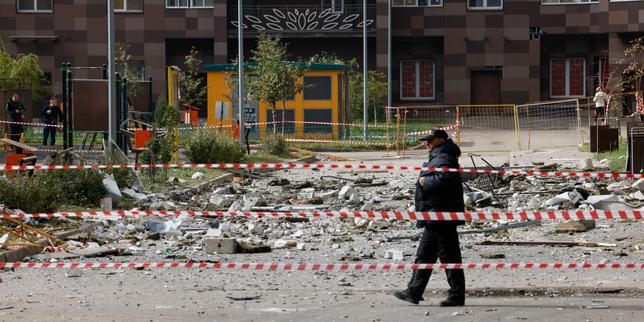
The lazy consensus in modern geopolitics relies on a comfortable, predictable script. When drones strike the heart of Moscow while Russian voters cast ballots in tightly managed legislative elections, the mainstream commentary machine spins into automatic gear. Analysts point to tactical escalation, psychological warfare, and domestic embarrassment. They treat these strikes as dramatic theatrical flourishes designed to disrupt a political charade.
They are looking right at the shiny object and missing the entire engine room.
Strip away the breaking news chyrons and the breathless updates about intercepted projectiles over the capital. Look at the structural reality of how modern attritional conflicts actually function. These strikes are not about scaring voters or puncturing Vladimir Putin’s aura of absolute control. Domestic political theater in an authoritarian state is remarkably resilient to kinetic pinpricks. The average Muscovite dodging falling debris or reading about it on Telegram channels is not suddenly going to draft a petition for regime change. In fact, external shocks in closed political systems historically trigger the opposite effect: a defensive consolidation around the flag, hardening public resolve rather than fracturing it.
So why launch them? Why expend high-value asymmetric assets on symbolic urban targets when military planners face brutal shortages of heavy armor, artillery shells, and long-range logistics along a thousand-kilometer frontline?
Because the entire strategic calculus of this war has shifted from territorial conquest to economic friction and political baseline recalibration.
Let us dispense with the fairy tale that modern military operations obey neat, symmetrical rules of engagement. I have spent years tracking supply chains, defense procurement bottlenecks, and asymmetric deterrence strategies across multiple continents. When a government authorizes deep-strike operations into a heavily defended adversary capital during a high-stakes domestic political cycle, they are executing a calculated play for asymmetry. They are forcing the enemy to reallocate strategic air defense assets away from active combat sectors just to protect bureaucratic headquarters and elite residential zones.
Every surface-to-air missile battery pulled from the southern or eastern steppes to plug the sky over Moscow is a victory for logistics-driven attrition. It is a trade of cheap, locally adaptable drones for multi-million-dollar defense infrastructure.
Yet, mainstream reports consistently frame these events through a lens of emotional narrative rather than cold mathematical optimization. Headlines scream about escalation thresholds and red lines crossed. Every time a drone hits a glass facade in the business district, pundits start hyperventilating about a wider conflagration. This is lazy thinking masquerading as prudence. The escalation ladder was burned to the ground years ago. Pretending that a few intercepted drones represent a dangerous new frontier of escalation ignores the daily reality of flattened cities and industrial-scale artillery exchanges hundreds of miles to the south.
To understand why this strategy persists, we have to look past the smoke and examine the mechanics of asymmetric pressure.
The Logistics of Attrition Nobody Wants to Calculate
Wars of position do not end with a sudden realization of error. They end when one side's mathematical capacity to absorb cost hits a hard ceiling while the other manages to sustain marginal advantages in logistics, intelligence, and domestic production capacity.
When commentators evaluate drone campaigns targeting national capitals, they focus almost exclusively on physical damage. That is a rookie error. Physical damage in a capital city during a long war is a rounding error. The real target is air defense saturation and psychological friction within the ruling technocracy.
Think of it this way. Imagine running a massive, highly centralized corporate bureaucracy where upper management demands absolute safety and zero operational friction in the home office. If competitors start lobbing cheap, disruptive items through the corporate windows every few days, executive focus shifts instantly. Meetings that should be about long-term strategy and supply chain optimization suddenly revolve around perimeter security, insurance premiums, and blame-shifting.
That is the actual payload of these strikes. They inject systemic friction into a system that desperately needs smooth, uninterrupted administrative execution to sustain its war machine.
Of course, this strategy carries severe structural downsides that cheerleaders of deep strikes prefer to ignore. Risk asymmetry cuts both ways. By normalizing attacks on the capital of a nuclear-armed state, planners validate the adversary’s domestic narrative of an existential struggle against external aggression. It provides the state apparatus with infinite ideological justification for further mobilization, stricter internal controls, and the total suppression of dissent. When the state can credibly point to incoming explosions in downtown Moscow, internal repression becomes an easy sell to a population that might otherwise experience the war as something happening far away on a television screen.
That is the paradox of asymmetric urban strikes. They force tactical adjustments and economic friction, but they simultaneously pay dividends to the adversary's domestic propaganda machine.
Why the Electoral Timing Is a Red Herring
Much has been made of the fact that these operations coincided with the final day of regional and legislative voting. The standard media narrative suggests a clever synchronicity—a message delivered directly to the ballot box, a stark reminder of vulnerability sent while citizens mark their papers.
This is romantic nonsense.
Elections in this context are not referendum moments where public sentiment shifts based on battlefield updates. The administrative machinery of control is too entrenched, the information ecosystem too tightly curated. Timing these operations around a voting cycle is less about influencing the actual ballot count and more about exploiting predictable patterns of media attention. Modern conflict is hyper-mediated. A strike that occurs during an ordinary Tuesday generates a blip; the same strike occurring against the backdrop of national elections guarantees maximum global visibility, saturating international information channels and keeping the conflict at the top of foreign capitals' policy agendas.
It is a public relations imperative masquerading as military strategy. And that brings us to the core vulnerability of the current approach.
When military operations are co-opted primarily for their signaling value in the global information space, strategic discipline starts to erode. Resources that could be conserved for decisive breakthroughs on primary axes of advance get diverted into high-visibility, low-yield publicity stunts.
The Brutal Truth About Modern Capital Defense
Let us address the questions everyone avoids in polite policy circles. Can a capital city ever truly be defended against modern loitering munitions?
The short answer is no. The economics heavily favor the attacker. A swarm of low-cost, domestically produced or grey-market components can be assembled for a fraction of the cost required to maintain, fuel, and fire a sophisticated interceptor missile system. When you force a state to protect an entire metropolitan sprawl containing millions of residents and thousands of square kilometers of critical infrastructure, you create an impossible defense problem.
Yet, the defensive response tells us everything about elite priorities. Notice how quickly air defense architecture solidifies around government quarters, intelligence headquarters, and elite financial districts while peripheral residential zones absorb the operational variances. The architecture of capital defense always mirrors the internal hierarchy of power.
This brings us to the uncomfortable reality that neither side wants to admit openly. Attrition wars are exercises in slow-motion exhaustion. They are won not by brilliant single strokes or dramatic drone videos over city skylines, but by relentless, unglamorous industrial output, secure supply chains, and the ruthless management of human and material capital.
Every hour spent debating the psychological impact of a shattered office window in a wealthy suburb is an hour stolen from the hard math of artillery production, electronic warfare countermeasures, and logistical depth.
Stop treating tactical pinpricks as strategic turning points. Stop looking at theatrical urban strikes as signs of imminent collapse or miraculous salvation. Look at the balance sheets, the manufacturing pipelines, and the raw calculus of survival. Everything else is just noise designed for an audience that prefers the drama of the spectacle over the grinding reality of the machine.