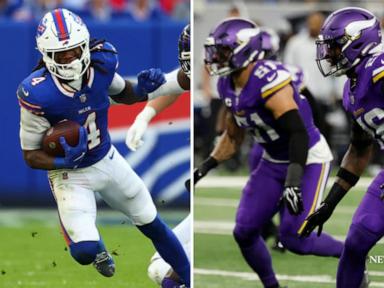
Turn on any sports talk show right now and you will hear the exact same lazy script about the upcoming Buffalo Bills and Minnesota Vikings showdown.
Fireworks. Track meet. Last team with the ball wins.
Every mainstream preview is selling you a high-scoring fantasy football bonanza between two explosive, high-flying offenses. They point to the quarterback talent. They point to the highlight-reel wide receivers. They point to the gaudy offensive yardage totals and assume these two teams are going to trade haymakers for sixty minutes until the scoreboard operator runs out of bulbs.
That consensus is not just lazy. It is structurally backwards.
If you are expecting an offensive clinic where both quarterbacks throw for 350 yards and four touchdowns, you are watching the tape with your eyes closed. The real story of a Bills-Vikings collision has nothing to do with aerial fireworks and everything to do with trench warfare, disguise-heavy defensive architecture, and which coaching staff blinks first when their primary explosive plays get taken away.
The Myth of the Guaranteed NFL Shootout
Sports media loves a simple narrative because nuance does not fit into a thirty-second television segment. When two franchises with dynamic offensive reputations collide, talking heads default to predicting a shootout. It feels safe. It sounds exciting. And historically, it is one of the most reliable traps in football analysis.
I have spent years breaking down NFL film and watching analytical models crumble when two supposed juggernauts meet. The public sees two high-powered offenses and assumes they will amplify each other. In reality, modern NFL defensive coordinators spend their entire week designing structural roadblocks specifically engineered to force high-variance offenses into slow, methodical, agonizing drives.
When you put Buffalo and Minnesota on the same field, you are not watching two track teams. You are watching two heavyweight fighters who both prefer to win by knockout, forced into a phone booth where neither has room to swing.
Let us look at the actual mechanics of how these two rosters operate under pressure. Both teams thrive on generating explosive plays—passes of twenty or more yards that flip field position and erase third-down situations. When those explosive plays are available, both offenses look unstoppable. When a defense takes away the vertical shot and forces twelve-play drives, both offenses suddenly look mortal.
Why Buffalo’s Offensive Identity Is Misunderstood
Ask a casual fan how the Buffalo Bills win football games, and they will talk about deep crossers, off-script quarterback magic, and relentless vertical aggression. That used to be true. It is no longer the whole picture.
Buffalo’s offensive evolution has been defined by a deliberate shift toward physical, ball-control pragmatism whenever defenses sell out to stop the deep ball. If you play two-high safety shells against Buffalo and refuse to let them beat you over the top, they will happily hand the football off twenty-five times, throw quick perimeter screens, and bleed the clock dry.
The mainstream previews miss this entirely. They treat Buffalo like a reckless sandlot offense that will force throws into double coverage just to satisfy highlight-reel expectations.
The Trap of the Two-High Shell
To understand why this matchup will grind down rather than explode, you have to understand two-high safety coverage—a defensive alignment where two deep safeties split the field in half before the snap, eliminating deep vertical seams and forcing the offense to throw underneath.
Against teams that live on explosive chunk plays, two-high shells act like a governor on a sports car. You can still drive, and you can still move the chains, but you cannot hit top speed.
- Patience becomes a weapon: Quarterbacks who want to hunt big plays must suddenly settle for four-yard checkdowns.
- Drive length doubles: Instead of scoring in four plays, an offense must execute eleven or twelve consecutive snaps without a penalty, a dropped pass, or a missed blocking assignment.
- Turnover probability spikes: The longer a drive lasts, the higher the statistical likelihood that the offense makes a self-inflicted mistake.
Buffalo knows this. Their coaching staff has spent seasons adjusting to defenses that refuse to give them easy vertical access. Yet the media still previews every Bills game as if defensive coordinators are going to line up in single-high man coverage and beg to get burned.
Minnesota’s Defensive Deception Is the Real Story
While everyone is busy drooling over Minnesota’s offensive skill players, they are completely ignoring the real reason the Vikings are dangerous in this matchup. Minnesota’s defense does not win by lining up and out-muscling you. They win by breaking your quarterback’s pre-snap processing.
Modern NFL offenses rely heavily on pre-snap indicators—subtle clues in defensive alignment, safety depth, and linebacker leverage that tell the quarterback where the blitz is coming from and which coverage is rotating behind it. When a quarterback knows the coverage before the ball is snapped, the game slows down.
Minnesota’s defensive scheme is built to erase those clues.
They crowd the line of scrimmage with six, seven, or even eight defenders, threatening an all-out blitz on every single down. Then, at the snap, half of those defenders bail into deep zone coverage while a cornerback or safety fires off the edge untouched.
How Simulated Pressure Kills Rhythm
This concept is known in coaching circles as simulated pressure—bringing four pass rushers from unexpected angles while dropping traditional defensive linemen into coverage.
You are not actually blitzing. You are still keeping seven defenders in pass coverage. But to the offensive line and the quarterback, it looks like a jailbreak.
Imagine a scenario where Buffalo’s offense breaks the huddle on third-and-six. They see seven Minnesota defenders standing on the line of scrimmage. The quarterback changes the protection at the line, sliding his offensive line to block the overloaded side and alerting his receivers to run hot routes. The ball is snapped. Three of those seven defenders immediately drop into the exact passing lanes where the hot routes are running, while a linebacker loops around the opposite edge with a clean path to the quarterback.
That is not a shootout environment. That is a cognitive minefield.
If Minnesota’s front can muddy the picture early, Buffalo’s offense will not be launching deep bombs. They will be spending four quarters trying to figure out who is rushing and who is dropping, taking sacks, throwing the ball away, and punting from inside their own thirty-yard line.
The Vikings Offense Has a Fatal Flaw Nobody Mentions
Now flip the field. Why won’t Minnesota simply turn this game into a track meet on their own?
Because Minnesota’s offense is fundamentally built on timing, rhythm, and pristine pocket integrity. When their offensive line holds up and the quarterback hits his back foot in rhythm, their passing attack looks like a surgical instrument. Receivers separate at the top of their routes, the ball comes out on time, and chains move effortlessly.
The problem is what happens when you disrupt the timing at the line of scrimmage.
Buffalo’s defensive philosophy under their coaching regime has always prioritized disguised zone coverage and disciplined rush lanes over reckless blitzing. They rarely send extra defenders. Instead, they rely on their front four to generate pressure while seven defenders read the quarterback’s eyes and squat on intermediate routes.
When you play a timing-based offense with disciplined zone defenders who refuse to bite on play-action fakes, the quarterback’s internal clock speeds up.
- The first read gets jammed: Physical cornerbacks disrupt the receiver’s release off the line, throwing off the route spacing by half a second.
- The second read is bracketed: Safeties rotate post-snap to take away the intermediate middle of the field, where timing offenses love to live.
- The pocket collapses: Without a clean step-up lane, the quarterback is forced to drift backward or bail laterally, turning a structured play into backyard improvisation.
Minnesota is elite when playing on schedule. They are profoundly uncomfortable when forced to play off-script against a disciplined four-man rush that keeps everything in front of them.
Dismantling the Common Misconceptions About This Matchup
If you look at the questions fans and bettors are asking leading up to kickoff, almost every single one is rooted in a flawed premise. Let us tear down the three biggest myths surrounding this game.
Myth 1: Whichever Quarterback Plays Cleaner Wins
This sounds smart on a broadcast, but it completely misses the tactical reality. Quarterbacks do not play in a vacuum. Turnover-worthy plays in a game like this are rarely the result of a quarterback suddenly forgetting how to read a defense. They are the direct byproduct of which offensive line loses its one-on-one matchups on early downs.
If Buffalo’s interior offensive line cannot handle Minnesota’s twists and stunts on first down, Buffalo will live in second-and-nine and third-and-eight. Nobody plays "clean" football when they are constantly forced to throw into predictable passing situations against simulated pressures. Conversely, if Minnesota cannot run the ball effectively on early downs, Buffalo will pin its ears back and tee off on their tackles. The game will be decided by the offensive guards and centers, not the quarterbacks.
Myth 2: The Team With Better Wide Receivers Has the Edge
Star wide receivers win games when the quarterback has three seconds to throw and single coverage on the outside. Neither coaching staff is going to allow that to happen.
Both defensive coordinators have spent their careers subscribing to the exact same core principle: make the other team’s third and fourth options beat you. You will see bracket coverage on the primary wideouts. You will see safety help rolled over the top of every vertical threat. The team that wins this showdown will not be the one whose superstar receiver goes for 150 yards. It will be the team whose tight ends, running backs, and slot receivers can consistently win ugly, four-yard slants and option routes in traffic.
Myth 3: Home-Field Advantage Guarantees Fast Starts
Pundits love to point to crowd noise and stadium energy as catalysts for early offensive momentum. In reality, extreme crowd noise and high-stakes environments often produce the exact opposite effect in the first quarter.
Communication breakdowns at the line of scrimmage lead to false starts, burned timeouts, and conservative play-calling early in the game. Coaches test the waters. They run the ball into stacked boxes to establish physicality. They throw safe screen passes to get their quarterback into a rhythm. Expecting a 14-14 tie at the end of the first quarter ignores how cautious NFL coaching staffs actually behave when facing an unfamiliar out-of-conference opponent.
Where the Contrarian Thesis Could Break Down
Intellectual honesty requires admitting how a contrarian argument can fail. If you are going to fade the public consensus and bet on a defensive, trench-driven slog, you have to acknowledge the exact variables that could blow that thesis apart.
There are two scenarios where this game actually turns into the track meet everyone is predicting.
First: Special teams and defensive touchdowns. Even the tightest defensive battle can turn into a high-scoring affair on the scoreboard if a muffed punt, a blocked kick, or a tipped-pass interception hands an offense the ball inside the opponent’s twenty-yard line. Short fields create cheap points. Cheap points force the trailing team to abandon its conservative game plan, opening up the vertical passing game and accelerating the pace of play.
Second: Early blown coverages. Both of these defenses rely heavily on post-snap communication and disguise. Disguise is a double-edged sword. When everyone executes their assignment, it looks like genius. When a safety and a cornerback miscommunicate a coverage check in the first quarter and leave a receiver running completely uncovered down the sideline for a seventy-five-yard touchdown, the entire script changes. Suddenly, the trailing coach panics, abandons the run game, and starts throwing forty-five times.
If the defenses hold their water in the first twenty minutes and force the offenses to earn every single yard, the grind-it-out script takes over. If a coverage bust gifts an easy touchdown early, all bets are off.
How to Actually Watch This Game Like an Insider
Stop watching the football. When the ball is snapped on Sunday, force yourself to ignore the quarterback for the first two seconds of the play.
If you want to know who is going to win this game before the fourth quarter even starts, watch three specific battles happening away from the spotlight:
- Watch the Minnesota linebackers at the snap: Look at how quickly they trigger downhill versus how fast they bail into their drop zones. If Buffalo’s offensive line is successfully sorting out the simulated pressures and keeping a clean pocket, Minnesota’s defensive magic trick is dead, and Buffalo will slowly suffocate them.
- Watch Buffalo’s defensive tackles on first down: If Buffalo can reset the line of scrimmage and force Minnesota into negative runs on first down, Minnesota’s play-action passing game completely vanishes. Without the threat of the run, Minnesota’s timing routes become predictable, and Buffalo’s zone defenders will feast.
- Watch the red zone execution: Because both defenses are built to bend without breaking between the twenties, both offenses will move the ball into scoring range. The difference between winning and losing will be which team settles for field goals from the twelve-yard line and which team punches it into the end zone using heavy personnel and power run concepts.
Stop Buying the Highlight-Reel Hype
The sports media industrial complex needs you to believe every marquee matchup is going to be an instant-classic offensive explosion. It sells commercials, drives clicks, and keeps casual fans glued to the screen.
Ignore the noise.
This Bills-Vikings showdown is not a beauty contest. It is a test of structural discipline, interior offensive line durability, and coaching patience. The team that tries to force the shootout the pundits are promising is going to throw three interceptions and lose by two touchdowns. The team that embraces the mud, takes the ugly four-yard gains, and protects the football will walk away with the win.
Turn down the volume on the pregame show and watch the trenches.