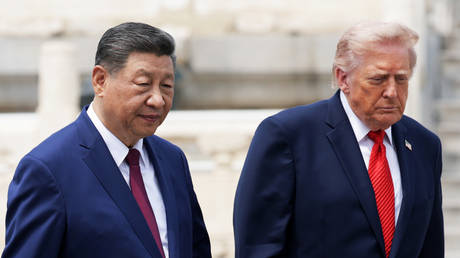
Diplomatic leaks don't happen by accident. When the Financial Times dropped a bombshell report claiming Chinese President Xi Jinping privately told Donald Trump that Vladimir Putin would "regret" invading Ukraine, it set off global shockwaves. Beijing moved at lightning speed to kill the narrative. Within hours, Chinese Foreign Ministry spokesman Guo Jiakun slammed the report as "completely false" and "fabricated out of thin air."
Then came the real twist. Donald Trump himself stepped up to the microphones at the White House and backed China up. "No, he never said that," Trump told reporters. Even Kremlin spokesperson Dmitry Peskov weighed in, noting that the Chinese had already thoroughly debunked the claim.
When Washington, Beijing, and Moscow all rush to deny the exact same thing, you know you are looking at something much bigger than a standard media dispute. This isn't just about whether Xi actually said those words during the high-stakes Beijing summit. It's about a highly coordinated, multi-national damage control operation. The real story isn't the denial. It's why all three superpowers are terrified of what happens if the public believes the leak.
The Strategic Nightmare of a Xi Putin Rift
To understand why Beijing panicked, you have to look at the calendar. The Financial Times report hit the press just days before Vladimir Putin was scheduled to touch down in Beijing for a massive symbolic summit. This wasn't just any regular meeting. The trip was timed to mark 25 years since Russia and China signed their historic friendship treaty, cementing the "no-limits partnership" they declared right before the 2022 invasion of Ukraine.
Imagine the diplomatic humiliation for Moscow if its most vital economic and political lifeline was caught trash-talking the war to Donald Trump just four days prior.
If Xi genuinely told Trump that Putin made a catastrophic mistake, it would signal a massive, tectonic shift in global alignment. China has spent four years walking a razor-thin tightrope. They refuse to publicly condemn the war, they keep buying Russian oil, and they keep Moscow's economy afloat. Yet, they also desperately want to avoid secondary Western sanctions that could cripple their own cooling economy.
A leak like this blows up that strategic ambiguity. It paints China as an unreliable partner to Russia and a hypocrite to the rest of the world. By forcefully killing the story, Beijing isn't just protecting its relationship with Putin. It's protecting its reputation as a steady, calculated superpower that doesn't talk behind its allies' backs.
Trump and the Art of the Three Way Coalition
The most fascinating part of this mess is Trump's immediate defense of Xi. Why would an American president go out of his way to validate a Chinese diplomatic denial?
According to sources familiar with the US assessment of the Beijing summit, the conversations weren't just about Ukraine. Trump reportedly floated a wild, counter-intuitive diplomatic play. He suggested that the United States, China, and Russia should actively join forces to challenge the International Criminal Court (ICC).
Trump has never hidden his disdain for international bodies like the ICC, viewing them as tools of judicial overreach that threaten American sovereignty. In his mind, finding common ground with Xi and Putin against a shared institutional enemy is basic pragmatism.
If Trump is actively trying to broker a grand trilateral understanding to de-escalate global tensions—including the war in Ukraine and the volatile conflict involving Iran—the last thing he needs is a media firestorm driving a wedge between Beijing and Moscow. Trump needs Xi to have maximum leverage over Putin to bring Russia to the negotiating table. If Putin thinks Xi is plotting against him with Washington, the whole house of cards collapses. Trump denied the quote because the leak threatened his own diplomatic playbook.
What Really Happened Behind Closed Doors
We know the official White House factsheet about the Beijing summit didn't say a single word about Putin or Ukraine. Diplomatic readouts are notoriously sanitized, designed to tell the public absolutely nothing of substance.
But let's look at the reality of where the war stands in 2026. The conflict has ground into a brutal, exhausting stalemate. Ukraine has turned to aggressive, highly effective drone warfare, relentlessly striking targets deep inside Russian territory. This is no longer the war Putin thought he would win in a week. It's a resource drain that is reshaping global trade and energy markets.
When Xi sat down with Joe Biden in the past, he kept things strictly formal. He discussed Russia and Ukraine in broad, direct terms but never offered a personal critique of Putin's judgment.
But Trump is a completely different kind of conversationalist. He pushes boundaries, speaks informally, and forces leaders out of their scripted talking points. It is entirely plausible that during a wide-ranging, hours-long meeting, Xi expressed tactical concerns about the economic fallout of a prolonged war. A nuanced, analytical comment about the long-term costs of the invasion could easily be interpreted by US intelligence officials as Xi hinting that Putin will "regret" the move.
The leak likely wasn't a total invention. It was a classic piece of intelligence weaponization. Someone within the US apparatus wanted to disrupt the upcoming Russia-China summit, and they used the media to drop a grenade right in the middle of it.
How to Read Global Intelligence Leaks
In the modern information ecosystem, you cannot take diplomatic denials or media bombshells at face value. To understand what is actually happening in global politics, you need to shift how you consume this kind of news.
First, always look at who benefits from the timing of a leak. When a report drops right before a major bilateral summit, the goal is almost always disruption. It forces leaders to spend their first three hours in a room doing damage control rather than negotiating real policy, like the Power of Siberia-2 gas pipeline Russia is desperate to finalize with China.
Second, watch for alignment among adversaries. When the US President, the Chinese Foreign Ministry, and the Kremlin all sync their public narratives to call a Western media report "pure fiction," the substance of the report matters less than the shared desire for stability.
The global order is incredibly fragile right now. Treat these explosive headlines as tactical maneuvers, not absolute truth. The real negotiations are happening in the silence between the denials.