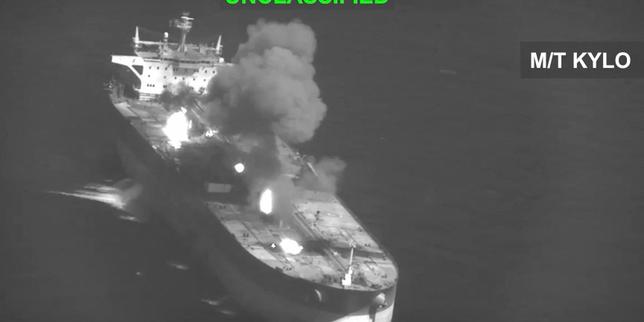
Every major media desk rushed to frame the recent U.S. strikes on three Iranian tankers in the Persian Gulf as standard retaliatory theater. The lazy consensus claims Washington is simply maintaining open maritime lanes and responding tit-for-tat to missile provocations near the Strait of Hormuz.
That narrative is dangerously naive. It misses the structural mechanics of modern energy choke points entirely.
Let us look at the actual physics of maritime logistics instead of swallowing Pentagon press releases whole.
The Logistics Fallacy
The mainstream media treats supertankers as static targets in a video game. When the Central Command reports neutralizing vessels near Kharg Island and the Gulf of Oman, pundits instantly calculate barrel shortages and scream about ninety-dollar Brent crude. They assume a damaged hull equals a permanent macroeconomic catastrophe.
It does not. I have watched corporations and state actors burn millions on asset replacement strategies while ignoring the actual supply chain elasticity.
A VLCC (Very Large Crude Carrier) is not a rare artifact. It is a floating commodity. When three tankers get hit, the structural vulnerability is not the steel on the water; it is the insurance underwriting and the shadow fleet routing algorithms. Iran does not need pristine state-flagged vessels to move crude. They rely on an opaque, decentralized web of dark-to-ship transfers that laughs at conventional naval strikes.
Blowing up three tankers does not choke Tehran's revenue stream. It merely updates the routing table.
Why Deterrence is Dead
For decades, military analysts have clung to the myth of proportional deterrence. The core assumption goes like this: if you hit our warship, we sink your asset to teach you a lesson, and rational actors step back from the brink.
Imagine a scenario where two heavily armed players sit in a burning room, both convinced that splashing water on the other guy proves total dominance, while ignoring the fact that the floor is soaked in gasoline.
Washington thinks it is sending a signal of strength. Tehran treats the loss of hulls as a negligible operational expense in an asymmetric war of attrition. By framing these engagements as isolated retaliations, the press hides the grim reality: the United States Navy is playing a high-cost tactical game against an opponent whose entire strategy is built on infinite strategic redundancy.
The Real Choke Point Is Information
Ask any commodities trader what actually moves the price of oil, and they will not point to a smoking hull off the coast of Jask. They will point to risk perception and freight rates.
The media focuses on the explosions because fire is photogenic. They ignore the invisible infrastructure of maritime insurance syndicates and satellite tracking loopholes. When underwriters reprice risk in the Persian Gulf, the cost multiplies across every barrel globally, regardless of whether a specific ship made it to port.
The U.S. strikes do not stop the flow of Iranian oil. They institutionalize a permanent risk premium that drains Western economies while Iran adapts its shadow logistics within forty-eight hours.
Stop looking at the smoke. Look at the balance sheets.