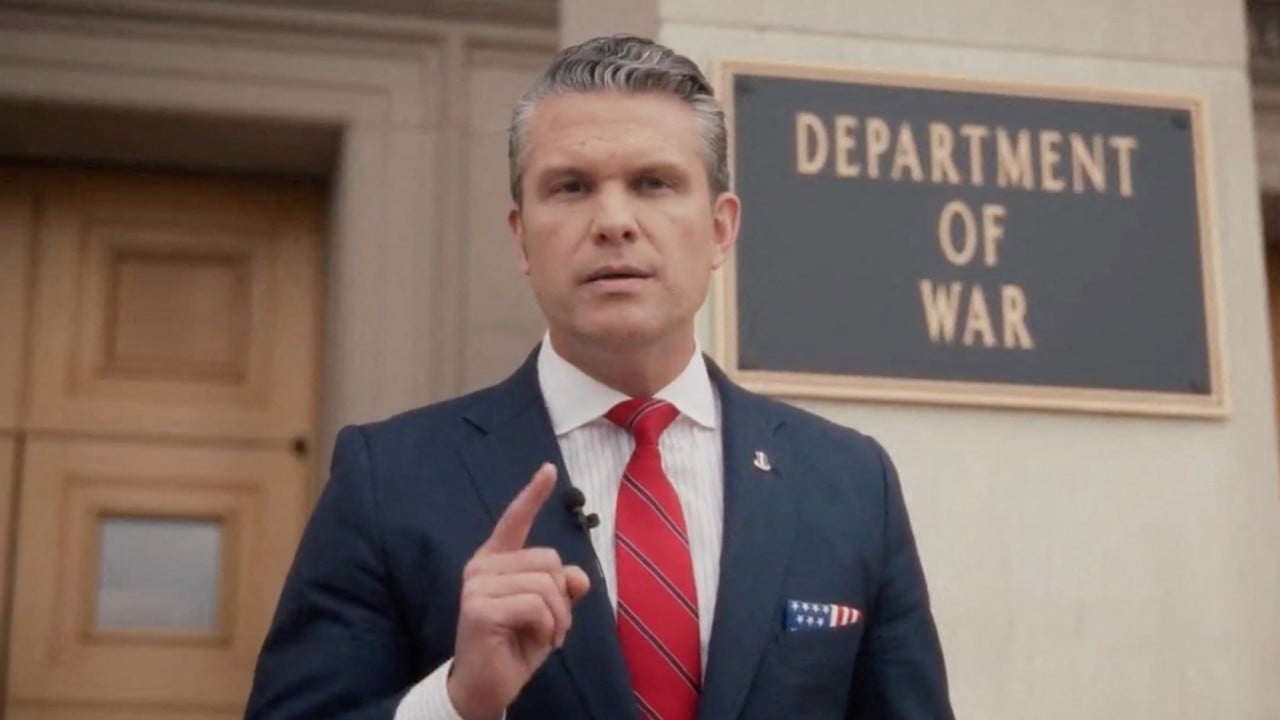
When a defense chief argues that military action against Iran is necessary while dismissing impeachment threats, two separate institutions collide: wartime executive discretion and legislative constitutional oversight. This analysis maps the structural logic behind that posture, separates confirmed constitutional mechanics from speculative outcomes, and examines where executive necessity arguments face hard legal, political, and operational limits.
The Structural Logic of the Competitor Framing
A headline pairing the necessity of war with the dismissal of impeachment compresses two distinct arguments into a single political signal. The first claim operates inside strategic and operational reasoning: portraying conflict with Iran as unavoidable shifts the burden onto opponents to explain how inaction protects national security. The second claim operates inside constitutional and political incentives: treating impeachment as a routine or futile threat signals confidence that legislative pushback lacks the votes, statutory leverage, or public momentum to alter military operations.
Evaluating that framing requires separating its components rather than reading them as one unified proof. Necessity is a strategic judgment about threat trajectories, deterrence, and force posture. Impeachment is a constitutional remedy governed by high thresholds, fact-finding hurdles, and partisan math. An official can be right about a tactical threat while miscalculating legislative endurance, or right about short-term congressional gridlock while underestimating how prolonged conflict reshapes political coalitions.
To analyze this dynamic rigorously, the underlying argument breaks down into three analytical pillars:
- Threat Necessity Framing: Defining adversarial actions or escalatory risks as acute enough to justify immediate kinetic or coercive action before diplomatic options are exhausted.
- Executive Authority Claims: Grounding unilateral or rapid military moves in Commander-in-Chief powers, force protection, or existing statutory authorities rather than waiting for fresh congressional authorization.
- Impeachment Discounting: Treating legislative removal threats as political theater that cannot pass constitutional hurdles or interrupt ongoing command decisions.
A common analytical error in coverage of such statements is treating rhetoric as an accomplished legal fact. Declaring an action necessary does not automatically satisfy statutory requirements or settle constitutional disputes between the White House and Congress. Dismissing impeachment does not eliminate other congressional tools, such as oversight hearings, subpoenas, funding restrictions, or war powers resolutions.
Constitutional Mechanics vs. Political Speculation
Analyzing executive war powers and impeachment requires strict separation between established constitutional rules and educated hypotheses about future events. Under the United States Constitution, the president serves as Commander-in-Chief while Congress holds powers to declare war, raise and support armies, and control appropriations. Statutory frameworks such as the War Powers Resolution of 1973 add reporting timelines and withdrawal mechanisms, though disputes over their scope and constitutionality have persisted across administrations for decades.
Impeachment follows an equally explicit procedural track. The House of Representatives holds the sole power of impeachment by a simple majority vote, and the Senate holds the sole power to try impeachments, requiring a two-thirds supermajority of senators present to convict and remove an official. Because those thresholds are high, impeachment rarely succeeds without broad cross-party alignment or overwhelming evidentiary shock.
By contrast, several critical elements of a conflict with Iran and any resulting political backlash remain hypotheses rather than settled facts:
- Escalation Pathways: Whether limited strikes or defensive engagements remain contained or trigger wider regional retaliation across maritime chokepoints, proxy networks, or air defenses.
- Coalition Durability: Whether domestic public opinion and congressional factions hold firm or fracture if casualties mount, energy prices spike, or timelines stretch beyond initial projections.
- Institutional Enforcement: Whether courts decline to intervene in political war-powers disputes and whether Congress relies on non-removal leverage instead of articles of impeachment.
Consider a conceptual example of how these mechanics diverge in practice. Suppose a defense leader justifies strikes on Iranian-linked assets as urgent force protection and waves off impeachment talk in the press. Even if impeachment never reaches a House floor vote, lawmakers on armed services and appropriations committees can still demand classified briefings, scrutinize munitions stockpiles, and press the administration on legal justifications. Dismissal of impeachment addresses the most extreme constitutional penalty, not the full range of friction Congress can generate.
Cause-and-Effect Chains Often Missed in War Rhetoric
Surface-level coverage often treats executive resolve and congressional pushback as static positions. In reality, military escalation and domestic political pressure interact through feedback loops that alter incentives over time.
Escalation and Authorization Feedback
When military operations begin under an argument of urgency, operational tempo can outrun legislative debate. Commanders focus on force protection, target sets, and deterrent signaling, while members of Congress face pressure not to appear to undercut troops once engagement is underway. That dynamic can temporarily mute impeachment talk in the short term.
The second limitation of relying on initial urgency is that early tactical momentum does not guarantee strategic closure. If retaliatory strikes hit regional bases, shipping lanes, or partner infrastructure, the cost function changes. What began as an argument for decisive necessity can turn into a debate over open-ended entanglement, giving critics stronger grounds to challenge executive authority.
Oversight vs. Removal Incentives
Politicians weigh multiple instruments when opposing an administration's war policy. Impeachment carries high stakes and high failure risk when one party controls the chamber or when evidence centers on policy disagreements rather than clear statutory or constitutional violations. Because a failed or purely partisan impeachment effort can backfire politically, lawmakers often prefer investigations, budget riders, or public messaging that keep pressure on the executive without risking a high-profile acquittal.
This creates a bottleneck for critics who want immediate operational restraint. Impeachment is a blunt instrument designed for high crimes and misdemeanors, not a rapid-response brake on military command. Expecting impeachment to stop a conflict misreads the tool; assuming impeachment threats mean nothing misreads how early rhetoric tests political boundaries.
Economic and Operational Trade-Offs
Even when exact casualty figures, strike counts, or market moves are unknown in advance, the underlying economic and operational mechanisms are clear. Conflict involving Iran touches global energy transit, regional air and missile defense inventories, and alliance coordination.
In energy markets, perceived risk around key transit routes can inject a risk premium into crude oil and shipping costs even before physical supply is lost. Higher energy prices transmit through supply chains and consumer fuel costs, which in turn shape voter sentiment and congressional urgency. Operational planners face a parallel resource constraint: high-end interceptors, precision munitions, and intelligence assets are finite over any given window, meaning sustained operations require attention to replenishment rates and theater allocation.
Strategy fails when leaders confuse short-term political insulation with long-term operational freedom of action.
From an organizational standpoint, defense leadership must manage two tracks at once: executing military objectives cleanly and maintaining institutional credibility with lawmakers who fund the force. Treating congressional pushback solely as noise can backfire if prolonged operations require supplemental funding, industrial surge support, or diplomatic backing from regional partners.
Analytical Limits and Blind Spots
Every strategic framework has boundaries, and over-applying game theory or constitutional mechanics can obscure human and diplomatic variables. War is shaped by miscalculation, signaling errors, and third-party actions that no single capital controls. Adversaries respond to perceived vulnerability as well as perceived resolve, and domestic allies often weigh their own political survival when crises widen.
Another limitation lies in information asymmetry. Public statements by officials are crafted for multiple audiences—adversaries, allies, troops, and domestic voters—simultaneously. Analysts who take public dismissal of impeachment at face value without watching behind-the-scenes committee engagements, legal memos, and budget negotiations risk mistaking posture for certainty.
Strategic Play for Decision-Makers and Analysts
Track three concrete indicators over the coming weeks rather than focusing on rhetorical exchanges alone: first, whether Congress moves from public warnings to formal oversight demands, subpoenas, or war-powers votes; second, whether administration legal and operational briefings provide clear objectives and exit conditions rather than open-ended necessity claims; and third, whether regional escalation alters energy costs or force-protection demands enough to shift congressional vote math. Anchor every assessment to verified constitutional rules and observable institutional actions, treating bold declarations of necessity or invulnerability as opening moves rather than settled outcomes.


