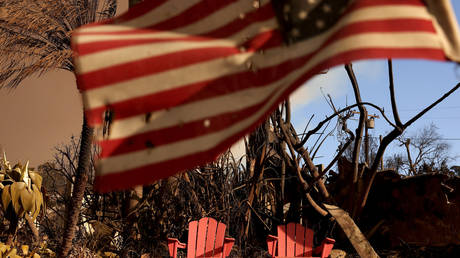
The screen door of Miller’s Hardware swung shut with a familiar, metallic slap that had bounced off the brick walls of Main Street for forty years. Inside, Joe Miller was wiping down a counter that didn't need wiping. Outside, the morning sun was hitting the pavement, heating up a typical July morning in Ohio. But something felt different. The massive canvas American flag that usually flew from the bracket next to the storefront was sitting in a cardboard box behind the counter. It wasn't torn. It wasn't dirty. Joe just hadn't felt like putting it out.
He isn't alone.
For generations, national pride in the United States was an ambient condition, as fixed and unquestioned as gravity. It was the air people breathed. You wore it on T-shirts, slapped it on bumper stickers, and belted it out at baseball games. But lately, that collective exhale of shared identity has grown shallow. The latest polling data from Gallup confirms what Joe felt in his bones: American pride has hit a historic low. Only 39% of adults say they are "extremely proud" to be American.
Think about that number. Less than four out of ten.
To understand how we arrived at this quiet fracturing of the American psyche, we have to look past the cold percentages and look at the kitchen tables where these shifts actually happen. National pride isn't a switch you flip. It is a slow-burning fire fueled by trust, shared memory, and a belief in a common trajectory. Right now, the wood is damp.
The Anatomy of the Drop
The decline didn't happen overnight. It has been a steady, agonizing drip. At the turn of the millennium, in the shadow of the September 11 attacks, patriotism spiked to an all-time high. In 2002, a staggering 70% of Americans expressed extreme pride in their country. It was a moment of fierce, collective defiance. But collective trauma is a fragile foundation for long-term unity.
Consider the trajectory of a single generation. A twenty-two-year-old entering the workforce today has no living memory of that post-9/11 unity. Their formative years were shaped by a different set of landmarks: the 2008 financial crash that upended their parents' lives, a grinding decade of political gridlock, a global pandemic that shuttered their schools, and an economic landscape where buying a home feels like a hallucination.
When you look at the data broken down by age, the fault lines become chasms. Among young adults aged 18 to 29, the percentage of those who are extremely proud to be American plummets to a mere 18%.
Eighteen percent.
That is more than a statistical dip; it is a cultural realignment. For these young people, the flag isn't a symbol of unblemished opportunity. It is a complicated tapestry woven with historical reckonings, economic anxieties, and systemic frustrations. They are not necessarily anti-American; they are disillusioned. They look at the promise of the American Dream and see a contract where the terms were changed without their consent.
The Partisan Divide and the Mirror
We often treat patriotism as a monolith, but it has always been interpreted through different lenses. The modern tragedy is that even the definition of pride has become tribal.
Historically, Republicans have maintained higher baseline levels of expressed national pride than Democrats. That gap remains wide today. The data shows that 60% of Republicans say they are extremely proud, compared to just 29% of Democrats and 34% of independents.
But look closer at the mechanics of those numbers. When a country is deeply polarized, national pride becomes transactional. It fluctuates based on who is occupying the Oval Office. For many, patriotism is no longer about the enduring ideals of the republic; it is about whether their team is winning the current political game.
This transactional pride creates a brittle society. If your love for your country depends entirely on the outcome of the latest election, then half the population is always living in a state of soft alienation. The shared ground shrinks until there is barely enough room for everyone to stand.
What We Lose When the Magic Fades
It is easy to dismiss this shift as mere semantics. Does it really matter what people tell a pollster over the phone on a Tuesday afternoon?
It matters immensely.
National pride is the social glue that makes a massive, diverse democracy functional. It is the invisible force that convinces a taxpayer in Oregon to care about a crumbling bridge in Kentucky. It is the impulse that drives young people to public service, to military enlistment, to volunteering in their communities. When that pride erodes, it is replaced by cynicism. And cynicism is a corrosive agent. It tells you that nothing is worth saving, that everyone is out for themselves, and that the grand experiment has failed.
Imagine a neighborhood where everyone stops caring about their front yards. At first, it’s just a few overgrown lawns. But soon, property values drop, crime creeps in, and the sense of community evaporates. Cynicism does that to a country’s soul. It turns citizens into mere residents.
The View from the Porch
Back in Ohio, Joe Miller eventually took the flag out of the box. He didn't hang it on the storefront, though. He took it home and draped it over the railing of his back porch, where only he and his family could see it.
He realized he wasn't angry at the country. He was tired. Tired of the noise, tired of the anger on the news, tired of feeling like his neighbors were turning into strangers.
The decline in American pride isn't necessarily an obituary for a superpower. It might be something else entirely: a painful, necessary reckoning. It is the moment a society realizes it cannot survive on nostalgia alone. The myths of the past are no longer enough to sustain the realities of the present.
To build that pride back up will require more than flag-waving or cheap political slogans. It will require fixing the machinery that broke the trust in the first place. It means creating an economy where young people can breathe, a political culture that values compromise over theater, and a societal grace that allows people to disagree without hating each other.
The sun began to set over Main Street, casting long shadows across the empty pavement. The flag on Joe's porch stirred slightly in the evening breeze, its colors muted by the twilight, waiting for a new dawn that felt far away, yet entirely possible.