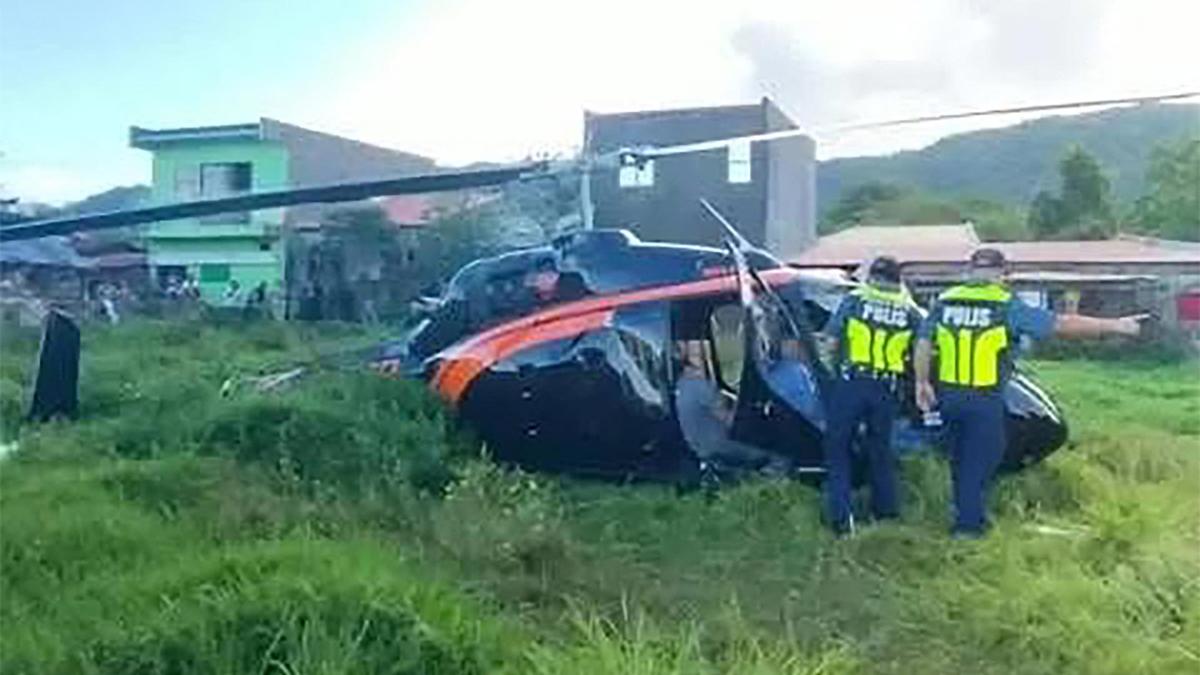
A routine flight turned into a localized catastrophe this week when a private helicopter attempted an emergency landing in the Philippines, resulting in two fatalities and three critical injuries. While early reports focus on the immediate chaos of the crash site, the real story lies in the systemic failures of maintenance oversight and the aging fleet of light aircraft operating in the region's challenging tropical environment. This isn't just about a single engine failure; it's about the thin margin for error when private operators push hardware to its absolute limit.
The aircraft, a multi-passenger light utility helicopter, went down in a rugged area, forcing rescuers to navigate difficult terrain to reach the wreckage. Initial assessments point toward a sudden loss of power, a nightmare scenario for any pilot, but particularly deadly at the low altitudes common for inter-island transfers. When an engine cuts out over dense foliage or uneven ground, the pilot has seconds to execute an autorotation—a maneuver where the air moving up through the rotors keeps them spinning. If the altitude is too low or the airspeed is insufficient, gravity wins every time.
The Illusion of Safety in Private Charters
The Philippines' geography makes helicopters more than a luxury; they are essential tools for connecting a fragmented archipelago. However, the surge in demand for private air travel has outpaced the regulatory body's ability to police every hangar. For many operators, the cost of genuine, manufacturer-certified parts and the rigorous inspection schedules required by international standards represent a massive drain on the bottom line.
Investigation logs from previous incidents in the region frequently highlight a "patch and fly" culture. In these cases, minor mechanical discrepancies—a slight oil leak, a vibrating tail rotor, or an aging fuel pump—are noted but not immediately rectified. The logic is usually that the part can "last one more cycle." This gamble ignored the reality that tropical humidity and salt air accelerate corrosion at a rate far higher than in temperate climates.
Why Engines Quit in the Tropics
A turbine engine is a finely tuned machine that requires a precise mixture of air and fuel. In high-heat, high-humidity environments, the air is less dense. This "density altitude" forces the engine to work harder to produce the same amount of lift. If an engine is already compromised by poor maintenance or "timed-out" components, the added strain of a hot-weather takeoff or climb can be the final straw.
When we look at the wreckage of this latest incident, investigators will be searching for signs of fatigue in the compressor blades or contamination in the fuel lines. These aren't "freak accidents." They are the predictable outcomes of mechanical exhaustion.
The Regulatory Gap
The Civil Aviation Authority of the Philippines (CAAP) finds itself in a permanent state of catch-up. While commercial airlines are held to a gold standard of safety, the "General Aviation" sector—which includes private owners and small charter firms—often operates in a gray area.
- Insufficient Oversight: There are simply not enough qualified inspectors to conduct unannounced audits of every private pad.
- Paperwork vs Reality: Logbooks often show a clean bill of health, but those records are only as honest as the mechanic signing them.
- Pressure on Pilots: Pilots working for smaller firms often feel immense pressure to fly even when they have concerns about the aircraft's condition. If they refuse a flight, there is always another pilot willing to take the risk to keep their job.
This culture of silence kills. When a pilot is forced to choose between their paycheck and a questionable maintenance report, the result is often a smoking hole in a mountainside.
Survival is a Matter of Seconds
In this specific crash, the three survivors are currently fighting for their lives in a local medical facility. The fact that anyone walked away at all suggests a high level of skill from the pilot during the final moments. To survive an emergency landing in a helicopter, the impact must be horizontal as much as possible. Vertical impacts—where the aircraft simply drops out of the sky—are rarely survivable because the human spine cannot handle the G-forces of a sudden stop from a vertical fall.
The wreckage indicates a high-energy impact, but the lack of a post-crash fire likely saved the three survivors. In many light helicopter crashes, the fuel bladders rupture upon impact, turning the cabin into an incinerator within seconds. Modern helicopters are supposed to be fitted with crash-resistant fuel systems (CRFS), but many older models still flying in the Philippines have not been retrofitted.
The Problem with Retrofitting
The technology exists to make these flights safer. Crash-resistant seats, reinforced fuel bladders, and better flight data recorders are all available. The barrier is, and has always been, the cost. A full safety retrofit can cost hundreds of thousands of dollars—sometimes more than the residual value of the aircraft itself. Owners would rather sell the airframe to a less-regulated market or continue flying it until a catastrophic failure occurs.
Beyond the Official Statement
The official government statements will likely use words like "unfortunate" and "unforeseen." They will promise a full investigation that will take months, by which time the public's attention will have moved on. But for those within the industry, the causes are already clear.
We are seeing a trend where the infrastructure of the Philippines is being tested by a new class of wealthy travelers and business moguls who demand speed over safety. The "emergency landing" described in the news is often a polite euphemism for a controlled crash. When the mechanical systems of a helicopter fail, there is no such thing as a "soft" landing; there is only a struggle to minimize the violence of the impact.
The Accountability Vacuum
Who is responsible when a private helicopter falls from the sky? The pilot? Often, the pilot pays with their life. The owner? They are shielded by layers of corporate shell companies and insurance policies. The manufacturer? They will point to the maintenance logs and claim the aircraft was not serviced according to their specifications.
This leaves the victims and their families in a legal limbo. Without a centralized, transparent database of maintenance records and a more aggressive stance from aviation authorities, these "accidents" will continue to be treated as isolated incidents rather than symptoms of a broader rot.
If you are a passenger boarding a private charter in Southeast Asia, you have the right to ask for the aircraft's maintenance release. You have the right to see the pilot's recent hours. Most importantly, you have the right to walk away if the aircraft looks weathered or the crew seems rushed. A shiny paint job can hide a multitude of mechanical sins, but it cannot defy the laws of physics when a neglected engine decides it has had enough.
The industry needs to move toward a model of mandatory, real-time digital maintenance tracking that cannot be falsified by a pen-and-paper logbook. Until then, every takeoff in an aging light helicopter remains a calculated risk where the odds are slowly but surely shifting against the passenger.
Demanding a higher standard of transparency is the only way to ensure that the next "emergency landing" doesn't end in a funeral. Check the tail number, research the operator, and never assume that a high price tag for a flight guarantees a safe arrival.