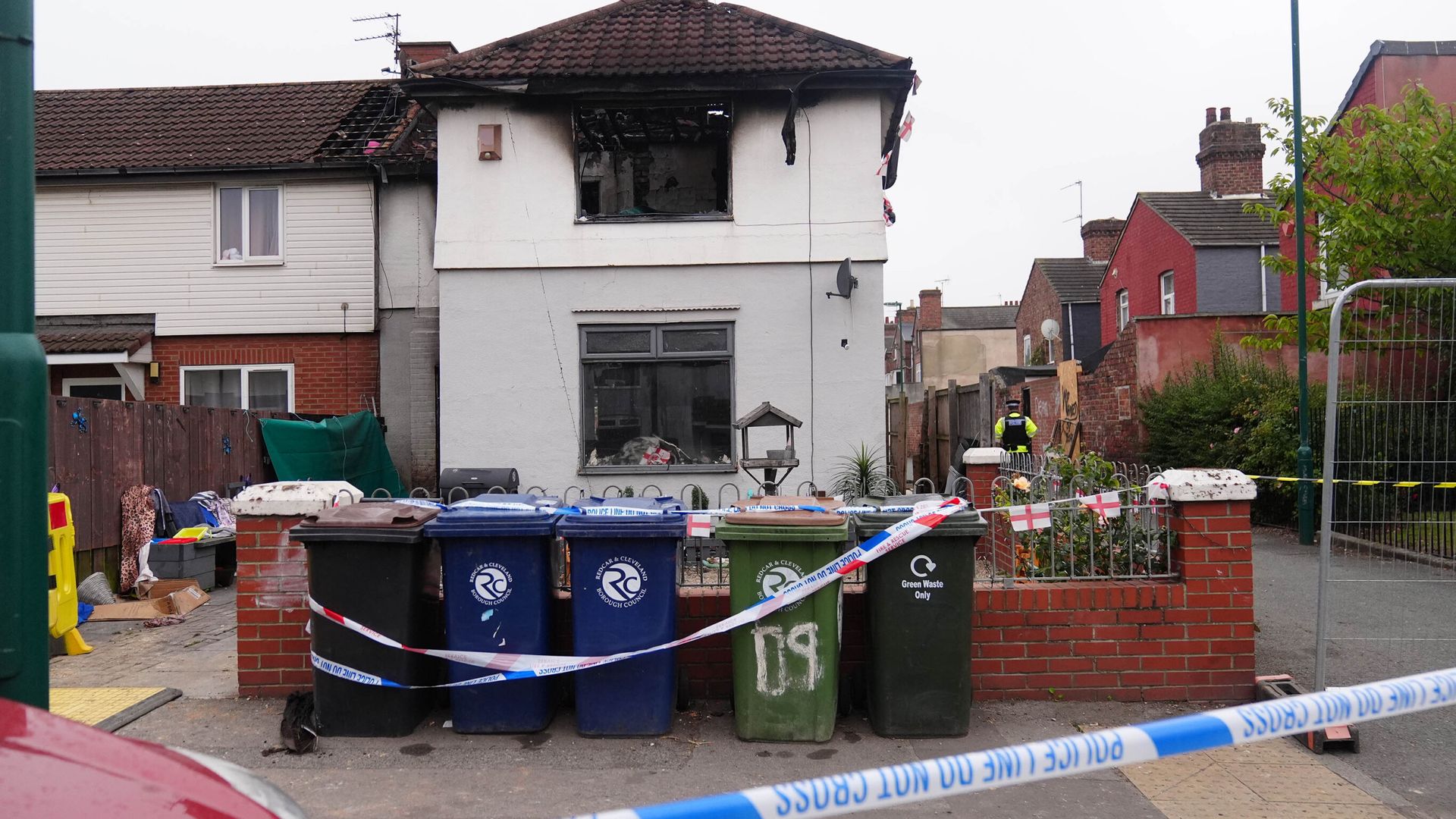
A house burns to the foundation. Someone dies in the ashes. Days later, a grim-faced local prosecutor steps to the podium to announce a murder charge. The media regurgitates the press release. The public breathes a collective sigh of relief. The monster has been caught. Justice is served.
We love this narrative. It is clean. It provides a villain. It allows us to believe that fatal tragedies are the direct result of malicious human action rather than chaotic accidents, failed building codes, or terrifying physics.
The standard news coverage of fatal house fires stops at the arrest. Journalists print the police department's claims about "accelerant patterns" and "inconsistent statements" without a second thought. They treat arson forensics as an exact science.
They are dead wrong.
I have watched defense teams tear apart prosecutors who relied on outdated fire lore. I have seen innocent people railroaded into plea deals because the prospect of a death penalty conviction—based entirely on a local fire chief's gut feeling—was too terrifying to risk. The criminal justice system loves a quick arson-murder conviction. Yet, fire investigation remains one of the most scientifically contaminated fields in modern forensics.
Before you applaud the next high-profile murder charge stemming from a house fire, you need to understand the structural, chemical, and legal failures that routinely frame innocent survivors.
The Junk Science of Old School Arson Forensics
For decades, fire investigation was not a science. It was folklore. It was an apprenticeship system where older fire marshals passed down unverified rules of thumb to younger investigators. If a fire behaved in a way that looked "unusual" to an investigator, they assumed it was intentionally set.
Up until the late 1990s and early 2000s, investigators relied on a specific set of visual indicators to declare a fire was arson. They would walk through the charred remains of a living room, point a flashlight at the floor, and condemn a grieving spouse to prison based on visual myths.
Here is what they looked for, and why every single one of these "indicators" has been thoroughly debunked by actual chemists and physicists:
- Crazed Glass: Investigators used to believe that window glass featuring a spiderweb-like cracking pattern (crazing) meant a fire burned unusually hot and fast, indicating a liquid accelerant like gasoline was used. Science later proved crazing happens when hot glass is rapidly cooled, typically by the fire department's own water hoses.
- Alligatoring: This refers to the blistering pattern on charred wood. The myth stated that large, shiny blisters meant a fast, hot accelerant fire. Real burn tests showed that wood blisters exactly the same way regardless of whether the fire started from a dropped cigarette or a bucket of kerosene.
- Spalling: Concrete floors that flaked or chipped during a fire were said to be proof that a liquid accelerant was poured directly on the ground. Structural engineers eventually demonstrated that spalling is simply caused by the natural moisture inside concrete expanding under intense heat.
- Narrow V-Patterns: A V-shaped burn mark on a wall was the holy grail of origin point detection. Narrow V-patterns supposedly proved a fast-moving, chemically enhanced fire. Testing later confirmed that the shape of a V-pattern is dictated entirely by ventilation, room geometry, and fuel load, not the presence of arson.
When the National Fire Protection Association introduced NFPA 921 in 1992—the first scientifically backed guide for fire and explosion investigations—the old guard fought it bitterly. They refused to accept that their decades of "experience" were rooted in confirmation bias. Today, courts recognize NFPA 921 as the gold standard.
Yet, in rural jurisdictions and underfunded police departments across the country, local investigators still rely on the debunked folklore. They testify in front of juries who watch crime shows and believe every word the person in the uniform says.
The Polyurethane Trap and Flashover
People frequently ask search engines, "How do police prove someone started a fire?" The brutal truth is that police often look at the aftermath of a totally normal modern fire and mistake it for a crime scene.
The homes we live in today are entirely different from the homes built fifty years ago. In the 1950s, furniture was made of solid wood, cotton, and wool. A room fire in the mid-twentieth century took roughly twenty to thirty minutes to reach critical temperatures.
Today, your couch is made of polyurethane foam. Your carpet is synthetic. Your curtains are derived from petroleum products. A modern living room is essentially a solid-state gasoline refinery.
Because of these synthetic fuel loads, modern house fires reach a phenomenon called flashover in as little as three to five minutes.
Flashover is the point where the radiant heat trapped at the ceiling becomes so intense that every single combustible item in the room ignites simultaneously. The room does not just contain a fire; the room becomes on fire.
Once flashover occurs, the rules of fire physics shift entirely.
During and after flashover, fires burn downward. The intense radiant heat chars the floorboards. It burns irregular patterns into the carpet. To an untrained investigator, these localized floor burns look exactly like "pour patterns"—the trails left behind when someone pours liquid accelerant through a house.
Imagine a scenario where an overloaded power strip ignites a synthetic couch. The homeowner tries to fight it, fails, and flees the house. Their spouse, asleep in another room, dies of smoke inhalation. The fire department arrives after flashover has occurred. The fire is extinguished, and the local investigator walks in.
They see irregular, heavy burn marks on the floor. They see extreme, rapid destruction. They look at the surviving homeowner, who escaped without major burns. They pull out their notebook and write down one word: Arson.
The homeowner is charged with murder. The media runs the mugshot. The public demands blood. And the actual cause—a cheap, unregulated power strip igniting unregulated polyurethane—is ignored. The real danger remains on store shelves while an innocent person fights for their life in court.
The Psychology of the "Suspicious" Survivor
The junk science is only half the problem. The other half is how law enforcement treats trauma victims.
When a person escapes a fatal fire, they have just experienced one of the most violent, terrifying events a human brain can endure. They are in shock. Their clothes smell like smoke. Their memory of the timeline is almost certainly fragmented.
Police detectives are trained to look for deception. They are not trained to understand trauma.
When they bring a fire survivor into an interrogation room, they apply the exact same pressure tactics they use on gang members and drug traffickers. If the survivor displays a "flat affect"—a common symptom of acute shock—detectives interpret it as a lack of remorse. If the survivor's timeline changes from their initial statement on the lawn to their statement in the precinct, detectives interpret the inconsistency as a lie to cover up a murder.
We have built a system that actively punishes the neurological symptoms of trauma.
Detectives will often lie to the survivor. They will say, "The fire marshal found gasoline on the floorboards. We know you did it. Just tell us it was an accident." Exhausted, traumatized, and believing the police must know something they do not, innocent people will sometimes confess to fires they never set just to stop the interrogation.
The Downside of Disbelief
I will admit the uncomfortable reality of this stance. Malicious arsonists do exist. Spouses do murder their partners and use fire to cover up the crime. Organized crime syndicates use fire for intimidation. When we demand an impossibly high standard of scientific proof, there is a risk that a guilty person walks free because the fire destroyed the necessary evidence.
Fire consumes its own history. Proving an intentional act beyond a reasonable doubt in an environment that has been reduced to carbon is incredibly difficult.
But allowing the state to execute or imprison people based on pseudoscience and gut feelings is a far greater threat to a free society. The 2009 National Academy of Sciences report on forensic science ripped the lid off the fire investigation industry. It stated plainly that many rules of thumb used to determine arson were scientifically invalid.
Yet, arrests continue. Charges are still filed based on the testimony of investigators who have never taken a college-level chemistry class.
How to Read the Next Headline
The next time you see a headline screaming about a man charged with murder over a fatal house fire, do not take the bait. Do not assume the local authorities have an airtight case. Change the questions you are asking.
Instead of asking, "Why did he do it?", ask the questions that actually matter:
- Was the investigator certified to NFPA 921 standards? If the state is not using the National Fire Protection Association guidelines, their investigation is legally and scientifically suspect.
- Did the prosecution rely on laboratory gas chromatography? Visual inspections of floorboards mean absolutely nothing. Unless a state-certified lab found definitive, unexplainable traces of ignitable liquids using a gas chromatograph, the "pour pattern" is an illusion.
- Were the victims trapped by illegal building modifications? Landlords routinely escape manslaughter charges by letting police hyper-fixate on the ignition source rather than the lack of fire exits, hardwired smoke detectors, or fire-rated drywall.
- Did the police record the entire interrogation? False confessions in arson cases are a documented epidemic. If the cameras were turned off, the confession is garbage.
We need to stop demanding simple villains for complex tragedies.
When we cheer for the arrest of a fire survivor based on bad science, we allow the real culprits—slumlords, cheap material manufacturers, and apathetic building inspectors—to operate with impunity. We allow the justice system to hide its incompetence behind the facade of forensic certainty.
Stop taking the police press release at face value. Demand the raw fire data. Demand the investigator's credentials. Because the next time a house burns down, the person standing in the ashes, surrounded by pointing fingers and bad science, could be you.