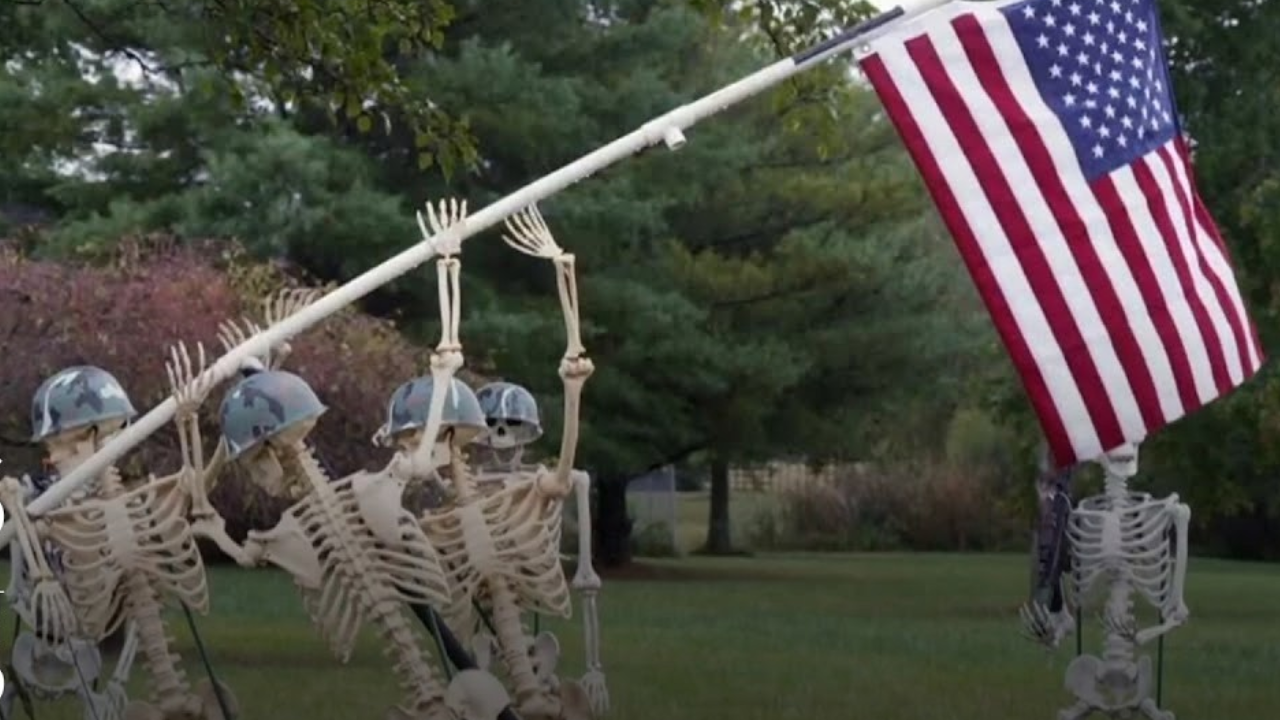
You saw the headline. An Ohio neighbor leaves Halloween skeletons out year-round to cheer on a woman named Tammy during her cancer treatment. Local news eats it up. Social media shares it ten thousand times. Everyone pats themselves on the back for how "inspiring" humanity is.
Here is the uncomfortable truth nobody wants to say out loud. Public, performative displays of support often do more for the spectators than the patient.
Media outlets love a tidy narrative. They take a grueling, terrifying medical ordeal and wrap it in a whimsical bow—plastic bones holding encouraging signs on a front lawn. It sells clicks. It makes readers feel warm inside without requiring them to actually show up when things get ugly. That is the lazy consensus of modern illness coverage: reduce survival to a cute aesthetic and pretend good vibes cure disease.
If you have ever sat in an infusion chair for six hours while platinum-based chemotherapy burns through your veins, you know that lawn ornaments do not touch the reality of the fight.
The Toxic Positivity Trap in Oncology
Let us define what we are actually looking at here. Psychologists call it toxic positivity—the relentless pressure to maintain a cheerful, optimistic facade regardless of how dire or painful a situation truly is.
When a community turns a patient’s diagnosis into a public spectacle of cheer, they unintentionally build a cage. Suddenly, the patient is no longer just fighting for their life; they are responsible for validating everyone else’s emotional investment. If you are Tammy, and the whole neighborhood is looking at those skeletons waiting for you to smile and wave, how safe do you feel admitting that you are terrified? How easy is it to tell your neighbors that you spent the morning vomiting, or that you are grieving the loss of your hair, your energy, and your future?
I have spent years working alongside patient advocates and psycho-oncology researchers, and I have watched this exact dynamic break people down. Patients frequently report feeling an exhausting obligation to perform gratitude for community gestures they never asked for. They put on a brave face for the neighborhood parade, the pink-ribbon fundraiser, or the viral lawn display, and then collapse behind closed doors because the emotional labor of keeping everyone else comfortable is heavier than the treatment itself.
What Heavy Hitters in Psycho-Oncology Actually Say
The data backs this up, even if local news refuses to cover it. Dr. Jimmie Holland, widely recognized as the founder of psycho-oncology at Memorial Sloan Kettering Cancer Center, spent decades documenting what she called the "tyranny of positive thinking." Her clinical work showed that forcing cancer patients to stay upbeat creates intense guilt whenever natural feelings of anger, fear, or despair inevitably surface. When a patient believes their survival depends on maintaining a sunny attitude—or when their community reinforces that idea through constant cheerleading—every bad day feels like a personal failure.
Susan Sontag tackled this decades ago in Illness as Metaphor. She dismantled the cultural obsession with turning disease into a moral test of willpower and cheerfulness. Cancer is a cellular mutation, not a character contest. Treating it like a pep rally distorts the biology of the disease and isolates the person living inside it.
Why Spectators Love Lawn Displays More Than Real Help
Look closely at why stories like the Ohio skeleton display go viral. It is low-friction empathy.
Putting a plastic skeleton in your yard or liking a heart-warming post costs almost nothing. It requires zero emotional intimacy. You do not have to sit in silence with someone who is crying. You do not have to clean their bathroom when they are too weak to stand. You do not have to navigate the awkwardness of mortality.
Real support is invisible, unglamorous, and completely unphotogenic. Nobody writes a viral human-interest piece about the neighbor who quietly drops off bland, high-protein broth because chemo ruined the patient’s taste buds, and then leaves without ringing the doorbell so the patient does not have to make small talk. Nobody shares a photo of the friend who sits in a sterile waiting room for four hours just to drive someone home.
Yet that quiet, unsexy labor is the only thing that actually moves the needle for a person in active treatment.
The Nuance the Viral Story Missed
Let us be fair. Intent matters, and context is everything. For Tammy in Ohio, seeing those skeletons every day might genuinely bring a moment of dark humor and levity to a brutal routine. Gallows humor is a well-documented coping mechanism among chronic illness and oncology patients. Laughing at a plastic skeleton while dealing with the very real threat of death is a way of reclaiming power over fear. If the display was tailored specifically to her sense of humor, and if she truly loved it, then it served a real purpose for her.
The problem is not the neighbor who put up the skeletons. The problem is how the rest of us consume the story.
When media outlets turn an idiosyncratic inside joke between neighbors into a universal blueprint for "how to support a cancer patient," they teach the public the wrong lesson. They reinforce the myth that grand, visible gestures are the gold standard of care. They trick well-meaning people into thinking that visibility equals impact.
Dismantling the Wrong Questions People Ask
When someone in your life gets diagnosed with a serious illness, your brain immediately scrambles for a script. Look at the questions people frantically type into search engines:
- What is the best gift to buy someone with cancer?
- How do I cheer up a friend going through chemo?
- What inspiring quotes can I send to a cancer patient?
Every single one of those questions is built on a flawed premise. They all assume your job is to fix the patient's mood or hand them a physical object that makes you feel useful.
Question 1: "How do I cheer up a friend going through chemo?"
Stop trying to cheer them up. You cannot cheer someone out of nausea, neuropathy, or existential dread. Trying to force happiness onto someone in acute physical distress is invalidating. Your job is not to change their emotional state; your job is to sit inside their current emotional state with them without flinching. If they want to make dark jokes about skeletons, laugh with them. If they want to stare at the wall and say nothing, sit there and stare at the wall too.
Question 2: "What is the best gift for a cancer patient?"
Unless they explicitly asked for a cozy blanket or a novelty mug, skip the physical clutter. Most patients end up drowning in well-intentioned junk they have to store, dust, or thank people for. The best gift is time and logistics. Pay for a house cleaning service. Cover their grocery delivery for a month. Take over their lawn care or snow shoveling without asking for permission or recognition.
Question 3: "Should I organize a big public surprise for them?"
Almost never. Surprises strip control away from people whose autonomy has already been hijacked by doctors, insurance companies, and biology. When you have cancer, you lose control over your schedule, your body, and your appearance. A surprise party, a flash mob, or a sudden front-yard spectacle forces the patient into a reactive, public role when their energy reserves are near zero. Always ask before making their illness public.
The Mechanics of High-Impact Patient Support
If you want to actually help someone survive treatment with their sanity intact, abandon the viral playbook and switch to operational support. Think like a logistics coordinator, not a cheerleader.
Imagine a scenario where a close friend has just started a 16-week chemotherapy regimen. Every third Tuesday, they get infused. By Thursday afternoon, the steroids wear off, the immune system crashes, and bone pain sets in. By Sunday, they can barely walk up the stairs.
A viral-minded friend sends a text on Thursday saying, "Stay strong! You're a warrior! Thinking of you!" That text requires the exhausted patient to pick up their phone, summon the energy to type back "Thank you so much!", and pretend they feel warrior-like while lying on the bathroom floor.
Now look at how an operator handles that exact same Thursday:
- Eliminate Decision Fatigue. Never say, "Let me know if you need anything." That puts the mental burden of delegating onto a brain clouded by chemo fog. Instead, send a closed-loop offer: "I am at the grocery store right now. I am dropping off ginger ale, plain crackers, and rotisserie chicken on your porch at 4 PM. No need to answer the door or text me back."
- Protect Their Privacy. Do not broadcast their medical updates to mutual acquaintances or post photos of them looking frail without explicit, unpressured consent. Be the information gatekeeper so they do not have to repeat the same exhausting medical timeline twenty times a week.
- Show Up in Month Four. Everyone shows up in week one. The flowers, the casseroles, and the lawn signs flood in right after the diagnosis. By month four, when the novelty has worn off and the cumulative toxicity of treatment is at its peak, the crowd vanishes. Put a recurring reminder on your calendar to show up six months after the initial diagnosis. That is when the real loneliness hits.
- Validate the Dark Days. Give them explicit permission to hate the process. Tell them, "You do not have to be brave today. You are allowed to be angry that this is happening." Watch the physical relief wash over someone when they realize they do not have to perform strength around you.
Admitting the Flaw in My Own Approach
There is a real downside to stripping away public, symbolic gestures in favor of quiet logistics: community morale matters, and people are clumsy.
Most neighbors do not avoid deep, practical help because they are cruel; they avoid it because they are terrified of saying the wrong thing or overstepping boundaries. A yard display, a ribbon, or a public sign acts as a social bridge. It signals to an isolated patient that they have not been forgotten by the outside world. If you tell people to stop making visible gestures altogether, many will freeze up and do nothing at all—and total silence from a community feels far worse than a cheesy lawn ornament.
We do not need to ban front-yard skeletons. We just need to stop confusing the billboard with the building.
Stop Applauding the Spectacle
The next time you scroll past a heart-warming story about a neighborhood rallying around a sick resident with costumes, signs, or plastic skeletons, pause before hitting share. Ask yourself who the performance is really serving.
If it gives a specific patient a genuine laugh on a miserable morning, great. Let them have it. Just do not mistake spectator sport empathy for actual care. Real support happens behind closed doors, off camera, without an audience waiting to applaud.
Put down the plastic bones, skip the inspirational speech, and go wash their dishes.