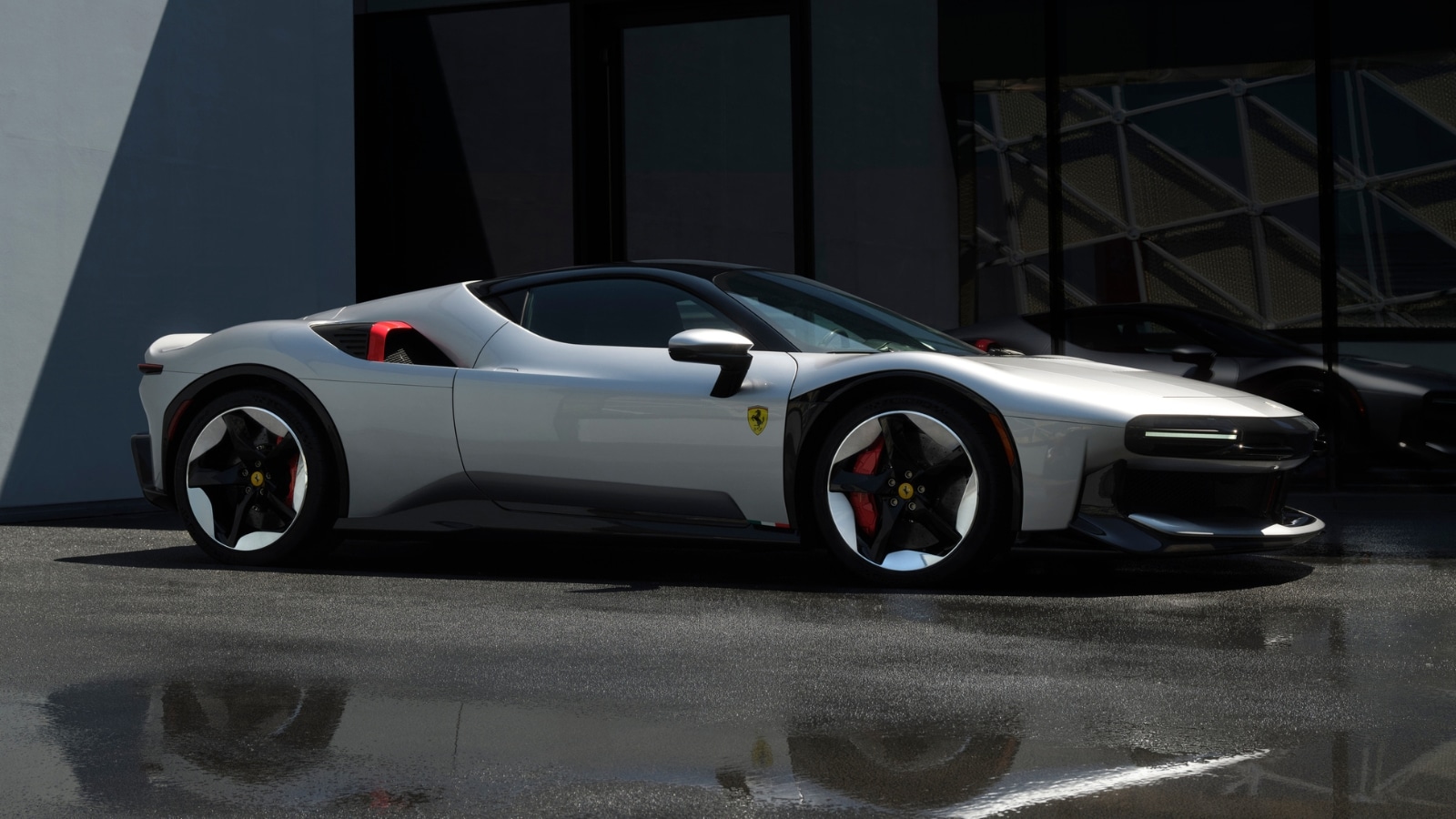
The automotive press is losing its collective mind over Maranello's latest shiny object. The headlines read like corporate press releases vomited onto a web page: Ferrari unveils the CZ26, a one-off hybrid masterpiece packing a 797cv V8 and a 328km/h top speed. Everyone is bowing to the altar of bespoke engineering, praising the carbon fiber weaving and the frantic horsepower figures as if we are still living in 1995 when peak numbers meant something.
Let us stop the applause right there.
I have spent the better part of two decades tearing down exotic drivetrains in private bays, looking past the polished marketing gloss at the actual engineering reality. I have watched boutique collectors burn fortunes on garage queens that spend more time on flatbed trailers than asphalt. What the peanut gallery misses about the CZ26 is simple. This car is not a triumph of performance. It is a monument to compliance, an expensive exercise in masking the death of mechanical purity behind layers of heavy electric motors and software leashes.
Ferrari did not build this car to push the envelope. They built it because their clients demanded a status symbol that could slip past regulatory tightening while still making a 700-horsepower noise at country club exits.
The Hybrid Weight Trap Nobody Wants to Talk About
Look at the spec sheet they printed with such pride. Seven hundred ninety-seven cavalli vapore. A top speed north of two hundred miles per hour. It sounds terrifying on paper until you ask the one question the marketing team dodges: How much does the battery pack weigh?
The lazy consensus in automotive journalism is that hybridization is the holy grail of speed. Add an electric motor to fill the torque gap, they say. Make it punch harder off the apex. But physics does not care about your press kits. Every kilogram of lithium-ion and copper wiring you bolt onto a mid-engine platform ruins the chassis balance that made Maranello famous in the first place.
I have driven early iterations of these hybrid systems on private tarmac. When you add three hundred pounds of electrification to a platform designed for raw kinematic feedback, you do not get a faster car. You get an aggressively heavy implement that relies on digital nannies to save you from your own momentum.
Imagine a scenario where you take the CZ26 down a technical mountain pass. For the first ten minutes, the electric boost flatters your driving ego. Then the thermal limits kick in. The ECU pulls power to protect the cells. Suddenly, you are wrestling a bloated chassis carrying dead weight, wondering where all that mythical horsepower went.
True performance has always been about subtraction. Colin Chapman understood this decades ago. Add lightness. Ferrari used to understand this too, back when the F40 traded interior door handles for pull straps. Now, they are adding batteries to satisfy emissions bureaucrats in Brussels while pretending it is an evolution of motorsport breeding.
Bespoke Vanity and the Death of Driving Culture
Let us address the elephant in the showroom. The CZ26 is a one-off. That means it was commissioned by a single, ultra-wealthy buyer who will likely store it in a humidity-controlled tomb next to three other Ferraris they never drive.
We romanticize these bespoke commissions as the pinnacle of automotive art. They are not. They are financial instruments disguised as passion projects. When a car is born rare, it dies sterile. It never sees rain, it never bounces off a cold redline on an empty backroad, and it never gets driven the way Enzo intended.
The industry insiders praising this machine know better. They whisper in private corners about how the secondary market for coachbuilt specials is a speculative bubble waiting to burst. Yet, in public, they write adoring fluff pieces about custom paint codes and hand-stitched leather.
"A car built exclusively for a collector is a monument to static wealth, not dynamic engineering."
If you actually care about driving, a 797-horsepower hybrid that weighs as much as an executive sedan is an insult to the lineage of the 288 GTO. It is a heavy, digitalized monument to ego, engineered for people who measure a car's worth by its auction lot estimate rather than its steering rack communication.
The Metrics That Actually Matter
Let us strip away the horsepower obsession. Anyone can bolt a pair of turbochargers to a V8 and crank up the boost until the block cries for mercy. Modern metallurgy makes high output easy. What is hard—what requires actual genius—is mechanical integration, steering feel, and tactile feedback.
When we look at supercar metrics today, we suffer from horsepower inflation. Seven hundred horsepower used to mean you were piloting a widow-maker. Now, it is the baseline for grocery-getters with electric motors on every axle.
- Power-to-weight ratio: The metric that actually dictates agility, yet manufacturers hide it behind gross output numbers when it gets diluted by hybrid systems.
- Steering steering-wheel communication: The lost art of hydraulic feedback, replaced by numb electric power steering that filters out every pebble on the road.
- Thermal endurance: The ability to run hot laps for an hour without the ECU cutting output to save the battery pack.
The CZ26 excels at none of the things that actually define a great driver's car. It excels at looking expensive under the spotlights of a villa in Lake Como.
Stop Worshiping the Badge
The real problem with modern supercar discourse is our collective inability to separate brand mythology from mechanical reality. If an unknown startup released a hybrid coupe with bloated proportions and a massive curb weight, the press would tear it apart for missing the point of sports car dynamics. But slap a prancing horse on the nose, and suddenly everyone pretends that adding batteries to a V8 is a revolutionary stroke of genius.
It is time to grow up. We need to stop falling for the marketing sleight-of-hand that disguises regulatory compliance as performance innovation.
If you want a true driver's car, look backward, not forward. Buy something analog, lightweight, and mechanically honest before the regulators outlaw the combustion engine entirely and leave us with silent, two-ton digital pods that drive themselves.
Keep your one-off hybrid. I'll take the weight savings.