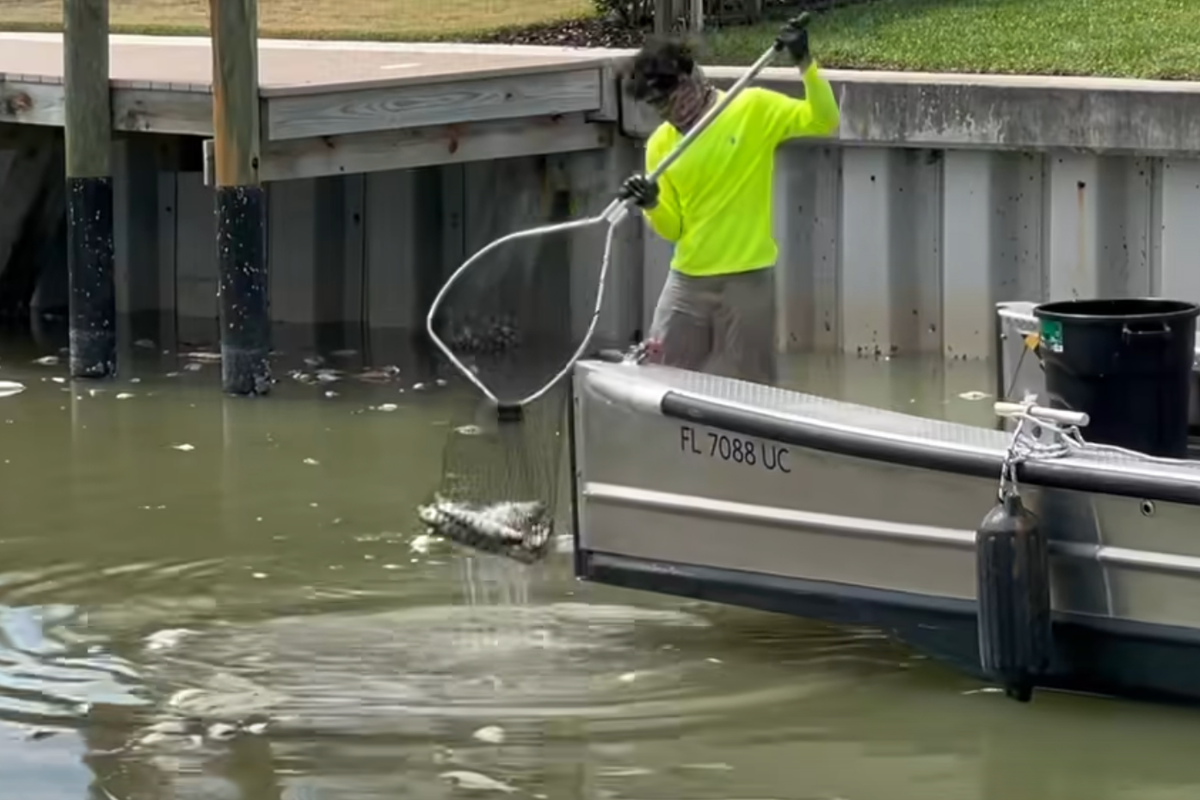
The local news cycle is predictable. A thousand fish turn up dead in a Florida canal, the water looks like pea soup, and the immediate response is a frantic, tear-jerking plea for suburbanites to stop feeding their St. Augustine grass. It is a neat, tidy narrative. It identifies a villain—the guy with the spreader—and offers a simple, low-cost solution: a summer fertilizer ban.
It is also a dangerous delusion.
If you think skipping a bag of 10-10-10 this July is going to save the Indian River Lagoon or the Gulf Coast, you aren't just wrong; you are being used as a shield for the real culprits. I have spent years looking at the intersection of urban runoff and water chemistry. I have seen municipalities spend millions on "awareness campaigns" while their 60-year-old clay pipe sewer systems leak millions of gallons of nitrogen-rich human waste directly into the groundwater.
We are blaming the gardener for a flood caused by a burst dam.
The Nitrogen Math That Doesn't Add Up
The "lazy consensus" suggests that residential fertilizer is the primary driver of the nutrient loading that fuels toxic algae blooms. It sounds logical. Rain falls, it washes the nitrogen off your lawn, it hits the storm drain, and the fish die.
But look at the isotopic signatures. When scientists actually bother to trace the source of nitrogen in these water bodies, a recurring, uncomfortable truth emerges: a massive percentage of the "fertilizer" in the water is actually "organic" in origin. In plain English, it is sewage and septic.
Florida sits on a porous limestone karst. Below your feet isn't solid rock; it’s a sponge. There are over 2.6 million septic systems in the state. Many of them were installed decades ago in areas where the water table is high. When it rains, these systems don't just "fail" in the sense of backing up into your sink. They "function" by pushing nutrient-dense effluent directly into the groundwater, which then migrates into the nearest canal in a matter of days.
A fertilizer ban is a political placebo. It costs the city nothing. It allows officials to look like they are "taking action" while avoiding the multi-billion dollar price tag of replacing failing infrastructure or forcing residents to hook up to a modern sewer grid.
The Counter-Intuitive Truth About Healthy Lawns
Here is the irony that the "stop the spread" crowd misses: A healthy, professionally managed lawn is actually one of the best filters for groundwater.
Imagine a scenario where a homeowner follows the ban to the letter. Their lawn becomes thin, patchy, and the root system retreats. When the heavy Florida summer rains hit, that soil—no longer held in place by a dense mat of healthy roots—erodes. The sediment itself carries legacy phosphorus. Because the turf is no longer "hungry" or active, it cannot absorb the nitrogen that falls naturally in rainfall (yes, rain itself contains nitrogen).
By mandating "starved" lawns, we are creating millions of acres of inefficient filters. A robust root system acts as a biological sponge. When you ban the responsible application of slow-release nutrients, you aren't stopping runoff; you are ensuring that any nutrients that do hit that soil—whether from pet waste, atmospheric deposition, or decaying organic matter—pass straight through to the aquifer because the biology of the lawn is too weak to capture it.
The Myth of the "Easy Fix"
People also ask: "Why can't we just use organic compost instead?"
This is a classic misunderstanding of chemistry. The algae in the water doesn't care if the nitrogen came from a "natural" compost pile or a synthetic pellet. In fact, raw organic matter often has a higher rate of phosphorus leaching if it isn't incorporated correctly.
The industry insider truth? The most "eco-friendly" thing you can do isn't to stop fertilizing. It is to fertilize with surgical precision.
We have the technology. We have site-specific delivery systems and slow-release coatings that ensure the nutrient stays in the soil for 90 days rather than dissolving in the first thunderstorm. But these products are more expensive than the "triple-10" junk sold at big-box stores. Instead of banning the practice, we should be mandating the quality of the product.
But again, that requires nuance. It requires understanding the difference between $N$ as $NO_3^-$ (nitrate) and $N$ as $NH_4^+$ (ammonium). It requires admitting that the "industry" isn't the enemy—the lack of standards is.
The Real Cost of Virtue Signaling
When officials "beg" residents to limit use, they are shifting the burden of environmental stewardship onto the individual while the systemic failures of the state go unaddressed.
- Agriculture: We talk about "towns," but look at the massive industrial sugar and citrus operations upstream. The volume of runoff there dwarfs a thousand suburban lawns.
- Infrastructure: If your city hasn't updated its lift stations since the 1980s, your lawn care habits are irrelevant.
- Pavement: The sheer amount of impervious surface—driveways, roads, parking lots—means that whatever does land on the ground is channeled at high velocity into the water.
If we were serious about the fish, we wouldn't be looking at the color of your grass. We would be ripping up asphalt and installing bioswales. We would be taxing the sale of low-grade, quick-release nitrogen and using that money to fast-track septic-to-sewer conversions.
Stop Asking the Wrong Question
The question isn't "Should I fertilize my lawn?"
The question is "Why is my local government using my lawn as a scapegoat for their refusal to fix the sewers?"
We are witnessing a massive displacement of responsibility. Every time a "fertilizer ban" is enacted, the real polluters breathe a sigh of relief. They know the public will be too busy arguing about "Florida Friendly Landscaping" to notice the millions of gallons of untreated wastewater being pumped into the bay every time a pump station loses power during a storm.
You are being sold a narrative of individual guilt to mask a reality of institutional neglect.
Stop patting yourself on the back for having a brown lawn. You aren't saving the fish. You are just making it easier for the people actually killing them to stay out of the spotlight.
Demand the sewer bill. Demand the isotopic source tracking data. Stop falling for the easy answer.
Fix the pipes or keep burying the fish. There is no middle ground.