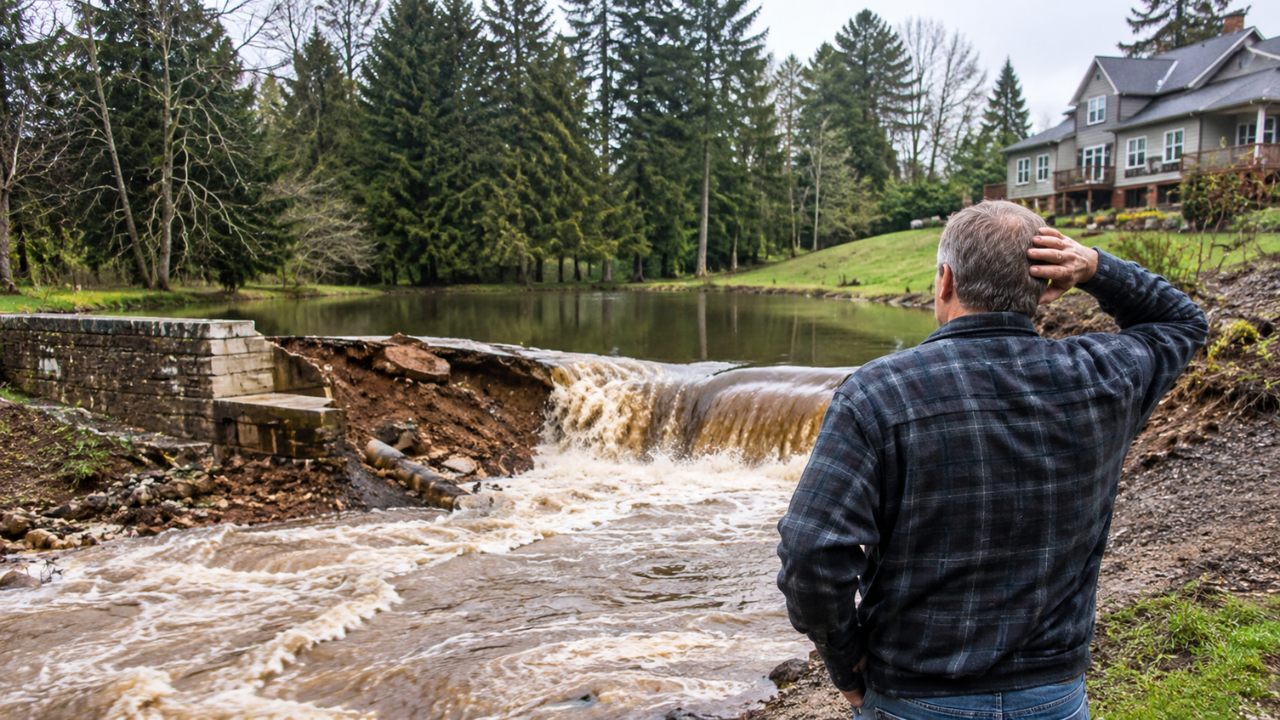
Most rural property owners treat a dam repair like fixing a leaky roof. You notice a structural flaw, you hire an excavator, you push some dirt around, and you sleep soundly knowing your pond won't wash out the county road.
Then your downstream neighbor sends you a bill for $150,000 to dredge five feet of silt out of their prize trout pond.
Legal commentators and farm-journal summaries love to frame disputes like the recent Washington appellate battle over dam repairs and downstream sedimentation as simple "good neighbor" failures or bureaucratic permitting traps. That lazy consensus completely misses the real legal landmine buried in Pacific Northwest water law. The court didn't rule against the upstream landowner because they failed to fill out a piece of paper. They ruled against them because riparian rights and the common enemy doctrine do not give you a blank check to weaponize gravity against the parcel below you.
If you own acreage with impounded water, you are sitting on a hydrological liability. Standard maintenance isn't a legal shield. In fact, doing the "responsible" thing—repairing a failing earthen berm—is often the exact trigger that converts a passive, natural feature into an actionable nuisance and trespass.
The Myth of "Routine Maintenance"
Ask ten rural landowners what happens when they fix an existing dam on their own property, and nine will tell you they are grandfathered in. They assume that because the pond has been there since 1962, touching the dirt to keep it intact is a protected property right.
That assumption will bankrupt you in superior court.
In Washington, as in most Western states operating under a hybrid of prior appropriation and riparian principles, water law distinguishes sharply between natural flow and artificial alteration. When an old dam slowly degrades over forty years, the downstream ecosystem—and your neighbor’s property—adjusts to a baseline of gradual, predictable sediment transport. The moment you bring heavy machinery onto that embankment, draw down the water level, or disturb the settled benthic layer behind the structure, you are no longer maintaining a status quo. You are initiating a new, artificial discharge event.
I have watched property owners spend six figures in legal fees arguing that they were "preventing a catastrophic breach" that would have flooded the valley. They expect a medal from the judge. Instead, they get hit with strict liability or negligence per se. Courts do not care that your intentions were noble. They care about causation and unreasonable interference. If your repair work mobilizes decades of trapped silt and flushes it into a neighbor's intake pipe, irrigation canal, or recreational pond, the law views that mud no differently than if you had backed a dump truck up to their fence line and unloaded twenty tons of gravel onto their lawn.
Why the "Common Enemy" Doctrine Won't Save You
Whenever drainage or runoff disputes hit the dockets in Washington, defense attorneys inevitably reach for the common enemy doctrine. Historically, this rule allowed landowners to treat surface water as an outlaw, letting them dike, dam, or divert diffuse rainwater without worrying about where it went next.
Here is the nuance the surface-level legal summaries miss: the common enemy doctrine applies to diffused surface water, not defined watercourses or impounded bodies.
Once water collects in a natural channel, a stream, or an established pond fed by a waterway, the legal rulebook flips entirely. You are now dealing with riparian rights and watercourse law. Furthermore, even where the common enemy doctrine applies to surface runoff, Washington courts have spent the last century carving massive exceptions into it:
- The Channeling Exception: You cannot collect water into an artificial conduit or concentrated flow and discharge it onto adjoining land in a manner different from its natural course.
- The Due Care Requirement: You must exercise due care to avoid unnecessary injury to neighboring property.
- The Sedimentation Trap: While water itself might be a "common enemy," the solid earth suspended inside that water is your real property. When your earth moves onto someone else's land because you altered the hydraulic grade, that is a textbook physical trespass.
In the Washington dam repair case, the upstream owner learned this distinction the hard way. Lowering a reservoir or breaching a cofferdam during repairs increases flow velocity. Basic fluid dynamics dictates that sediment-carrying capacity increases exponentially with water velocity. Double the speed of the outflow, and you aren't just doubling the dirt it carries—you are multiplying its scouring power several times over. The court looked at the physical mechanism, saw an artificial mobilization of silt, and rejected the defense that repairing an existing structure immunizes the owner from downstream damage.
What Landowners Actually Need to Know (Dismantling the FAQ)
If you search online for dam repair liability, you get a wall of generic boilerplate telling you to "check local zoning" and "talk to your neighbor." That advice is useless when you are staring at a slumping earthen wall in October with winter rains three weeks away. Let's look at the actual questions property owners ask—and why the standard answers are wrong.
"If I have a permit from the state, am I protected from my neighbor suing me?"
No. A permit from the Department of Ecology or the Department of Fish and Wildlife is merely a license from the state saying you haven't violated public regulatory statutes. Regulatory compliance is a floor, not a ceiling.
I have seen landowners wave a Hydraulic Project Approval (HPA) in a judge's face like a get-out-of-jail-free card, only to learn that administrative permits almost always contain explicit boilerplate stating that the approval does not authorize injury to private property rights. Your neighbor doesn't have to prove you broke a state environmental statute to win in civil court. They only have to prove nuisance, trespass, or negligence. Even worse, if you skipped the permit because you thought the pond was too small to regulate, your neighbor's attorney will use that regulatory violation as automatic proof of negligence.
"Can't I just argue that the sediment would have washed down naturally anyway?"
You can try, and your expert witness will get shredded on cross-examination. Courts deal in proximate cause and acceleration. Every pond in the world eventually fills with sediment over geological time. That does not give you the right to compress fifty years of natural erosion into a single weekend because you pulled the stop-logs without installing a turbidity curtain.
If your neighbor's pond lost three feet of depth in two months immediately following your backhoe work, no judge is going to buy an "act of nature" defense. The temporal link between human intervention and downstream accumulation is too obvious to argue away.
"Isn't my neighbor responsible for maintaining their own pond's depth?"
Under standard riparian principles, a downstream owner has to accept the natural sediment load of the stream feeding their property. If a massive winter storm blows out a pristine, untouched hillside upstream and fills their pond with mud, that is their problem.
The legal obligation shifts the exact second human engineering alters the sediment transport regime. By maintaining a dam upstream, you created an artificial sediment trap. You took custody of that silt. Once you hold it back behind an earthen wall, you inherit the duty not to dump it all at once onto the person downstream.
The Engineering Blind Spot in Rural Water Law
The core failure in almost every upstream-downstream sediment lawsuit isn't malice; it is hydrological illiteracy. Landowners hire general excavation contractors who know how to build a driveway or dig a septic field, assuming those skills translate to hydraulic structures.
They don't.
When an excavator operator repairs a dam, they focus on the dry side—compacting clay, armoring the spillway with riprap, or clearing brush off the crest. They completely ignore what happens on the wet side when the water level fluctuates.
Imagine a scenario where you have a two-acre farm pond with four feet of soft, organic muck sitting on the bottom. You drop the water level by three feet so your contractor can patch a leaking outlet pipe. As the water recedes, the exposed mud banks lose the hydrostatic pressure that was holding them in place. Simultaneously, the incoming stream—which used to hit a wide, deep pool and instantly lose velocity—now cuts a narrow, fast channel directly through that exposed mudflat.
Within forty-eight hours, that stream turns into a liquid conveyor belt, carving out hundreds of cubic yards of black silt and pumping it straight through your newly repaired outlet pipe into your neighbor's property. You fixed the dam, and you destroyed a downstream habitat in the exact same afternoon.
The Heavy Hitters: Precedent That Governs Your Dirt
To understand why appellate courts show zero sympathy for sloppy dam work, look at how Washington courts treat water and earth modifications across decades of case law:
- Nuisance Statutory Framework (RCW 7.48.010): Washington defines an actionable nuisance broadly as anything that is injurious to health, indecent, offensive to the senses, or an obstruction to the free use of property, so as to essentially interfere with the comfortable enjoyment of life and property. Filling a neighbor's pond with silt strips them of the free use of their water rights and recreation.
- Trespass by Particulate Matter (Bradley v. American Smelting & Refining Co.): While famous for microscopic airborne particles, the Washington Supreme Court established a critical rule here: intentional acts that cause physical matter to invade another's land constitute trespass, regardless of whether the invading substance is a boulder, smoke, or suspended silt.
- Watercourse Alteration (Currens v. Sleek): Even in cases examining the limits of the common enemy doctrine, the Washington Supreme Court reinforced that landowners cannot act with impunity. When altering drainage or water structures, the duty to act without negligence and avoid unnecessary harm to downstream owners overrides absolute property dominion.
How to Repair a Dam Without Buying Your Neighbor a New Pond
If you own a dam, weir, or impounded pond, you cannot afford to leave it unmaintained—a catastrophic failure carries far worse liability than a silt plume. You have to fix it. You just have to stop treating it like a backyard landscaping project.
Here is the exact operational playbook that keeps property owners out of appellate court:
- Dredge Before You Draw Down: If your pond is half-full of silt, you cannot safely lower the water level to fix the dam without mobilizing that muck. You have to excavate or hydraulically dredge the sediment first while the pool is still holding it back, or isolate the work area completely from the main basin.
- Install Cofferdams and Bypass Pumping: Never let a live stream flow through an active earthen construction zone. Isolate the dam face using sheet piling, sandbags, or bladder dams, and pump the incoming creek water around the work site via a sealed pipe discharging onto an energy-dissipating apron downstream.
- Deploy Multi-Stage Turbidity Curtains: A single silt fence staked into dry mud is a joke in moving water. Use weighted floating turbidity curtains anchored to the pond bed in layers around your work zone to trap suspended solids before they ever reach the outlet structure.
- Document the Baseline Downstream: Before a single machine touches your property, take high-resolution drone photos, water clarity readings, and depth soundings at your property line—and, if your neighbor is cooperative, in their pond. You cannot defend against a claim that you "ruined" a pond if you can't prove it was already choked with weeds and three feet deep in silt before you started.
The Uncomfortable Downside of Doing It Right
Let’s be brutally honest about the flaw in this approach: it makes small dam repairs wildly expensive.
If you own a modest three-acre parcel with a legacy farm pond, hiring a geotechnical engineer, renting bypass pumps, deploying turbidity curtains, and pulling environmental permits can easily turn a $12,000 backhoe job into a $65,000 civil engineering project. For many landowners, the cost of legally compliant repair exceeds the recreational or agricultural value of the pond itself.
That is the reality of modern water law. The era of cheap, informal dirt work in watersheds is dead. If you cannot afford to engineer the sediment control during a repair, your smartest financial move isn't cutting corners with a local tractor guy—it is filing for a permanent, permitted decommissioning of the dam to restore the natural stream channel and eliminate your perpetual liability.
Water always flows downhill, and in the American legal system, liability flows right alongside it. Touch the dirt that holds back a stream, and you own every single grain of sand that washes out the other side.