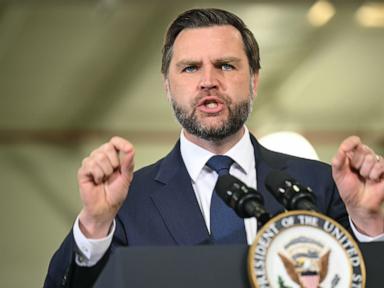
Political coverage often frames a shift in messaging between foreign affairs and domestic priorities as a sudden rift or a dramatic change in direction. When headlines highlight a directive from President Donald Trump urging Vice President JD Vance to pivot from discussing Iran toward focusing on domestic crime and corruption, the standard media takeaway reduces complex governing mechanics to simple palace intrigue.
That framing misses the structural reality of modern executive governance. Foreign policy and domestic stability do not operate in separate vacuums, nor does emphasizing one require abandoning the other. Viewing an administration's public messaging as a zero-sum game misunderstands how the White House divides labor, manages legislative bandwidth, and responds to voter priorities.
The Myth of the Binary Pivot
Standard political commentary thrives on conflict. A headline suggesting one leader bluntly told another to change topics creates an immediate narrative of friction, distraction, or strategic course correction. According to typical Beltway analysis, attention paid to Tehran automatically subtracts from attention paid to Chicago, New York, or Washington, D.C.
In practice, executive branch communications operate on parallel tracks rather than a single rail.
- Institutional Division of Labor: The president commands the overarching foreign policy apparatus, flanked by the National Security Council, the Department of State, and the Department of Defense. Meanwhile, a vice president frequently serves as a domestic surrogate, legislative liaison, and focal point for targeted domestic initiatives.
- The Attention Economy: Public messaging requires discipline. When multiple high-profile figures speak on the same geopolitical crisis simultaneously, they risk muddying official diplomatic posture or inadvertently escalating tensions. Assigning the vice president to hammer domestic themes—such as public safety and institutional accountability—keeps the administration's public bandwidth broad without diluting the commander-in-chief's singular voice on sensitive national security matters.
- Electoral Calculus: Voters consistently rank economic conditions, public safety, and government integrity near the top of their daily concerns, whereas foreign policy rarely drives domestic ballot decisions unless American troops are directly engaged in combat. Shifting a surrogate's microphone toward domestic issues reflects basic political math rather than a sudden ideological conversion.
What the Headlines Miss About Executive Messaging
To understand why a directive to focus on domestic crime and corruption makes strategic sense, one has to look at how administrations actually lose control of their narratives. Administrations rarely fail because they lack policies; they fail because their messaging fractures across too many competing fronts.
When an administration allows every senior official to freelance on foreign policy, two problems emerge immediately. First, foreign adversaries scrutinize every word uttered by a vice president for daylight between the Oval Office and the West Wing. In high-stakes diplomacy involving Iran—where sanctions enforcement, regional deterrence, and nuclear nonproliferation hang in delicate balance—ambiguity creates risk. Second, domestic audiences tune out when leadership appears preoccupied with overseas conflicts while local concerns remain unresolved.
By contrast, directing the vice president to concentrate on domestic crime and corruption accomplishes three distinct objectives:
- Message Consolidation: It reserves nuanced foreign policy signaling for the president and top national security principals, reducing the chance of mixed signals abroad.
- Base Mobilization: Themes of law, order, and rooting out institutional corruption resonate deeply with core populist constituencies that view federal institutions with skepticism.
- Offensive Positioning: Focusing on urban crime rates and alleged administrative misconduct puts political opponents on the defensive over tangible, everyday issues rather than abstract geopolitical debates.
The Overlap Between Foreign Threats and Domestic Integrity
The deeper flaw in pitting "Iran" against "crime and corruption" is the assumption that national security stops at the water's edge. Modern geopolitical competition blurs the boundary between foreign policy and domestic law enforcement.
Consider how international adversaries operate inside the United States today. Foreign intelligence services and state-backed actors routinely engage in cybercrime, financial fraud, illicit procurement networks, and influence operations aimed at domestic institutions. Investigating foreign-linked illicit finance or transnational criminal syndicates requires close coordination between the Department of Justice, the Treasury Department, and intelligence agencies.
Furthermore, energy security and inflation—issues felt directly by American households—remain tethered to stability in the Middle East. A spike in regional conflict involving Iran affects global oil markets, shipping lanes, and domestic fuel prices within hours. Treating foreign policy and domestic well-being as mutually exclusive categories ignores the basic mechanics of the modern global economy.
Why Political Analysts Default to Drama
If the strategic logic behind dividing foreign and domestic messaging is straightforward, why does political media consistently frame it as a sharp rebuke?
Part of the answer lies in the incentives of modern journalism. Nuanced explanations of interagency communications strategy do not generate clicks. Conflict does. Framing a strategic adjustment as a "blunt" reprimand transforms routine message discipline into a dramatic storyline about personalities and power dynamics.
Another factor is the historical baggage of the vice presidency itself. Political observers constantly search for signs of whether a vice president is being elevated or sidelined. When a vice president steps back from high-profile foreign policy commentary to focus on domestic enforcement and political messaging, pundits reflexively interpret the move through the lens of personal standing rather than operational utility.
The Trade-Offs of a Domestic-First Messaging Strategy
While concentrating vice-presidential messaging on domestic crime and corruption offers clear political advantages, it carries distinct risks and limitations that proponents often overlook.
Jurisdictional Limits of Federal Power
Crime in the United States is overwhelmingly a state and local matter. Murder, robbery, burglary, and street-level offenses are prosecuted primarily under state statutes by local district attorneys and policed by municipal departments. While the federal government can surge grant funding, deploy federal task forces for specific gun or drug offenses, and prosecute federal corruption statutes, the White House cannot unilaterally dictate local policing policies or municipal bail laws. Overpromising federal solutions to local crime creates an expectations gap that can backfire if local metrics do not move quickly.
The Politics of Corruption Investigations
Campaigning against corruption is universally popular in the abstract, yet executing an anti-corruption agenda in office is fraught with institutional friction. Pursuing investigations into political opponents or entrenched bureaucratic actors inevitably invites accusations of weaponizing the justice system. Maintaining public trust requires strict adherence to evidentiary standards and clear separation between political rhetoric and Department of Justice decision-making.
Foreign Policy Bandwidth
Pulling a visible principal away from foreign policy messaging also narrows the administration's bench when major international crises erupt. If regional tensions in the Middle East escalate rapidly, an administration needs multiple credible voices capable of explaining complex strategic decisions to Congress, allies, and the public.
Evaluating What Actually Drives Governing Outcomes
Cutting through the noise around political directives requires looking past the rhetoric to the underlying mechanisms of power. Whether an administration succeeds on foreign policy or domestic reform depends far less on who delivers which talking point and far more on execution within the executive branch.
- In Foreign Affairs: Outcomes depend on coherent deterrence, alliance management, and disciplined diplomatic execution—not how frequently the vice president mentions a foreign capital in domestic speeches.
- In Domestic Policy: Outcomes depend on judicial appointments, federal grant administration, regulatory enforcement, and legislative negotiations on Capitol Hill.
When political commentary fixates on who was told to talk about what, it mistakes the stagecraft of politics for the substance of governing. Messaging discipline is a tool, not a policy outcome.
The real test for any administration is not whether its leaders pivot their talking points between Tehran and Washington, D.C., but whether their policies produce measurable security abroad and tangible accountability at home.