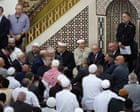
Anthony Albanese walked into the Lakemba mosque expecting the warm embrace of a traditional power base. He left to the sound of rhythmic chanting and the sight of a community in open revolt. While the Prime Minister later dismissed the confrontation as a fringe reaction to Labor’s decision to outlaw extremist organizations, that explanation is a convenient political shield that ignores a much deeper, more tectonic shift in Australian demographics. This was not a disagreement over legislative fine print. It was a visceral rejection of a government that many in the Western Sydney heartland believe has traded its soul for geopolitical convenience.
The mosque at Lakemba has long been the site of a silent contract between the Australian Labor Party and the Islamic community. For decades, Labor provided the social safety net and the inclusive rhetoric, and in exchange, it received some of the safest margins in the country. That contract is currently being shredded. The heckling of a Prime Minister in a space once considered a safe harbor signals that the "Labor way" no longer resonates with a generation of voters who view the world through a lens of global human rights rather than local branch politics.
The legislative smoke screen
In the aftermath of the Lakemba incident, the Prime Minister’s office moved quickly to frame the narrative. The official line was clear. The protesters were angry because the government had taken a "tough on terror" stance by listing groups like Hizb ut-Tahrir as terrorist organizations. By focusing on the "extremist" label, the government attempted to delegitimize the protest. It turned a complex grievance into a simple binary of law and order versus radicalism.
But this framing is intellectually dishonest. The anger on the ground in Lakemba and across the surrounding suburbs of Watson and Blaxland is not rooted in a sudden affection for banned organizations. It is rooted in the perceived double standard of Australian foreign policy. To the residents of Western Sydney, the government’s speed in banning local political groups stands in stark contrast to its perceived hesitancy in addressing the humanitarian catastrophe in Gaza. When the Prime Minister speaks about "extremism," the audience in the mosque hears a selective application of morality.
Labor’s problem is that its traditional base is no longer a monolith that can be managed through community leaders and mosque imams. The demographic is younger, more connected to global movements, and increasingly skeptical of the "quiet diplomacy" that Labor favors. They see a government that is quick to legislate against domestic dissent but slow to distance itself from traditional security partners when those partners are accused of international law violations.
A breakdown in the backrooms
For years, the Labor machine relied on "ethnic branch stacking" and local power brokers to deliver votes. This system functioned on patronage and personal relationships. If the Prime Minister showed up for Iftar, the community leaders ensured the cameras saw a smiling crowd. That machinery is failing. The leaders who once acted as gatekeepers between the mosque and the Lodge are losing their grip on the youth.
The rise of independent movements in Western Sydney is the direct result of this vacuum. Groups like "The Muslim Vote" are not fringe elements; they are organized, data-driven, and increasingly professional. They are looking at the 2022 election results and realizing that Labor’s hold on seats like Watson is not as ironclad as the history books suggest. If a significant percentage of the primary vote shifts to an independent, the preference flow becomes a nightmare for Labor strategists.
Tony Burke and Jason Clare, two of Labor’s most effective communicators, find themselves in the crosshairs of this shift. They represent the very heart of the community that is currently booing their leader. Their challenge is not just one of policy, but of identity. How do you remain a loyal member of a cabinet that maintains a specific line on Middle Eastern affairs while your constituents are watching livestreams of a different reality every night on their phones?
The myth of the fringe
The Prime Minister’s insistence that the protesters represent a small minority is a classic political gamble. It is an attempt to reassure middle Australia that the government is not being bullied by "radicals." However, this overlooks the quiet dissatisfaction of the moderate majority. For every person shouting at a microphone, there are a thousand more who will simply stay home on election day or quietly put a "1" next to an independent candidate.
The "fringe" narrative also ignores the socio-economic context. Western Sydney has been hit hardest by the cost-of-living crisis. Mortgage stress is higher here than in the leafy suburbs of the North Shore. When you combine economic pain with a feeling of cultural betrayal, you create a volatile political environment. The government’s focus on legislative bans on extremist groups feels like an ivory-tower solution to a street-level problem.
The communication gap
Labor’s messaging is designed for a 24-hour news cycle that revolves around Canberra. It is a language of "process," "national interest," and "measured responses." This language does not translate in the markets of Auburn or the cafes of Bankstown. In those spaces, the language is one of "justice," "consistency," and "humanity." The Prime Minister is speaking a dialect that his former supporters no longer wish to learn.
There is a growing sense that Labor takes these seats for granted. The assumption has always been that the Liberal Party is not a viable alternative for these voters, so they have nowhere else to go. This "lesser of two evils" strategy is being challenged by the "Teal" phenomenon in the wealthy suburbs and now by the "Community Independent" movement in the west. The threat is no longer from the right; it is from a grassroots surge that refuses to be ignored.
The geopolitical shadow
Australia’s alliance with the United States has always required a certain level of domestic gymnastics, but the current conflict in the Middle East has made the balance nearly impossible to maintain. The Labor government is trying to walk a tightrope. On one side is the AUKUS agreement and the deep-state security ties that define Australian defense policy. On the other is a diverse, multicultural electorate that expects Australia to have an independent foreign policy.
The mosque incident was a collision between these two worlds. The Prime Minister was there in his capacity as a national leader, but the crowd saw him as a representative of a global order they find increasingly unjust. By blaming the heckling on "extremism laws," Albanese chose the path of least resistance. He chose to defend the security apparatus rather than engage with the moral core of the protest.
This choice has long-term consequences. When a community feels that its grief is being dismissed as radicalism, the bond of trust is not just frayed—it is severed. The government can pass all the laws it wants to ban specific organizations, but it cannot legislate away a feeling of alienation.
The electoral math of discontent
Looking at the numbers, Labor cannot afford a 5% or 10% swing in Western Sydney. These seats are the foundation of their majority. If they lose the ability to campaign safely in places like Lakemba, they lose their path to power. The Prime Minister’s dismissal of the protesters as people upset about "extremist bans" is a tactical error that may haunt the next campaign. It signals a lack of empathy for the genuine distress felt by a large section of the population.
The "why" behind the Lakemba heckling is simple: people feel unheard. They see a Prime Minister who visits their community for the photo op but ignores their pleas when it comes to the cabinet table. The "how" of the protest was spontaneous and raw, a sign that the old ways of managing community dissent through "elders" are over.
The rise of the independent movement
We are seeing a blueprint for a new kind of politics. It is localized, faith-informed, and fiercely independent. This movement doesn't care about the traditions of the Labor Party or the history of the labor movement. It cares about representation. If the local member won't speak up in Canberra, the community will find someone who will.
This is not a "fringe" problem. It is a structural realignment of the Australian political landscape. The Prime Minister can continue to blame extremist organizations for his reception at Lakemba, but the reality is much more uncomfortable. He is losing the very people who put him in office, and no amount of tough-on-terror rhetoric will win them back.
The next time a Labor leader visits Western Sydney, they should leave the talking points in the car. They should sit down and listen to the stories of the families who feel their country has turned its back on them. Because if they don't, the next sound they hear won't be chanting—it will be the sound of a ballot box closing on their time in government.
Would you like me to analyze the specific polling data in the seats of Watson and Blaxland to see how this sentiment is translating into voter intention?