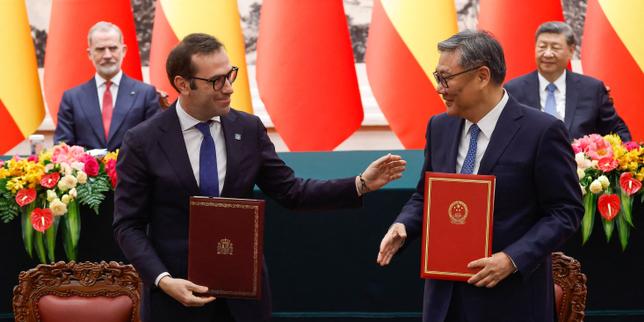
Europe pretends it speaks with one voice on Beijing. It doesn't. Behind closed doors in Brussels, Paris and Madrid are playing an entirely different game when it comes to trade policy, green subsidies, and economic security.
If you look past the standard diplomatic handshakes, you will find a sharp fracture. France wants protectionist shields, hard tariffs, and a defensive fortress. Spain wants open shipping lanes, foreign investment in its renewable sector, and trade without friction.
Understanding this split explains why European Union policy toward the East often feels paralyzed. It is a classic battle of economic survival, and neither side is willing to back down.
The French Playbook for Strategic Autonomy
President Emmanuel Macron has made no secret of his vision. He wants Europe to stand on its own two feet. To Paris, heavy Chinese manufacturing isn't just a competitor; it is an existential threat to European industrial might.
When cheap electric vehicles started flooding European ports, Paris pushed hard for anti-subsidy investigations. They wanted tariffs and they wanted them yesterday. French automakers are terrified of getting squeezed out of their home markets by state-backed Asian manufacturing giants.
France views globalization through a lens of national sovereignty. If you cannot build your own cars, batteries, and tech infrastructure, you are vulnerable. Paris argues that temporary pain from trade defenses is worth the long-term survival of local factories.
They want strict rules on green subsidies, too. If Beijing subsidizes solar panels and wind turbines, Paris believes Europe should match those protections to keep domestic clean-tech companies alive. It is aggressive, loud, and unapologetically protectionist.
Why Madrid Prefers an Open Door
Spain looks at the exact same map and sees a completely different opportunity. Prime Minister Pedro Sánchez has taken a much softer line, welcoming Chinese investment, particularly in the booming renewable energy and electric vehicle supply chains.
Spain needs capital and infrastructure speed. Chinese firms have expressed interest in building battery plants and manufacturing hubs on the Iberian Peninsula. For Madrid, turning away that money means losing jobs to other regions.
While France worries about long-term industrial dependency, Spain focuses on immediate economic growth and employment numbers. Spanish ports like Valencia and Barcelona rely heavily on efficient, high-volume global trade routes. Slamming the door on Asian cargo creates massive local headaches.
Madrid also knows that a full-scale trade war hurts European exporters first. If Beijing decides to retaliate, agricultural products like Spanish pork and wine are usually right in the crosshairs. Spain has too much to lose in an export retaliation cycle.
The Brussels Stalemate
This divergence leaves the European Commission stuck in the middle. Ursula von der Leyen tries to thread the needle by using terms like de-risking instead of decoupling. But the policy translation is messy.
When Brussels proposes new trade defenses, French diplomats cheer. Spanish negotiators quietly water down the thresholds. The result is a patchwork of policies that satisfies neither side completely.
Tariffs get implemented, but they are often lower or slower than Paris demands. Meanwhile, investment flows into Spain continue, frustrating French officials who feel Madrid is undermining the bloc's collective leverage.
What This Means for Global Markets
Multinational corporations operating in Europe cannot afford to ignore this internal rift. If you are planning supply chains, betting on a unified European stance is a rookie mistake.
French pressure means increased regulatory scrutiny, potential tariffs, and compliance hurdles for Asian imports. Spanish openness means there are still welcoming entry points for capital if you set up operations on the Iberian Peninsula.
You have to look at regional politics, not just EU-wide directives. National capitals retain massive sway over how trade rules are enforced on the ground.
Expect this friction to grow as green transition deadlines approach. The pressure to secure cheap battery minerals will clash directly with the political need to protect local manufacturing jobs. Watch what governments actually fund, not just what they tweet about.